(1898-1967)

MAGRITTE René
Le dernier cri, 2004
Lithograph LCD8559
1 490.00€

MAGRITTE René
La Magie noire, 1979
Lithograph LCD8583
1 490.00€

MAGRITTE René
The Masterpiece, or The Mysteries of the Horizon, 2011
Lithograph LCD8024
1 100.00€

René MAGRITTE
L'île au Trésor, 1979
Sold

René MAGRITTE
La Peine Perdue, 2010
Sold

René MAGRITTE
The Sky Bird, 2011
Sold

René MAGRITTE
The Waterfall, 2003
Sold
Looking for a similar artwork?
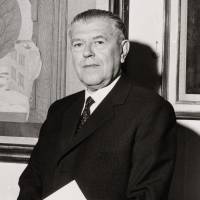
Portrait de René Magritte, photographe anonyme 1961 - Musée Carnavalet, Histoire de Paris PH19994 CC0 Paris Musées / Musée Carnavalet - Histoire de Paris
René Magritte (born in Lessines, Hainaut, on 21 November 1898; died in Schaerbeek, Brussels, on 15 August 1967) was the leading painter of Belgian Surrealism. His bowler-hatted men, his night-time street beneath a daylight sky and his pipe captioned ‘Ceci n’est pas une pipe’ are among the most widely recognised images of twentieth-century art. Yet Magritte was a painter first and foremost, and made very few prints. Most Magritte lithographs on the market today are posthumous editions after his paintings – a category that collectors must learn to tell apart from the handful of lifetime prints and from mere reproductions.
Le Coin des Arts currently offers two such posthumous lithographs after Magritte, and describes them as exactly that: La Peine perdue (2010), after the 1962 canvas of sky-coloured curtains, and Le Chef-d’œuvre ou les mystères de l’horizon (2011), after the 1955 composition of three men in bowler hats. Both were printed in lithography by Philippe Moreno at the Art-Lithographies workshop in Paris on BFK Rives wove paper, numbered from an edition of 275, signed in the plate and blind-stamped in the margin by ADAGP and the Succession Magritte.
The eldest son of Léopold Magritte, a tailor and textile merchant, and Régina Bertinchamps, a former milliner, René grew up in several towns of the Hainaut. On 24 February 1912 his mother drowned herself in the Sambre at Châtelet; her body was recovered sixteen days later. Between 1916 and 1918 he studied, intermittently, at the Académie Royale des Beaux-Arts in Brussels under Constant Montald, and he first exhibited at the Centre d’Art in Brussels in 1920. In June 1922 he married Georgette Berger, whom he had first met in Charleroi in 1913 and who would remain his model. He earned his living designing wallpaper, then posters and advertisements. That same year a reproduction of Giorgio de Chirico’s The Song of Love showed him the path his painting would take. In 1924 he worked with the poet and collagist E. L. T. Mesens on the review Oesophage – a name that would matter greatly to his British reputation.
A contract with the Galerie Le Centaure in Brussels allowed him to paint full time from 1926, the year of The Lost Jockey, generally regarded as his first Surrealist picture. His first solo exhibition, at Le Centaure in 1927, was poorly reviewed, and in September 1927 he moved to Le Perreux-sur-Marne, on the eastern edge of Paris, joining André Breton’s circle. There he painted The Lovers (1928), The False Mirror (1929) and The Treachery of Images (1929). His illustrated essay ‘Les mots et les images’ appeared on 15 December 1929 in the final issue of La Révolution surréaliste. After the Wall Street Crash and the closure of the Galerie Goemans, he returned to Brussels in July 1930.
From 1930 to 1954 the Magrittes rented the ground floor of 135 rue Esseghem in Jette, now the René Magritte Museum. He returned to commercial work with his brother Paul. His Belgian network soon reached Britain: in 1938 the London Gallery, then directed by his compatriot E. L. T. Mesens, gave him his first solo exhibition in England. The English collector Edward James put him up in his London house; James appears in two canvases of 1937, The Pleasure Principle and Not to Be Reproduced. Magritte remained in occupied Brussels during the Second World War, a choice that distanced him from Breton, and in 1943–44 adopted the bright, broken brushwork of his so-called ‘Renoir period’.
The deliberately crude ‘période vache’ of 1948 was short-lived; Magritte soon returned to the lucid manner of The Dominion of Light and Golconda (1953). From 1953 the dealer Alexandre Iolas showed him regularly in New York, Paris and Geneva, and that year he painted the mural The Enchanted Domain for the Knokke casino. A retrospective at the Palais des Beaux-Arts in Brussels followed in 1954, and the Museum of Modern Art in New York honoured him in 1965. He died in Schaerbeek on 15 August 1967, shortly after the opening of a major exhibition at the Museum Boijmans Van Beuningen in Rotterdam. Britain has been central to his posthumous scholarship: the Tate Gallery held a retrospective from 14 February to 2 April 1969; that same year the British critic David Sylvester was entrusted with the catalogue raisonné, completed with Sarah Whitfield in five volumes (1992–97) plus a 2012 addendum. The Hayward Gallery retrospective (21 May – 2 August 1992) then travelled to New York, Houston and Chicago, and Tate Liverpool staged René Magritte: The Pleasure Principle (24 June – 16 October 2011), with more than a hundred paintings, before it went to the Albertina in Vienna. In Brussels, the Magritte Museum on the Place Royale opened in 2009.
The standard reference is The Graphic Work of René Magritte by Gilbert E. Kaplan and Timothy Baum (II Editions, New York, 1982), quoted as ‘Kaplan/Baum’ or ‘K&B’ with a number. It lists only about twenty prints, several of them etched by others after his drawings or printed after his death. The best-known lifetime print is the colour lithograph Les Bijoux indiscrets (1963, K&B 3), printed by Mourlot for San Lazzaro’s review XXe Siècle: around 2,000 unsigned impressions appeared in the magazine, alongside a deluxe issue of 75 signed and numbered proofs. There is also the aquatint Paysage de Baucis (1966, K&B 5), signed and numbered from an edition of 100. In 1966 Le Soleil Noir published Alain Jouffroy’s Aube à l’antipode, whose deluxe copies on Arches contain two signed etchings; ordinary copies carry only line-block reproductions of drawings.
Among illustrated books, the 1948 Brussels edition of Lautréamont’s Les Chants de Maldoror (La Boétie) is illustrated with photomechanical reproductions of Magritte’s drawings; loose plates from it are not original prints. Since 1967 the estate has authorised many editions: etchings from sketches, prints with printed or stamped signatures, and interpretative lithographs such as the 2010–11 series printed by Philippe Moreno in editions of 275.
Lifetime or posthumous? Ask this first. A pencil-signed impression of 1963 or 1966 recorded by Kaplan/Baum belongs to a different market from a 2010 lithograph after a painting. Both are legitimate if they are described accurately.
Signature. Magritte signed his few prints in pencil. A signature ‘in the plate’ is printed with the image and is not autograph. See the signature.
Blind stamps and numbering. Authorised posthumous editions usually carry the ADAGP and Succession Magritte blind stamps, with an edition number such as 275 plus HC proofs. See the printing.
Catalogue references. Any print sold as a lifetime work should carry a Kaplan/Baum number. The Sylvester catalogue covers the paintings and helps identify the source picture of a later edition.
Condition. Check for foxing, light-staining and old hinges, and choose conservation framing with UV-filtering glazing.
Pitfalls. Exhibition posters, offset or digital reproductions and plates cut from books are often sold as ‘lithographs’. Ask for the technique, printer, publisher and edition size. Our guarantees are set out on the authenticity page.
The gallery selects editions after Magritte for print quality and condition, alongside prints by fellow Surrealists Max Ernst, Man Ray, Roberto Matta, Dorothea Tanning and Hans Bellmer. Explore Surrealism and our engravings and lithographs.
Gilbert E. Kaplan and Timothy Baum, The Graphic Work of René Magritte, II Editions, New York, 1982 · David Sylvester (ed.), with Sarah Whitfield and Michael Raeburn, René Magritte: Catalogue Raisonné, 5 vols, 1992–97, addendum 2012 · Sarah Whitfield, Magritte, South Bank Centre, London, 1992 · Magritte, exhibition catalogue, Tate Gallery, London, 1969 · Tate – René Magritte: The Pleasure Principle · Menil Collection – Catalogues raisonnés · Peggy Guggenheim Collection – René Magritte · René Magritte Museum, Jette

Secure payment
3DSecure 2.2

Free DHL Express delivery from €1,200
Carefully prepared parcel
Parcel tracking

Shipment insured
for the value of the artwork, covering theft and damages

Fairest prices
Certificate of authenticity
Two galleries in Paris
Receive an email as soon as a new artwork is added for this artist
Your message has been sent ! We will get back to you as soon as possible.
Please fill in the form if you need further information such
Please fill in your email address, an email will be sent with a link to update your password.
You can now place orders and track your orders.
To save your wishlist, you can log in or create an account :
This is a 100% custom-made frame, carefully crafted by a professional framer. Finishes are available in light oak, white wood or black wood, with or without mat board and plexiglass. Delivery times may vary depending on the order, with an average lead time of 10 days.
This option will be offered during the cart step.