
(1891-1976)
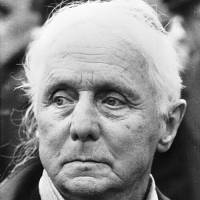
Max Ernst, 1968 — Anefo / Nationaal Archief — CC0
Few artists did as much to shape the imagery of the twentieth century as Max Ernst (1891-1976). Born in the Rhineland and later a French citizen, he was a painter, sculptor, printmaker and poet, a leading spirit of Cologne Dada and one of the founding figures of Surrealism. He invented frottage, reinvented collage and created the collage novel, using technique itself as a way of letting chance, dreams and the unconscious into the picture. His forests, birds, his alter ego Loplop and his cosmic visions remain instantly recognisable. Printmaking and the illustrated book run through his entire career, from the collotypes of Histoire naturelle (1926) to the etchings of Maximiliana (1964).
In Paris, Galerie Le Coin des Arts offers original prints by Max Ernst – pencil-signed etchings and lithographs and signed illustrated books – together with exhibition posters printed by the Mourlot workshop, each chosen for the quality of the impression, its provenance and its condition.
Maximilian Maria Ernst was born on 2 April 1891 in Brühl, a small town between Cologne and Bonn, the third of nine children in a Catholic household. His father Philipp taught deaf children and painted as an amateur. After leaving school, Max read philology, philosophy, psychology and art history at the University of Bonn, where he became fascinated by the drawings of psychiatric patients. Largely self-taught as a painter, he joined August Macke’s circle of Rhenish Expressionists, saw the landmark Sonderbund exhibition in Cologne in 1912 and showed two works at Herwarth Walden’s gallery Der Sturm in Berlin in 1913. In 1914 he met Hans Arp, beginning a friendship that lasted some fifty years.
Called up in 1914, he spent four years in the German army on the Western and Eastern Fronts – an experience he later summed up by writing that Max Ernst “died” on 1 August 1914 and came back to life on 11 November 1918. That year he married the art historian Luise Straus; their son Ulrich, later the painter Jimmy Ernst, was born in 1920.
In 1919 Ernst, Johannes Theodor Baargeld and Arp formed the Cologne Dada group, and Ernst and Baargeld issued the short-lived magazines Der Strom and die Schammade. Cutting up mail-order catalogues, scientific plates and teaching manuals, Ernst devised a disquieting new form of collage; with Arp he produced the collaborative “Fatagaga” pictures. The 1920 exhibition Dada-Vorfrühling, staged behind a Cologne brasserie, was closed by the police.
His first Paris exhibition opened at the bookshop-gallery Au Sans Pareil in May 1921 and delighted André Breton and his friends. The same year Ernst met the poet Paul Éluard, who bought Celebes and asked him to illustrate Répétitions and Les Malheurs des immortels (1922).
Unable to obtain papers, Ernst entered France illegally in 1922 and lived with Paul and Gala Éluard, first at Saint-Brice and then at Eaubonne, where he painted murals throughout the house. He painted the group portrait Au rendez-vous des amis (1922) and took part in Surrealism from its very beginnings in 1924.
In his studio in the rue Tourlaque in 1925, he discovered frottage: by rubbing pencil over paper laid on floorboards, leaves or fabric, he let unexpected forms emerge. He carried the idea into oil painting with grattage, scraping paint over textured surfaces, and later explored decalcomania. In 1926 he and Joan Miró designed Romeo and Juliet for Diaghilev’s Ballets Russes.
His collage novels – La Femme 100 têtes (1929, with a preface by Breton), Rêve d’une petite fille qui voulut entrer au Carmel (1930) and Une semaine de bonté (1934, published by Jeanne Bucher) – were built from nineteenth-century wood-engraved illustrations. He appeared in Luis Buñuel’s film L’Âge d’or (1930) and from 1934 took up sculpture alongside Alberto Giacometti.
Britain discovered Ernst in the 1930s. He was among the exhibitors at the International Surrealist Exhibition held at the New Burlington Galleries in London in 1936, and in 1938 Peggy Guggenheim acquired several of his works, which she showed at her London gallery, Guggenheim Jeune. From 1937 he lived with the painter Leonora Carrington at Saint-Martin-d’Ardèche, in the south of France.
Treated as an enemy alien, he was interned in September 1939 at the Camp des Milles near Aix-en-Provence, alongside Hans Bellmer, and was detained again in 1940. With the help of Varian Fry and Peggy Guggenheim, he escaped through Madrid and Lisbon and reached New York in 1941. He married Guggenheim, but the marriage was short-lived. In 1946 he married the American painter Dorothea Tanning in Beverly Hills, in a double ceremony with Man Ray and Juliet Browner; the couple settled in Sedona, Arizona, where he built their house and the large sculpture Capricorn (1948).
Back in Paris in 1953, Ernst won the Grand Prize for painting at the 1954 Venice Biennale (Arp took the sculpture prize and Miró the printmaking prize that year) – an official honour for which Breton expelled him from the Surrealist group. He moved with Tanning to Huismes in the Touraine in 1955, became a French citizen in 1958 and received the Grand Prix national des arts in 1959.
Major retrospectives followed in Paris (1959), at the Museum of Modern Art in New York (1961), at the Tate Gallery in London, in Cologne (1962), Stockholm (1969) and, in 1975, at the Guggenheim Museum in New York and the Grand Palais in Paris. The Tate holds key paintings such as Celebes and Pietà or Revolution by Night. From 1964 the couple lived at Seillans in the Var. Max Ernst died in Paris on 1 April 1976, on the eve of his 85th birthday, and is buried at Père-Lachaise. A museum devoted to him opened in his home town of Brühl in 2005.
For Ernst, the print was a laboratory rather than a means of reproduction. Histoire naturelle, published by Jeanne Bucher in 1926, gathers 34 collotypes after his frottages, introduced by Hans Arp. In the 1930s he was among the first artists to work at Atelier 17, the Paris studio of the English printmaker Stanley William Hayter.
After the war, and above all from the 1950s, printmaking became a central part of his output. He worked in etching and aquatint with the Paris printer Georges Visat, who printed and often published his plates, and in colour lithography; the Mourlot workshop also printed several of his exhibition posters. Strips of ornamental pattern, suns and discs, birds, constellations and invented scripts make up the vocabulary of these sheets.
His finest book is 65 Maximiliana ou l’exercice illégal de l’astronomie (1964), designed and published by Iliazd as a tribute to the nineteenth-century astronomer Wilhelm Tempel: 34 etchings and aquatints printed by Georges Visat and Louis Lemoine, with Ernst’s own secret “hieroglyphs”, in an edition of 65. Other books include Das Schnabelpaar (1953, Ernst Beyeler, Basel) and Lewis Carrolls Wunderhorn (1970, with 36 lithographs).
German and Swiss publishers played a large part in his late work: the Manus Presse in Stuttgart issued Jean Giraudoux’s Judith in 1972 with six lithographs by Ernst and six by Dorothea Tanning, and the Erker-Presse in St Gallen published lithographs linked to the poetry of Jean Cassou. The standard catalogue of the prints is Max Ernst. Œuvre-Katalog. Das graphische Werk, edited by Werner Spies and compiled by Helmut R. Leppien (Menil Foundation and DuMont Schauberg, 1975), cited as “Spies/Leppien no.” or simply “Leppien”.
When considering an etching or lithograph by Max Ernst, check the medium (etching, aquatint, lithograph, collotype), the print run and its numbering – artist’s proofs, hors commerce or trial proofs marked “essai” –, the pencil signature, the Spies/Leppien catalogue number, the publisher and printer (Visat, Iliazd, Manus Presse, Erker-Presse), the paper (Rives, Arches, Japan), the provenance and the condition: light-staining, foxing and trimmed margins all matter. Illustrated books should be complete, with the signature usually found on the justification or colophon page.
Original print or reproduction? Ernst is among the most reproduced of all Surrealists. Exhibition posters, even when lithographed by Mourlot, are unsigned and unnumbered and are collected as posters, not as original prints. Photomechanical reproductions of his paintings, sometimes sold as “lithographs”, and plates with a signature printed in the stone should not be confused with pencil-signed impressions recorded in the catalogue raisonné. See also what is an original print.
Galerie Le Coin des Arts selects Max Ernst’s original prints and illustrated books with close attention to authenticity, provenance and condition, and can advise on conservation framing and mounting. You may also enjoy the prints of Dorothea Tanning, Hans Arp, Joan Miró, André Masson and René Magritte.
Max Ernst, Wikipedia · Moderna Museet, Max Ernst in Europe 1953-1976 · Stanley William Hayter and the Surrealists · MoMA, 65 Maximiliana (1964) · LeMO, Deutsches Historisches Museum · Werner Spies, Helmut R. Leppien, Max Ernst. Œuvre-Katalog. Das graphische Werk, Houston / Cologne, 1975

Secure payment
3DSecure 2.2

Free DHL Express delivery from €1,200
Carefully prepared parcel
Parcel tracking

Shipment insured
for the value of the artwork, covering theft and damages

Fairest prices
Certificate of authenticity
Two galleries in Paris
Receive an email as soon as a new artwork is added for this artist
Your message has been sent ! We will get back to you as soon as possible.
Please fill in the form if you need further information such
Please fill in your email address, an email will be sent with a link to update your password.
You can now place orders and track your orders.
To save your wishlist, you can log in or create an account :
This is a 100% custom-made frame, carefully crafted by a professional framer. Finishes are available in light oak, white wood or black wood, with or without mat board and plexiglass. Delivery times may vary depending on the order, with an average lead time of 10 days.
This option will be offered during the cart step.


