
(1919-2022)

SOULAGES Pierre
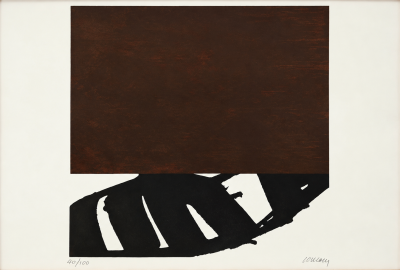
Lithograph No. 40, 1978
Lithograph LCD8534
10 000.00€


SOULAGES Pierre
Lithograph No. 27, 1969
Lithograph LCD8252




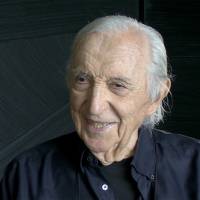
NVP3D, CC BY-SA 3.0, via Wikimedia Commons
Pierre Soulages (1919–2022) was one of the leading figures of French abstraction and of 20th-century art. A painter of black and light and the creator of Outrenoir, he developed an instantly recognisable body of work over more than seventy years. While his monumental paintings hold an essential place in the history of contemporary art, his work as a printmaker and lithographer is also a fundamental part of his output.
Le Coin des Arts gallery in Paris regularly presents original works by Pierre Soulages, including lithographs, etchings and screenprints, which offer another way into his explorations of black, matter, paper and light.
Pierre Soulages was born on 24 December 1919 in Rodez, in the Aveyron region of southern France. From an early age he was drawn to the austere landscapes of his native region, to the prehistoric statue-menhirs held at the Musée Fenaille and to the Romanesque architecture of the abbey church of Sainte-Foy in Conques.
In the late 1930s, a stay in Paris introduced him to the work of Cézanne and Picasso. After a brief spell at the École des Beaux-Arts in Paris, followed by studies in Montpellier, he devoted himself fully to painting in the immediate post-war years.
From 1946 onwards, Soulages developed an abstract painting defined by powerful dark forms. His celebrated walnut stain works on paper (brous de noix), made with a material traditionally used by cabinetmakers, already reveal his interest in deep browns, in black and in the contrast created by the light of the paper.
By the late 1940s his work was being exhibited in France and then abroad. He quickly became one of the major figures of post-war European abstract painting.
Black holds an essential place in Pierre Soulages’s work, yet for him it is never a uniform surface or a mere absence of colour.
The artist worked the paint so that light would react differently according to texture, relief, the direction of the grooves and the position of the viewer. The same work can therefore change profoundly in appearance depending on the lighting and the movement of the eye.
In 1979, this research took a decisive turn. Soulages produced paintings entirely covered in black and realised that their true subject was no longer simply the pigment, but the light that the black surface absorbs, reflects or diffuses.
He gave this approach the name Outrenoir – literally a black that leads ‘beyond black’. The surfaces become in turn matt, glossy, smooth or ridged, making light an active element of the work.
Pierre Soulages’s printed work forms a particularly important chapter of his artistic career. From the early 1950s he experimented with intaglio printmaking, before going on to create a major body of lithographs and screenprints.
Soulages never regarded the print as a mere reproduction of his painting. In his view, each technique has its own constraints, accidents and possibilities, which must lead to the creation of an autonomous work.
This approach is key to understanding a Pierre Soulages lithograph or etching. The aim is not to reproduce an existing painting on paper, but to explore what the lithographic stone, copper, acid, ink, press and paper can produce.
His printed work thus comprises more than a hundred original prints, made in etching, lithography and screenprinting. Today this body of work forms a field of its own within his oeuvre and is documented in a catalogue raisonné: Soulages, l’œuvre imprimé, edited by Pierre Encrevé and Marie-Cécile Miessner (Bibliothèque nationale de France, 2003; new edition, BnF / Musée Soulages, 2011).
For Soulages, etching became a true field of experimentation.
The technique relies on the action of acid on a metal plate, usually copper. Yet Soulages did not seek to control the process entirely. On the contrary, he allowed the bite of the acid to transform the plate profoundly and made use of the sometimes unexpected effects produced by the metal.
In some works, the acid goes so far as to perforate the copper plate. What might be considered a technical accident then becomes part of the composition: the paper appears directly in the image and interacts with the printed areas.
Pierre Soulages’s etchings are therefore distinguished by their strong physical presence. The ink, the plate mark left by the pressure of the plate, the whiteness of the paper, its thickness and its grain all play a part in how the work is perceived.
In his lithographs, Pierre Soulages recaptures the power of the large forms that characterise his painting, while developing a language specific to the lithographic process.
Black remains central, but many compositions also combine reds, blues, yellows, browns or ochres. These colours create tensions and balances that give some sheets a character very different from the Outrenoir paintings with which the artist is most often associated today.
His lithographs are generally more intimate in size than his large canvases, yet their compositions often retain a sense of monumentality.
Since the paper, its grain and its margins play a full part in the work, the condition of an original Pierre Soulages lithograph should be assessed carefully: quality of the paper, freshness of the colours, framing and storage conditions.
Between 1986 and 1994, Pierre Soulages carried out one of the most important projects of his career: the 104 stained-glass windows of the abbey church of Sainte-Foy in Conques.
For this monumental ensemble, he designed a translucent glass intended to diffuse natural light without resorting to traditional coloured stained glass. The project is a direct extension of his research into the relationship between matter and light.
In 2009–2010, the Centre Pompidou devoted a major retrospective to him, bringing together more than a hundred works.
In 2014 the Musée Soulages opened in Rodez, built around the substantial donations made by Pierre and Colette Soulages.
To mark his hundredth birthday, the Musée du Louvre held an exceptional exhibition of his work in the Salon Carré in 2019–2020.
Pierre Soulages continued working until the final years of his life. He died on 25 October 2022, at the age of 102.
Original prints by Pierre Soulages offer an approach to his work through a relatively limited, coherent and clearly identifiable body of work within his career.
When examining a Soulages lithograph, etching or screenprint, several elements matter: the technique used, the edition, the signature, the reference in the catalogue raisonné of the printed work, the provenance and the condition of the paper and colours.
Each original Soulages print is listed there under a number, often cited as ‘BnF no.’. This reference is the first thing to check before any purchase.
Original lithograph or poster? Many Pierre Soulages exhibition posters circulate on the market, and some are wrongly presented as original lithographs. An original print is normally signed in pencil and numbered, or annotated ‘artist’s proof’, printed on fine art paper with margins, and listed in the catalogue raisonné. A poster usually carries text (the name of the museum or gallery, exhibition dates) and is not numbered. A poster signed by the artist is still a poster.
Le Coin des Arts selects and presents original prints by Pierre Soulages in Paris, paying particular attention to their authenticity, provenance and condition.
The gallery also advises collectors on choosing a work, as well as on its framing, display and conservation.
Musée Soulages, Rodez · Pierre Encrevé and Marie-Cécile Miessner (eds.), Soulages, l’œuvre imprimé, Bibliothèque nationale de France, 2003; new edition, BnF / Musée Soulages, 2011 · Centre Pompidou, Paris · Musée du Louvre, Paris.

Secure payment
3DSecure 2.2

Free DHL Express delivery from €1,200
Carefully prepared parcel
Parcel tracking

Shipment insured
for the value of the artwork, covering theft and damages

Fairest prices
Certificate of authenticity
Two galleries in Paris
Receive an email as soon as a new artwork is added for this artist
Your message has been sent ! We will get back to you as soon as possible.
Please fill in the form if you need further information such
Please fill in your email address, an email will be sent with a link to update your password.
You can now place orders and track your orders.
To save your wishlist, you can log in or create an account :
This is a 100% custom-made frame, carefully crafted by a professional framer. Finishes are available in light oak, white wood or black wood, with or without mat board and plexiglass. Delivery times may vary depending on the order, with an average lead time of 10 days.
This option will be offered during the cart step.

