(1906-1997)

VASARELY Victor
The Fifties, 1989
Silkscreen LCD8540
1 300.00€

VASARELY Victor
Lava, 1986
Silkscreen LCD8429
1 400.00€

VASARELY Victor
Turkiz positif, 1967
Sculpture LCD8123
4 800.00€

VASARELY Victor
The Fifties 5, 1989
Silkscreen LCD7835
1 300.00€

VASARELY Victor
The Fifties, 1989
Silkscreen LCD7934
1 300.00€

VASARELY Victor
Gordes Nives, 1948
Lithograph LCD6869
600.00€

VASARELY Victor
Ezust, 1966
Silkscreen LCD6474
1 500.00€

VASARELY Victor
Topaze, 1966
Silkscreen LCD7165
1 500.00€

VASARELY Victor
Gordes Gestalt, 1948
Engraving LCD6868
600.00€

VASARELY Victor
Gordes Synthèse, 1948
Engraving LCD6867
600.00€

VASARELY Victor
Bellatrix - Pyr, 1989
Silkscreen LCD6295
1 300.00€

VASARELY Victor
Beryl négatif, 1967
Sculpture LCD5736
6 500.00€

VASARELY Victor
Zebra 3, 1984
Lithograph LCD5719
1 500.00€

VASARELY Victor
Jenge
Silkscreen LCD5044
1 400.00€

VASARELY Victor
Clown, 1987
Silkscreen LCD3379
1 400.00€

VASARELY Victor
Heisenberg, 1983
Silkscreen LCD1781
950.00€

Victor VASARELY
Tsiga, 1973
Sold

Victor VASARELY
Mar-Kab, 1973
Sold

Victor VASARELY
Oslop, 1989
Sold
Looking for a similar artwork?
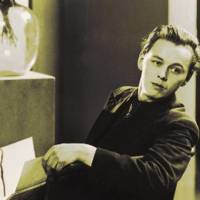
Portrait de Victor Vasarely par un photographe inconnu vers 1930 - Domaine public
Few twentieth-century artists changed the way we look as radically as Victor Vasarely (1906-1997). Hungarian by birth and Parisian by choice, he is widely regarded as the founding figure of Op Art and kinetic art: his chequerboards swell, his grids seem to recede and his colours appear to vibrate on the surface of the sheet. Trained as a graphic designer in the spirit of the Bauhaus, he believed that art should be shared rather than hoarded, and he made original prints – above all screenprints – and multiples a central part of his practice.
At its Paris galleries, Le Coin des Arts offers original screenprints, lithographs and multiples by Victor Vasarely, pencil-signed and numbered, dating from the 1960s to the late 1980s, each chosen for the quality of its printing, its provenance and its condition.
He was born Győző Vásárhelyi in Pécs, Hungary, on 9 April 1906, and spent his childhood in Pöstyén (now Piešťany, Slovakia) and Budapest. In 1925 he enrolled to read medicine, but within two years he had left for painting at the private Podolini-Volkmann Academy. The decisive step came in 1928-1929, when he joined the Műhely (“workshop”) run by Sándor Bortnyik, a school of applied graphics and typography that carried the ideas of the Bauhaus and Constructivism to Budapest. Grids, systems and the economy of the printed image would remain at the heart of his work.
Vasarely moved to Paris in 1930 with Claire Spinner, a fellow Műhely student whom he married; their son Jean-Pierre later worked as the artist Yvaral. Throughout the 1930s he earned his living as a commercial artist for the agencies Havas, Draeger and Devambez, while pursuing private “graphic studies” of line, texture and contrast. His Zebras of 1937 – animals drawn entirely from undulating black and white stripes – are now seen as one of the very first works of Op Art.
In 1944 Denise René opened her gallery on the rue La Boétie with a show of Vasarely’s graphic work, beginning a partnership that would last for decades. After a period of trying out other idioms, he arrived at his own abstract vocabulary between 1947 and the early 1950s, drawing on pebbles and shells from Belle-Île, the white-tiled walls of the Denfert-Rochereau Métro station and the light and stone of Gordes in Provence, where he spent his summers from 1948. The landmark exhibition “Le Mouvement” at Denise René in 1955 brought him together with Agam, Bury, Calder, Duchamp, Jacobsen, Soto and Tinguely; his accompanying notes, known as the Yellow Manifesto, became a founding text of kinetic art.
By the late 1950s Vasarely had devised his “plastic units”: a square paired with a contrasting geometric form, which could be recombined almost endlessly. He registered the system on 2 March 1959 and presented it in 1963 as “Folklore planétaire”, an alphabet designed for serial production. Recognition followed swiftly: the Guggenheim Prize in 1964, a place in MoMA’s defining Op Art exhibition “The Responsive Eye” in New York in 1965, and a first prize at the São Paulo Biennial the same year. The swelling Vega grids and the Hommage à l’hexagone series belong to this period, as does his 1972 redesign, with Yvaral, of the Renault lozenge.
Op Art found a ready audience in 1960s Britain, and Vasarely’s work is well represented in public collections here. Tate holds paintings including Nives II (1949-58) and Supernovae (1959-61). The Victoria and Albert Museum owns his poster for the Munich Olympic Games, part of the “Edition Olympia 1972” series, given by the organising committee in 1971. His influence reached popular culture too: the original 1969 British release of David Bowie’s second album – the record now known as Space Oddity – shows the singer’s face over an optical spotted design by Vasarely, a sleeve also in the V&A’s collection.
Vasarely planned his own museums. The didactic museum at the Château de Gordes opened in 1970 (it closed in 1996); the Fondation Vasarely in Aix-en-Provence, recognised as a public-interest foundation in 1971, opened its architectonic centre – sixteen hexagonal modules housing forty-four monumental works – in 1976. That same year a museum dedicated to him opened in his native Pécs, followed in 1987 by the Vasarely Museum in Budapest. He died in Paris on 15 March 1997. In 2018-2019 the Städel Museum in Frankfurt and the Centre Pompidou in Paris staged a major reassessment of his work.
Vasarely thought of a composition as a prototype that could be multiplied without any loss of quality. Screenprinting, with its flat, saturated areas of colour, suited his programmes perfectly. Many of his screenprints of the 1960s and 1970s were pulled in Paris by the studio of Wifredo Arcay, a Cuban-born printer who worked for Galerie Denise René; later editions were often printed by Silium. Publishers range from Denise René to Swiss, German, Austrian, Scandinavian and Hungarian houses. He also worked in lithography, notably with the Mourlot studio.
Highlights currently or recently offered by the gallery include Ezust and Topaze (1966), published by Denise René and printed by Arcay; Mar-Kab (1973), published by Pierre Belfond; Tsiga (1973); Heisenberg (1983) and the lithograph Zebra 3 (1984), a late return to the zebra motif, both published by Graphos Verlag and printed by Silium; Clown (1987), published by Galerie Börjesson in Malmö; Bellatrix-Pyr (1989), published by AZG Austria Zeichen; and the Les années Cinquante suite (1989), published by Pesti Műhely in Budapest. The gallery also offers Denise René multiples such as Turkiz positif and Beryl négatif (1967), each in an edition of 50, which you will find among our ceramics and sculptures.
Because Vasarely is one of the most widely reproduced artists of the twentieth century, his market rewards a careful eye. When considering a Vasarely screenprint or lithograph, check the medium, the print run and its annotation (a number, or E.A. or hors commerce), the pencil signature, the publisher and printer (Denise René, Arcay, Silium, Mourlot…), the reference in the Pedro Benavides catalogue commonly cited in the trade (“Benavides no.”), the provenance and, above all, the condition. Large flat areas of colour show every scratch, and some inks are light-sensitive: UV-filtering glazing and an acid-free mount are strongly recommended.
Original print or reproduction? Vasarely’s name appears on countless posters, offset prints, unsigned or posthumous screenprints and outright fakes bearing an imitated signature. A signature printed in the image, an implausible numbering or the absence of any publisher information should all prompt caution. An original print is hand-signed in pencil, numbered or annotated, and documented. Unique works – paintings, gouaches, collages – are authenticated by Pierre Vasarely, president of the Fondation Vasarely, universal legatee and holder of the artist’s moral rights; a catalogue raisonné of the paintings is being prepared by the Foundation. Every work sold by the gallery comes with a certificate of authenticity.
Le Coin des Arts selects Victor Vasarely’s original prints and multiples with close attention to authenticity, provenance and condition, and is happy to advise on framing and conservation. You may also enjoy the work of other kinetic and geometric artists in our collection: Jesús Rafael Soto, Yaacov Agam, Pol Bury and Josef Albers.
Tate, Victor Vasarely · Victoria and Albert Museum, “Olympische Spiele München 1972” poster · V&A, David Bowie’s artistic collaborations · Fondation Vasarely, Aix-en-Provence · Victor Vasarely, Wikipedia · Städel Museum, “Victor Vasarely. In the Labyrinth of Modernism”, 2018-2019 · MoMA, “The Responsive Eye” press release, 1965

Secure payment
3DSecure 2.2

Free DHL Express delivery from €1,200
Carefully prepared parcel
Parcel tracking

Shipment insured
for the value of the artwork, covering theft and damages

Fairest prices
Certificate of authenticity
Two galleries in Paris
Receive an email as soon as a new artwork is added for this artist
Your message has been sent ! We will get back to you as soon as possible.
Please fill in the form if you need further information such
Please fill in your email address, an email will be sent with a link to update your password.
You can now place orders and track your orders.
To save your wishlist, you can log in or create an account :
This is a 100% custom-made frame, carefully crafted by a professional framer. Finishes are available in light oak, white wood or black wood, with or without mat board and plexiglass. Delivery times may vary depending on the order, with an average lead time of 10 days.
This option will be offered during the cart step.