
(1915-1995)
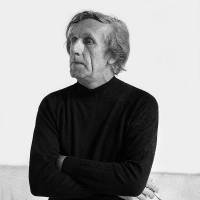
Dietmar Bührer, 1974 — CC BY-SA 4.0
Bernhard Heiliger (born in Stettin, now Szczecin, on 11 November 1915; died in Berlin on 25 October 1995) is often described as West Germany’s foremost post-war sculptor. Based in the Berlin suburb of Dahlem from 1949 and a professor at the Berlin Hochschule für bildende Künste for almost four decades, he moved from organic heads and figures to soaring abstract forms in bronze and steel. In Britain his name is bound up with the 1953 competition for a Monument to the Unknown Political Prisoner, run by the Institute of Contemporary Arts in London; his maquette is now in the Tate collection. Alongside the sculpture he drew constantly and made a small, carefully edited body of original lithographs, most of them published in St Gallen, Switzerland.
Le Coin des Arts currently offers three of these lithographs, each signed in pencil: Erker-Treffen 1 (1972) and Erker-Treffen 3 (1979), two 38 × 28 cm sheets from editions of 200 published by Erker in St Gallen, and a small 1966 composition from the portfolio Hommage à Hans Arp. They were chosen for the quality of the printing, their fresh condition and their place in the artist’s graphic work.
Heiliger trained as a stone carver in Stettin from 1930 and studied from 1933 to 1936 at the city’s Werkschule für Gestaltende Arbeiten under Kurt Schwerdtfeger, a former Bauhaus student. In 1938 he joined Arno Breker’s class at the Berlin Hochschule, although he later named Richard Scheibe as the more important teacher. In April 1939 he spent about two weeks in Paris, visiting Charles Despiau and Aristide Maillol; the Bernhard Heiliger Foundation notes that he later presented the trip as a much longer stay, and that Brancusi and Hans Arp became his lasting points of reference. Called up in 1941, he served for two years on the Eastern Front, worked in Breker’s studios in 1943 and, re-drafted in 1944, made his way back to Berlin before the war ended. Recent research has also pointed out how far he played down Breker’s influence on his work of 1939-41.
Back in Berlin, Heiliger exhibited from 1946, taught at the art school in Weißensee from 1947 to 1949 and held his first solo exhibition in 1948. In 1949 he moved into the studio on Käuzchensteig in Dahlem and was appointed to the Hochschule in Charlottenburg, where he taught until 1986. His simplified, archaic heads and figures were soon compared with those of Henry Moore, a parallel the critic Will Grohmann explored and Heiliger himself regarded with some scepticism. The British connection became concrete in 1953: the ICA’s international competition for the Unknown Political Prisoner drew some 3,500 entries from 57 countries, and a selection of 140 works was shown at the Tate Gallery from 14 March 1953. Reg Butler took the Grand Prize; Heiliger received one of the ICA’s recognition prizes, as well as a prize from the West German government. His maquette, in bronze and iron on a steel plate, is now in the Tate (T03897). In 2014 a Heiliger model from the competition was shown again, beside Butler’s winning model lent by Tate, in Those Early Years: British and German Art after 1945 at the Sprengel Museum in Hanover.
The same decade brought the Berlin (1950) and Cologne (1952) art prizes, the São Paulo Biennial (1953), documenta I in Kassel (1955), a solo presentation at the Venice Biennale and election to the Berlin Academy of Arts (1956), and the Figurenbaum for the German pavilion at the Brussels World’s Fair (1958). In 1959, the year of documenta II and his first retrospectives, including the Kunsthalle Mannheim and the Kunstmuseum Luzern, Henry Moore visited him in Dahlem.
A first trip to the United States accompanied his exhibition at the Staempfli gallery in New York in 1961. In 1963 Die Flamme was unveiled on Ernst-Reuter-Platz in Berlin and he made the relief Pantha Rhei for the West German embassy in Paris. The year 1964 brought documenta III and, from 3 October to 7 November, his first solo exhibition at the Galerie im Erker in St Gallen; a photograph in the Foundation’s archive shows him at the opening with Max Bill, Martin Heidegger and the gallerist Franz Larese. Then came the Burda Prize for sculpture (1965), stage designs for Faust II (1966), Expo 67 in Montreal and Vertikale Motive I-III at the Neue Nationalgalerie (1968). Kosmos 70 stood in the west foyer of the Reichstag from 1970 to 1994; around 1969 Heiliger turned to aluminium, steel and other new materials.
In 1973 he and the Berlin Senate gave the bronze Vertikales Motiv II to the Israel Museum; the Federal Cross of Merit followed in 1974 and the Lovis Corinth Prize in 1975, the year of retrospectives at the Akademie der Künste in Berlin and the Saarland Museum. A. M. Hammacher published a monograph in 1978. His late “iron age” produced Auge der Nemesis (1989) outside the Schaubühne on the Kurfürstendamm and Echo I and II by the Philharmonie’s chamber music hall. He became an honorary member of the Deutscher Künstlerbund in 1984 and was shown at the Wilhelm Lehmbruck Museum in Duisburg (1985) and at the Bundeskunsthalle in Bonn in 1995, the year he died. The Bernhard Heiliger Foundation, set up in his Dahlem studio in 1996, looks after the studio, the sculpture garden and the archive, whose drawings and lithographs it is now digitising.
Drawing was the engine of Heiliger’s practice, and lithography was its natural extension: black or coloured arcs, blades and splinters that echo the line of his metal sculpture. Most of his prints came through the Erker in St Gallen, the gallery, publishing house and lithographic workshop (the Erker-Presse) run by Franz Larese and Jürg Janett, which also printed for Robert Motherwell and published Eduardo Chillida’s book with Heidegger, Die Kunst und der Raum (1969). The Erker-Treffen sheets are small lithographs in editions of 200, numbered and signed in pencil; one impression of Erker-Treffen 1 sold at Drouot was catalogued as printed by the Erker-Presse on BFK Rives wove paper.
The portfolio Hommage à Hans Arp brought together small lithographs (about 22 × 17 cm) by artists including Hans Hartung, Ossip Zadkine, Antoni Tàpies, Giuseppe Santomaso, Fritz Wotruba, Asger Jorn and Robert Motherwell. Heiliger’s sheet is initialled and dated “BH / 66” and numbered out of 100. There is, as far as we know, no published catalogue raisonné of his prints. The standard reference for the sculpture is Marc Wellmann’s Bernhard Heiliger 1915-1995. Monographie und Werkverzeichnis (Wienand, Cologne, 2005), cited as “WV” plus a number (Die Flamme is WV 263). A lithograph is therefore identified by title, date, publisher, edition size and numbering.
Publisher. Look for an Erker imprint (Galerie im Erker, Erker-Verlag or Erker-Presse, St Gallen) and a clear statement of the publication the sheet comes from.
Edition and numbering. Erker-Treffen sheets are numbered out of 200; the Hommage à Hans Arp out of 100, with a small run in Roman numerals. See the printing.
Signature. Edition impressions are signed in pencil, sometimes only with the initials “BH” and the year. More on the signature.
Single sheets. Most impressions on the market have been separated from their portfolio. That is perfectly normal, but the description should say so.
Margins and condition. On sheets this small, trimmed margins matter. Dense black areas show rubbing, creases and old hinges; light causes the paper to yellow. Conservation framing with UV-filtering glazing is advisable.
What is not an original print. Exhibition posters, catalogue reproductions and photographs of sculptures are not original lithographs. Our guarantees are set out on the authenticity page.
We show Heiliger’s lithographs alongside those of other sculptors and fellow Erker artists: Henry Moore, Hans Arp, Fritz Wotruba, Eduardo Chillida and Piero Dorazio. Explore modern art and our engravings and lithographs.
Marc Wellmann, Bernhard Heiliger 1915-1995. Monographie und Werkverzeichnis, Wienand, Cologne, 2005 · A. M. Hammacher, Bernhard Heiliger, 1978 · Tate – Maquette for Monument for the Unknown Political Prisoner · Tate – The Unknown Political Prisoner, 1953 · Bernhard Heiliger Foundation – Chronology · Bernhard Heiliger Foundation – Panta Rhei · Bernhard Heiliger Foundation – Erker opening photograph · Museum of Fine Arts, Houston – Hommage à Hans Arp

Secure payment
3DSecure 2.2

Free DHL Express delivery from €1,200
Carefully prepared parcel
Parcel tracking

Shipment insured
for the value of the artwork, covering theft and damages

Fairest prices
Certificate of authenticity
Two galleries in Paris
Receive an email as soon as a new artwork is added for this artist
Your message has been sent ! We will get back to you as soon as possible.
Please fill in the form if you need further information such
Please fill in your email address, an email will be sent with a link to update your password.
You can now place orders and track your orders.
To save your wishlist, you can log in or create an account :
This is a 100% custom-made frame, carefully crafted by a professional framer. Finishes are available in light oak, white wood or black wood, with or without mat board and plexiglass. Delivery times may vary depending on the order, with an average lead time of 10 days.
This option will be offered during the cart step.


