
(1911-1994)

PAPART Max
Summer, 1991
Mixed media (modern) LCD8291
750.00€

PAPART Max
Don Giovanni, 1978
Mixed media (modern) LCD7998
550.00€
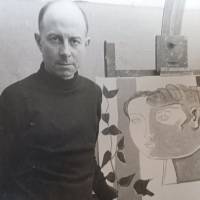
Portrait de Max Papart par Jean Garbit, 1957 - CC BY-SA 4.0
Max Papart (born in Marseille on 19 December 1911, died in Paris in 1994) was a French painter and printmaker whose work belongs to the long afterlife of Cubism. His figures, lovers, circus performers and birds are built from flat, overlapping planes of colour and texture, handled with a lightness of touch that is unmistakably Mediterranean. He is best remembered for his carborundum etchings, in which grit-based relief, aquatint, deep embossing and collaged handmade papers combine on a single sheet, making each impression feel close to a unique work.
Le Coin des Arts currently holds two works by Papart: Summer (1991) and Don Giovanni (1978), both catalogued as mixed media. With Papart, that label can mean a heightened or collaged print or an entirely unique work on paper, so the exact nature of each piece is set out on its own page after examination. Both were chosen for the freshness of their colour, the quality of the paper and their condition.
Papart trained at the École des Beaux-Arts in Marseille and moved to Paris in 1936, where he began showing at the Salon des Indépendants and learnt the classical techniques of engraving. The war took him back to his native city; he returned to Paris around 1950 with a reputation as an experimental painter. By then his vocabulary was in place: forms cut into interlocking coloured facets, a distant echo of the papiers collés of Georges Braque, but warmer and more playful in mood.
The decisive step in his printmaking was his adoption of carborundum, the process devised by Henri Goetz. Silicon carbide grit, bound to the plate with varnish or glue, holds the ink and prints as a rich, velvety, often raised surface; Joan Miró used it for his large prints of the late 1960s. Papart made it the core of his practice, combining it with etching and aquatint. During the 1960s and 1970s his imagery absorbed signs drawn from Aegean and pre-Columbian art. From 1969 to 1973 he taught printmaking at the University of Paris VIII-Vincennes.
Papart was also an illustrator of fine press books. He etched plates for Diderot’s Sur les femmes as early as 1952; in 1968 the Paris publisher Jacques Goutal-Darly issued Le Sang, la sève, l’eau et les larmes, five poems by the former Dadaist Georges Ribemont-Dessaignes with seven original prints in black and in colour, in an edition of 135 signed copies, followed by Telle la feuille et l’arbre in 1971. His reputation travelled well beyond France: a Geneva gallery, Cour Saint-Pierre, published a catalogue in 1974 with texts by Jacques Prévert; the catalogue of his prints appeared in Stockholm in 1979; and in 1985 the New Orleans Museum of Art mounted Max Papart: Master Prints and Other Works on Paper. The same year Roger Green’s monograph was published in Paris by Cercle d’Art and in English by Rizzoli.
Into old age Papart prepared his own plates and supervised the hand-printing of every edition. Large late sheets such as Into the Future (1987; etching, aquatint and carborundum with collage on embossed paper) were printed by Robert Dutrou at the Atelier Morsang. A retrospective at Galerie Nocera in Paris followed in 1991. Papart died in Paris in 1994. In Britain his prints circulate mainly through private collections and the secondary market, and we have not been able to confirm holdings in British public collections; documented impressions are held in American museums such as the Montgomery Museum of Fine Arts, Alabama (Blue Moon, 1981), and in the World Bank art collection.
Most of Papart’s graphic work is intaglio: etching, aquatint and carborundum, printed on heavy paper with strong embossing and finished with collaged papers; a smaller number of lithographs also exist. Several prints of the 1970s were published in Paris by Vision Nouvelle. The standard reference is L’Œuvre gravé de Max Papart (Galerie International, 1979), with texts by Stig Johansson and Michel Bohbot, which covers the years 1968 to 1979. Dealers cite it as, for example, ‘Bohbot 151’: the name identifies the catalogue, the number the plate. For later prints no complete catalogue raisonné is known to us, so dating rests on the sheet, the publisher and exhibition catalogues.
Edition and numbering. Papart’s prints are signed and numbered in pencil (46/90, 58/75 and so on); artist’s proofs are marked ‘E.A.’. See the printing.
Signature. A hand-signed pencil signature, usually lower right, is the rule; a signature printed in the image points to a poster or reproduction. See the signature.
Collage variations. Because the collaged papers were applied by hand, two impressions of the same edition may differ slightly; catalogues call these ‘variations’. That is part of the work, not a flaw.
Condition. Deep embossing and collage are delicate: check that the papers are still firmly attached, that the relief has not been flattened under glass, and that the colours have not faded.
‘Mixed media’. The term can cover a heightened print, a print with collage or a unique work. Always ask which.
Pitfalls. Exhibition posters and book reproductions are not original prints. Our pages on authenticity and framing explain more; a spacer that keeps the glazing off the surface protects the relief.
Le Coin des Arts selects Papart’s work for condition and the integrity of its collage. Related artists: Henri Goetz, Joan Miró, Georges Braque, Jacques Villon and Fernand Léger; see also modern art and engravings and lithographs.
L’Œuvre gravé de Max Papart, texts by Stig Johansson and Michel Bohbot, Galerie International, 1979 · Roger Green, Max Papart, Cercle d’Art, Paris / Rizzoli, New York, 1985 · Kenneth Nahan and E. John Bullard, Max Papart: Master Prints and Other Works on Paper, New Orleans Museum of Art, 1985 · World Bank Art Program – Max Papart · Montgomery Museum of Fine Arts – Blue Moon · University of Southern Mississippi – Into the Future

Secure payment
3DSecure 2.2

Free DHL Express delivery from €1,200
Carefully prepared parcel
Parcel tracking

Shipment insured
for the value of the artwork, covering theft and damages

Fairest prices
Certificate of authenticity
Two galleries in Paris
Receive an email as soon as a new artwork is added for this artist
Your message has been sent ! We will get back to you as soon as possible.
Please fill in the form if you need further information such
Please fill in your email address, an email will be sent with a link to update your password.
You can now place orders and track your orders.
To save your wishlist, you can log in or create an account :
This is a 100% custom-made frame, carefully crafted by a professional framer. Finishes are available in light oak, white wood or black wood, with or without mat board and plexiglass. Delivery times may vary depending on the order, with an average lead time of 10 days.
This option will be offered during the cart step.



