(1933-2006)
The Spanish sculptor Miguel Ortiz Berrocal (1933-2006) built a body of work unlike any other in post-war European art: figures, torsos and heads that come apart into dozens of precisely machined pieces and fit back together like a three-dimensional jigsaw. Trained in mathematics and architecture before turning to sculpture, he belongs to the story of contemporary art as one of the pioneers of the sculptural multiple – an original work conceived for editioning, in the same way that an original print is conceived for the press.
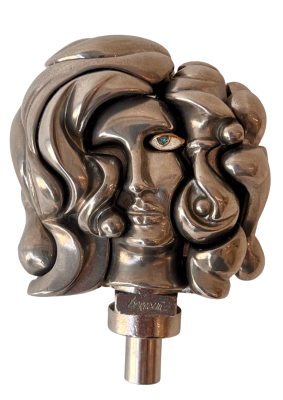
At its Paris galleries, Le Coin des Arts offers original multiple sculptures by Miguel Berrocal, notably the nickel-plated “Mini-Multiples” of the late 1960s such as Mini-Cariatide (Opus 109), Portrait de Michèle and Mini Zoraida – Homage to Paloma, each chosen for the quality of its casting, its provenance and its condition.
Berrocal was born on 28 September 1933 in Villanueva de Algaidas, in the province of Málaga, the eldest son of a country doctor. The family moved to Madrid when he was a child. Intended for a career in architecture, he read exact sciences at university and attended the San Fernando Academy of Fine Arts, the School of Graphic Arts and evening classes at the School of Arts and Crafts, where the sculptor Ángel Ferrant was his tutor. That blend of geometry and draughtsmanship would define everything he later made.
His first solo exhibition took place at the Galería Xagra in Madrid in 1952. Between 1952 and 1954 he worked in Rome as a draughtsman and assistant to architects, and in 1954 his drawings were shown in the Spanish pavilion of the Venice Biennale.
A scholarship took him to Paris in 1955 before he returned to Italy. In 1957 the Galleria La Medusa in Rome showed his first wrought-iron sculptures, still indebted to Eduardo Chillida, whom he had met in Madrid. From then on he gave up architecture altogether.
The decisive step came in 1959 with Grand Torse (Opus 31) and Hommage à Piero della Francesca, his first sculptures designed to be taken apart. Like a composer, Berrocal catalogued his output by opus number, and each work became an exact sequence of interlocking elements. Classical subjects – the torso, the head, the reclining figure – were reworked with geometric rigour and a touch of surrealist wit. In 1962 he showed at the Galerie Kriegel in Paris and at the Albert Loeb Gallery in New York, and a work entered the collection of the Museum of Modern Art.
From 1962 Berrocal began producing in series, multiplying a sculpture much as a printmaker pulls impressions from a plate. María de la O (Opus 92, 1962-64), issued in an edition of 200, was exhibited in the Spanish pavilion of the 1964 Venice Biennale, the same year he took part in documenta III in Kassel. Romeo e Giulietta (Opus 101, 1966-67), editioned in 2,000 examples, was the first of his works produced by injection casting, an industrial process that allowed large print runs without any loss of precision.
In the late 1960s Berrocal settled near Verona, at the Palazzo Rizzardi in Negrar, his home and workshop until 2004. There he combined monumental commissions with small-scale editions. The Mini David (Opus 107, 1967-70) launched the “Mini-Multiples” collection published by Multicetera: 9,500 nickel-plated examples set with green agate, 500 gilt examples set with lapis lazuli and six in 18-carat gold, each sold with an illustrated booklet printed in Verona. It was followed by the Mini-Cariatide (Opus 109), the Mini-María (1968), the Portrait de Michèle (1969), whose eye doubles as a removable ring, and Mini Zoraida, a homage to Paloma Picasso.
The major works of these years include Goliath (Opus 114, 1968-72), Richelieu (Opus 115, 1968-73) and the Monument to Picasso (Opus 129, 1972-74), commissioned by Málaga, the birthplace of Pablo Picasso. In 1973 Berrocal represented Spain at the São Paulo Biennial.
His first major Spanish retrospective, held in 1984 at the Palacio de Velázquez in Madrid’s Retiro park, brought together 176 sculptures. In 1987 he modelled the bust of Goya presented at the first Goya Awards, Spain’s national film prizes. For Expo ’92 in Seville he created Citius, Altius, Fortius and Doña Elvira, while the monumental Manolona (Opus 397) was made for Madrid. He received the Gold Medal of Andalusia in 1993, and the IVAM in Valencia held an exhibition of his work in 2002.
At the end of 2004 he returned to his native village; he died in Antequera on 31 May 2006. In 2007 his heirs set up the Fundación Escultor Berrocal, which runs a studio-museum in Villanueva de Algaidas; its first gallery, opened in 2014, is devoted to his graphic work.
For Berrocal the multiple played the role that the original print plays for a painter: a work designed by the artist to exist in a numbered edition, not a reproduction of a unique piece. His editions range from patinated or gilt bronzes in runs of a few hundred or a few thousand to nickel-plated mini-sculptures in zinc alloy (zamak) and brass, editioned in close to 10,000 examples. Every component is engineered so that the whole can be dismantled and rebuilt – often twenty pieces or more – and a piece of jewellery may be hidden inside: a ring, a pendant or a semi-precious stone.
The Mini-Multiples were sold boxed, with an illustrated booklet and assembly instructions showing the order of the parts; these accessories are much sought after today. Berrocal also produced screenprints, drawings and artist’s books, but it is the dismountable sculpture that gives his work its originality.
Before acquiring a multiple by Berrocal, check the title and opus number; the material (bronze, gilt bronze, nickel-plated metal); the example number and the size of the print run; the signature and numbering, usually incised in the metal; the publisher (Multicetera, Artcurial and others); and, above all, that every element is present – a missing piece significantly reduces value. The original box, booklet, instructions and certificate add to its desirability, and the plating or patina should be checked for scratches and oxidation.
Original multiple or later copy? Berrocal’s editions were numbered and signed in the metal. An object without a number, or whose pieces do not lock together precisely, calls for caution. As with prints, what makes a multiple original is the artist’s conception and his control over the edition.
Le Coin des Arts selects Miguel Berrocal’s multiples with care for their authenticity, provenance and completeness, and advises collectors on display, mounting on a base or framing. You may also enjoy works by Eduardo Chillida, Pablo Picasso, César, Pol Bury and Yaacov Agam.
Wikipedia – Miguel Berrocal · Wikipedia (Spanish) – Miguel Berrocal · MoMA – Le Mini-David · documenta III (1964) · IVAM – Miguel Berrocal (2002) · Junta de Andalucía – Medals 1993

Secure payment
3DSecure 2.2

Free DHL Express delivery from €1,200
Carefully prepared parcel
Parcel tracking

Shipment insured
for the value of the artwork, covering theft and damages

Fairest prices
Certificate of authenticity
Two galleries in Paris
Receive an email as soon as a new artwork is added for this artist
Your message has been sent ! We will get back to you as soon as possible.
Please fill in the form if you need further information such
Please fill in your email address, an email will be sent with a link to update your password.
You can now place orders and track your orders.
To save your wishlist, you can log in or create an account :
This is a 100% custom-made frame, carefully crafted by a professional framer. Finishes are available in light oak, white wood or black wood, with or without mat board and plexiglass. Delivery times may vary depending on the order, with an average lead time of 10 days.
This option will be offered during the cart step.