(1875-1963)

VILLON Jacques
The Norman dovecote, 1954
Lithograph LCD8037
890.00€
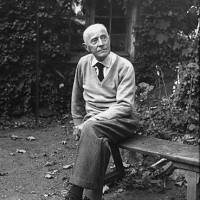
Photographe inconnu - CC BY-SA 4.0, via Wikimedia Commons
Jacques Villon (born Gaston Duchamp at Damville, Normandy, on 31 July 1875; died at Puteaux, near Paris, on 9 June 1963) was a painter of the Cubist generation and, above all, one of the finest French printmakers of the twentieth century. The eldest brother of the sculptor Raymond Duchamp-Villon and of Marcel Duchamp, he hosted the Puteaux group that launched the Section d’Or in 1912, and he is credited with giving Cubism a genuinely graphic language of its own. His printed work spans some seventy years – from his first drypoints of 1891 to the colour lithographs of the 1950s – and includes a large body of reproductive prints after other painters, which collectors must learn to tell apart from his original compositions.
Le Coin des Arts currently offers Villon’s Le Pigeonnier normand (‘The Norman Dovecote’, 1954), an original colour lithograph that returns to the Normandy of his childhood, and sources further prints as they appear, chosen for the quality of the impression, the edition, provenance and condition. To be told when a new work arrives, simply ‘follow the artist’ on this page.
Gaston Duchamp came from a prosperous, cultivated family. His maternal grandfather, the businessman and artist Émile Nicolle, introduced him to drypoint in 1891, while he was still at school in Rouen. In 1894 he moved to Montmartre with his brother Raymond, enrolled in law to please his father and soon gave it up for art. He took the name Jacques Villon – a nod to the medieval poet François Villon – to set himself apart from his siblings. He passed through Fernand Cormon’s studio in 1895 and later the Académie Julian (1904–05). For more than a decade he earned his living as a cartoonist for Le Courrier français, Gil Blas, Le Chat noir and L’Assiette au beurre, and designed a handful of Belle Époque posters. From 1899 the publisher Edmond Sagot issued his prints: large colour aquatints of Parisian society, fashionable women and fairgrounds, close in spirit to Degas and Toulouse-Lautrec. In 1903 he helped organise the drawing section of the first Salon d’Automne.
In 1906 Villon left Montmartre for Puteaux, his home for the rest of his life. Around 1911 his studio became the meeting place of a circle that included his brothers, Albert Gleizes, Jean Metzinger, Francis Picabia, Fernand Léger and Robert Delaunay, who argued over proportion and the golden section. Villon suggested the name Section d’Or for the exhibition that opened at the Galerie La Boétie in October 1912. In 1913 he produced seven large Cubist drypoints, among them L’Équilibriste, in which figures are built from interlocking networks of hatching; the same year every painting he sent to the Armory Show in New York found a buyer. Called up in 1914, he later served in a camouflage unit. La Table d’échecs, painted in 1919, became an etching in 1920.
The 1920s were lean years. In 1922 the Paris dealers Bernheim-Jeune commissioned from him a long series of large colour aquatints after modern paintings – Cézanne, Van Gogh, Renoir, Matisse, Picasso, Modigliani, Maximilien Luce and others. New York’s Museum of Modern Art counted some 140 of these plates in 1953 and noted that the coppers belonged to the Louvre. One of them has a quiet British resonance: the aquatint traditionally titled Londres (‘London’, 1929), after an 1893 canvas by Luce, published in an edition of 200 and signed by both artists – although the view probably shows the Île de la Cité in Paris rather than the Thames. Such sheets still turn up at the London Original Print Fair. They are skilful, authorised and collectable, but they are interpretations, not Villon’s own designs.
After a return to abstraction in the early 1930s (Amro, 1931) and to the figure around 1935, Villon was appointed chevalier of the Légion d’honneur in 1938. Recognition came late, but decisively. In December 1944 the Galerie Louis Carré showed him in Paris and later in New York, and Carré remained his dealer. He received first prize at the Carnegie International in Pittsburgh in 1950, a retrospective at the Musée National d’Art Moderne in 1951 – the year he was also shown at the Royal Academy in London – and the Grand Prize for painting at the Venice Biennale in 1956. From 1955 he designed stained glass for the Chapel of the Holy Sacrament in Metz Cathedral. He died at Puteaux in June 1963 and was buried in Rouen; in 1967 Marcel Duchamp organised the family exhibition Les Duchamp there.
Villon was essentially an engraver on copper, at home in every intaglio technique – drypoint, etching and aquatint, often combined on a single plate, and frequently in several states. His original prints fall broadly into the Sagot colour aquatints of the Belle Époque; the Cubist drypoints of 1913 and the rigorously constructed etchings of the interwar years (Les Trois Ordres, 1939; Globe céleste, 1944); and the post-war colour lithographs, several printed by Mourlot, alongside illustrated books such as Jacques Lassaigne’s Éloge de Jacques Villon (1955).
Two catalogues are standard. Jacqueline Auberty and Charles Pérussaux, Jacques Villon, catalogue de son œuvre gravé (Paris, Paul Prouté et ses fils, 1950), was compiled in the artist’s lifetime. It has been largely superseded by Colette de Ginestet and Catherine Pouillon, Jacques Villon. Les estampes et les illustrations. Catalogue raisonné (Paris, Arts et Métiers Graphiques, 1979), which also records the reproductive aquatints. A dealer’s note such as ‘Ginestet & Pouillon 663’ – the number of Londres – refers to that catalogue’s entry, where states, edition and dimensions are given.
Original or reproductive? Ask this first. A sheet ‘after Cézanne’ or bearing a second signature is an authorised interpretation, priced accordingly, not an original Villon composition.
Signature and numbering. Edition impressions are signed in pencil ‘Jacques Villon’; check that the number matches the edition recorded in the catalogue. See the signature and the printing.
States. Villon often pulled trial proofs and successive states; Ginestet & Pouillon will tell you where an impression sits.
Paper and condition. Early colour aquatints are vulnerable to light-staining, foxing and trimmed margins. Conservation framing with UV-filtering glazing is advisable.
Pitfalls. Exhibition posters, unsigned plates from periodicals, later impressions and photomechanical reproductions all circulate under his name. Our guarantees are set out on the authenticity page.
The gallery chooses Villon prints for the freshness of the impression and their condition. Continue with Georges Braque, Fernand Léger, Robert Delaunay, Jean Bazaine and Henri Matisse, or explore modern art and our engravings and lithographs.
Colette de Ginestet and Catherine Pouillon, Jacques Villon. Les estampes et les illustrations. Catalogue raisonné, Arts et Métiers Graphiques, Paris, 1979 · Jacqueline Auberty and Charles Pérussaux, Jacques Villon, catalogue de son œuvre gravé, Paul Prouté, Paris, 1950 · Peter A. Wick, Jacques Villon, Master of Graphic Art, Museum of Fine Arts, Boston, 1964 · MoMA – Villon print retrospective, press release, 1953 · London Original Print Fair – Villon after Luce, Londres (1929) · Larousse – Gaston Duchamp, known as Jacques Villon

Secure payment
3DSecure 2.2

Free DHL Express delivery from €1,200
Carefully prepared parcel
Parcel tracking

Shipment insured
for the value of the artwork, covering theft and damages

Fairest prices
Certificate of authenticity
Two galleries in Paris
Receive an email as soon as a new artwork is added for this artist
Your message has been sent ! We will get back to you as soon as possible.
Please fill in the form if you need further information such
Please fill in your email address, an email will be sent with a link to update your password.
You can now place orders and track your orders.
To save your wishlist, you can log in or create an account :
This is a 100% custom-made frame, carefully crafted by a professional framer. Finishes are available in light oak, white wood or black wood, with or without mat board and plexiglass. Delivery times may vary depending on the order, with an average lead time of 10 days.
This option will be offered during the cart step.