
(1904-1987)

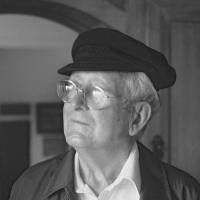
Cyril Deicha, CC BY-SA 4.0, via Wikimedia Commons
Jean Hélion (born Jean Bichier at Couterne, Normandy, on 21 April 1904; died in Paris on 27 October 1987) was a founding figure of geometric abstraction in 1930s Paris who, at the height of that success, turned back to the visible world. A co-founder of Art Concret and Abstraction-Création, he was also the Parisian painter British abstract artists turned to in the early 1930s, and the man behind the idea of the London review Axis. After 1939 his art became a figurative chronicle of everyday life – men in bowler hats, newspaper readers, passers-by, still lifes – recorded in paint and in a body of original lithographs that is still little known to collectors.
Le Coin des Arts currently offers Force de la mer VI, a 1965 original lithograph signed in pencil, from a series devoted to the sea. Like every print in our stock, it was chosen for the quality of its impression, its edition, its provenance and its condition. To be told when another sheet comes in, simply ‘follow the artist’ on this page.
The son of a taxi driver and a dressmaker, Jean Bichier was brought up by his grandmother until the age of eight, then joined his parents in Amiens. He trained as a pharmacist’s assistant and in 1920 began studying chemistry in Lille, but left for Paris in 1921, where he worked as an architectural draughtsman and wrote poetry. Seeing Poussin and Philippe de Champaigne at the Louvre persuaded him to paint. His first canvases date from 1922–23; the collector Georges Bine gave him a first contract, and the Uruguayan painter Joaquín Torres-García, who shared his studio, opened his eyes to Cubism. He made his debut at the Salon des Indépendants in 1928.
Meeting Theo van Doesburg in 1929, and visiting Piet Mondrian’s studio, proved decisive. In 1930 Hélion and van Doesburg launched Art Concret, whose manifesto Hélion co-wrote; on 15 February 1931 he was among the founders of Abstraction-Création, with Auguste Herbin, Jean Arp, Georges Vantongerloo and František Kupka. The association soon counted Ben Nicholson and Barbara Hepworth among its members, and both were deeply struck by visits to Hélion’s Paris studio in 1932–33. Hélion went further: he encouraged Myfanwy Evans to found Axis, conceived as an English counterpart to Abstraction-Création, which appeared in January 1935 with John Piper as its designer. His own paintings of these years – the Equilibriums and Compositions – bend Mondrian’s grid into curves and volumes. Two of them hang in British public collections: Abstract Composition (1934), shown at Tate Britain, and Ile de France (1935), both in the Tate collection. His first solo exhibition was held at the Galerie Pierre Loeb in Paris in 1932.
In 1932 Hélion crossed the Atlantic to marry Jean Blair, a Virginian; the New York collector A. E. Gallatin bought his work and sought his advice. By the mid-1930s he was living between New York and Rockbridge Baths, Virginia, where he built a studio by the Maury River. In 1939 Au cycliste and Figure tombée marked his break with abstraction. Returning to enlist in 1940, he was captured on 19 June 1940 and held at Stettin until his escape on 13 February 1942. Back in America he published They Shall Not Have Me (1943), an account of his captivity that became a bestseller. He then married Pegeen Vail, daughter of Peggy Guggenheim – they had three sons – and settled in Paris for good in 1946.
Hélion’s post-war figuration – men in hats, nudes in bare interiors, then, from around 1951, still lifes and studio scenes painted from observation – puzzled many who had admired the abstract painter. Married to Jacqueline Ventadour in 1963, he recovered in the 1960s the broad colour of the 1940s, painted the demonstrations of May 1968 (Choses vues en mai, Musée des Beaux-Arts, Orléans) and was given a retrospective at the Grand Palais in 1970, while the Galerie Karl Flinker became his Paris dealer. British audiences saw him again in 1981 in A New Spirit in Painting at the Royal Academy of Arts, London, alongside a younger generation of figurative painters. Nearly blind, he stopped painting in October 1983 and dictated his last writings, including Mémoire de la chambre jaune (1994). Major retrospectives followed at the Musée d’Art Moderne de Paris (1984–85), the Centre Pompidou (8 December 2004 – 6 March 2005, catalogue with an essay by Matthew Gale) and, most recently, Jean Hélion, La prose du monde at the Musée d’Art Moderne de Paris (22 March – 18 August 2024), with more than 150 paintings, drawings and notebooks. The Pompidou centenary show travelled to the Museu Picasso in Barcelona and to the National Academy Museum in New York in 2005. Most of the notebooks he kept from 1929 to 1984 are in the Bibliothèque nationale de France.
His earliest recorded print is an engraving of 1934 for 23 Gravures, the collective portfolio assembled by Anatole Jakovski and published by Éditions Orobitz in Paris in 1935, printed by Tanneur in an edition of 50; the Museum of Modern Art in New York holds an impression. From then on he favoured lithography, the medium closest to his drawing. The Eleanor D. Wilson Museum at Hollins University, Virginia, holds early lithographs such as Éléments écartés (1934) and Au cycliste (c. 1939), as well as Fille au mannequin (c. 1955). Later sheets follow the themes of his paintings: newspaper readers (1951), men in hats, the Force de la mer series (1965), Les Feux de mai (1969, a colour lithograph published by the Association française des amateurs d’estampes) and the late portfolio Les Passants (1986).
To our knowledge no catalogue raisonné of Hélion’s prints has been published, so his lithographs cannot be identified by a standard catalogue number. The reference monograph is Henry-Claude Cousseau’s Hélion (Éditions du Regard, 1992); the Association Jean Hélion is preparing a catalogue raisonné of the works on paper.
Signature and edition. Published lithographs are signed ‘Hélion’ in pencil and numbered, usually in small editions – 50 for the Force de la mer series. See our notes on the signature and the edition.
Image date versus print date. Some late lithographs reproduce abstract designs of the 1930s and carry double dates such as ‘1933–1970’. They are legitimate prints, but not contemporary with the abstract period, and are priced accordingly.
Portfolio and review plates. Sheets taken from a portfolio such as Les Passants are genuine prints; unsigned plates from art reviews are worth far less. Read our page on what makes an original print.
Provenance and condition. With no print catalogue, an old invoice, a publisher’s stamp or a Karl Flinker provenance carries real weight. Check margins, foxing and light-staining, and frame with UV-filtering glazing: see our framing service and our authenticity guarantee.
We also offer prints by Hélion’s fellow members of Abstraction-Création: Jean Arp, Auguste Herbin, Alexander Calder, Sonia Delaunay and Robert Delaunay. Explore modern art and our engravings and lithographs.
Henry-Claude Cousseau, Hélion, Éditions du Regard, 1992 · Didier Ottinger, Henry-Claude Cousseau, Matthew Gale et al., Jean Hélion, Éditions du Centre Pompidou, 2004 · Jean Hélion, They Shall Not Have Me, 1943 · Tate – Jean Hélion · Tate – Abstract Composition, 1934 · Musée d’Art Moderne de Paris – press release, 2024 · MoMA – plate from 23 Gravures · The Spectator – ‘French connection’, 2005

Secure payment
3DSecure 2.2

Free DHL Express delivery from €1,200
Carefully prepared parcel
Parcel tracking

Shipment insured
for the value of the artwork, covering theft and damages

Fairest prices
Certificate of authenticity
Two galleries in Paris
Receive an email as soon as a new artwork is added for this artist
Your message has been sent ! We will get back to you as soon as possible.
Please fill in the form if you need further information such
Please fill in your email address, an email will be sent with a link to update your password.
You can now place orders and track your orders.
To save your wishlist, you can log in or create an account :
This is a 100% custom-made frame, carefully crafted by a professional framer. Finishes are available in light oak, white wood or black wood, with or without mat board and plexiglass. Delivery times may vary depending on the order, with an average lead time of 10 days.
This option will be offered during the cart step.

