
(1896-1986)
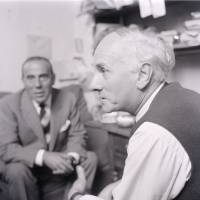
Gérard Schneider, 1961 — photographie Paolo Monti / Fondo Paolo Monti, BEIC — CC BY-SA 4.0, via Wikimedia Commons.
Gérard Schneider was born on 28 April 1896 in Sainte-Croix, in the Swiss canton of Vaud, and died in Paris on 8 July 1986. Swiss by birth and French by naturalisation (1948), he is recognised as one of the pioneers of Lyrical Abstraction and of the post-war School of Paris, a painter of broad, rapid strokes of black and saturated colour. Shown in Venice, at documenta in Kassel and at the São Paulo Biennial, he was also exhibited in Britain, notably at the Royal Academy in 1951. Alongside his canvases he produced a smaller but telling body of original prints: lithographs, aquatints, screenprints and illustrated books.
Le Coin des Arts currently offers two prints by Schneider: an untitled screenprint (Sans titre) and the 1968 lithograph La Peau des choses (‘The Skin of Things’), signed in pencil and numbered from an edition of 114, from the portfolio of the same name published by Jean-Robert Arnaud. Both were chosen, like every sheet we handle, for the quality of the impression, the edition, the provenance and the condition. To hear about new arrivals, simply ‘follow the artist’ on this page.
Schneider grew up in Neuchâtel, where his father was a cabinetmaker and antiques dealer. In 1916, aged twenty, he moved to Paris to study at the École nationale des arts décoratifs, and in 1918 he entered the École des beaux-arts in the studio of Fernand Cormon, whose earlier pupils had included Van Gogh and Toulouse-Lautrec. After a first solo exhibition in Neuchâtel in 1920, he settled in Paris for good in 1922. His debut at the Salon d’Automne in 1926, with L’Allée hippique, attracted notice. It was a thoroughly academic grounding, and the sureness of hand it gave him underpins even his most spontaneous later work.
By the mid-1930s Schneider had abandoned painting from nature. He darkened his palette, wrote poetry and moved in Surrealist circles, meeting Paul Éluard, Georges Hugnet, Óscar Domínguez and Luis Fernández; Kandinsky’s abstraction was another touchstone. He showed at the Salon des Surindépendants from 1936 to 1945, and from 1938 his titles no longer referred to the visible world. He met Picasso in 1939 and followed the teaching of G. I. Gurdjieff between 1941 and 1943. By about 1944 his painting had left representation behind entirely; a Composition of that year is now in the collection of the Centre Pompidou.
In 1946 Schneider took part in Peintures abstraites at the Galerie Denise René, one of the first post-war showcases of abstract painting, and contributed to the album Art abstrait, prefaced by the critic Charles Estienne, together with Hans Hartung, Serge Poliakoff and Marie Raymond. The Galerie Lydia Conti gave him solo shows in 1947, 1948 and 1950, and in 1949 showed him with Hartung and Pierre Soulages. He became a French citizen in 1948, the year of his first Venice Biennale; he returned in 1954 and again in 1966, when a whole room of the French pavilion was devoted to him. The São Paulo Biennial showed him in 1951, 1953 and 1961, and documenta in Kassel in 1955 and 1959.
British audiences met Schneider early. In 1951 he was included in The School of Paris 1900-1950 at the Royal Academy of Arts in London, and in 1962 in an École de Paris exhibition that toured London, Cardiff, Liverpool and Aberdeen. The Tate holds a work on paper from the 1964 Milan publication Poèmes d’Eugenio Montale, which can be seen by appointment in the Prints and Drawings Room at Tate Britain. Interest has revived recently: in 2024 the Cardi Gallery in London devoted an exhibition to his paintings of 1956 to 1981.
From 1955 Schneider was under contract to the Kootz Gallery in New York, which exhibited him from 1956 to 1961, while the Galerie Der Spiegel in Cologne championed him in Germany and the Milan dealer Bruno Lorenzelli from 1960. In Paris he showed regularly at the Galerie Arnaud. A retrospective travelled to the Kunstverein Düsseldorf and the Palais des Beaux-Arts in Brussels in 1962, and the Galleria Civica d’Arte Moderna in Turin hung around a hundred of his paintings in 1970. In 1974 he published a collection of poems, Mots au vol, with a preface by Eugène Ionesco. Neuchâtel and Dunkirk held retrospectives in 1983. Since his death, L’Envolée lyrique at the Musée du Luxembourg (2006), a show at the Musée d’art et d’histoire in Neuchâtel (2011) and a retrospective at the Musée des Beaux-Arts in Orléans (2013) have restored him to his rightful place.
Lithography suited the sweep of Schneider’s brush and was his main printmaking medium. His first published print appeared in the 1946 album Art abstrait (Opéra, Paris), printed by Desjobert in 100 numbered copies. In 1948 he illustrated Langage, a collection by the poet Robert Ganzo, with twelve colour lithographs, published by Lydia Conti. The catalogue of his 1957 show at Der Spiegel in Cologne contains an original lithograph printed by Mourlot. He also worked in intaglio: the Museum of Modern Art in New York holds his aquatint Abstraction (1953, edition of 100). In 1968 Jean-Robert Arnaud published the portfolio La Peau des choses, ten prints – etchings, screenprints and lithographs – by Schneider, Hartung, Soulages, Zao Wou-Ki, Victor Vasarely, César, Émile Gilioli, James Guitet, John-Franklin Koenig and Huguette-Arthur Bertrand, with poems by Michel Ragon, in an edition of 114.
As far as we are aware, no catalogue raisonné of Schneider’s prints has been published, and a catalogue of his paintings is still in preparation. A print is therefore identified by its title, date, technique, publisher and the book, album or exhibition catalogue it comes from. Treat with caution any ‘catalogue number’ quoted without an author or a title.
Signature. Edition impressions are signed in pencil ‘Schneider’. A signature printed in the plate or stone is not a hand signature; see the signature.
Edition and numbering. Editions are small: 100 for Art abstrait, 114 for La Peau des choses. The pencil number (103/114, for instance) should match the recorded edition. More on printing and editions.
Plates from books and catalogues. The lithograph in the 1957 Der Spiegel catalogue is genuine but signed only in the plate and folded down the centre; plates from Langage or Art abstrait are not individually signed. Prices should reflect this.
Posters and reproductions. Exhibition posters and offset reproductions ‘after Schneider’ are not original prints, even when signed.
Paper, margins and condition. Look for full margins and no folds or time staining. Bright inks fade in daylight, so UV-filtering glazing is wise; see our framing service.
Provenance. Without a catalogue raisonné, an old invoice, the original portfolio case or the complete book helps to place a sheet. Our guarantees are set out on the authenticity page.
The gallery also selects prints by Schneider’s fellow abstract painters: Hans Hartung, Pierre Soulages, Georges Mathieu, Serge Poliakoff and Jean-Michel Atlan. Explore the School of Paris and Lyrical Abstraction and our engravings and lithographs.
Gérard Schneider, Mots au vol, preface by Eugène Ionesco, 1974 · Robert Ganzo and Gérard Schneider, Langage, Lydia Conti, 1948 · Tate – Gérard Schneider · Cardi Gallery, London – Gérard Schneider (2024) · Perrotin – Gérard Schneider · Galerie Diane de Polignac – Gérard Schneider · MoMA – Abstraction, 1953 · Phillips – La Peau des choses, 1968

Secure payment
3DSecure 2.2

Free DHL Express delivery from €1,200
Carefully prepared parcel
Parcel tracking

Shipment insured
for the value of the artwork, covering theft and damages

Fairest prices
Certificate of authenticity
Two galleries in Paris
Receive an email as soon as a new artwork is added for this artist
Your message has been sent ! We will get back to you as soon as possible.
Please fill in the form if you need further information such
Please fill in your email address, an email will be sent with a link to update your password.
You can now place orders and track your orders.
To save your wishlist, you can log in or create an account :
This is a 100% custom-made frame, carefully crafted by a professional framer. Finishes are available in light oak, white wood or black wood, with or without mat board and plexiglass. Delivery times may vary depending on the order, with an average lead time of 10 days.
This option will be offered during the cart step.


