
(1901-1966)

Alberto GIACOMETTI
Standing Man, 1957
Sold
Looking for a similar artwork?
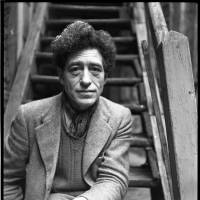
Emmy Andriesse, Public domain, via Wikimedia Commons
Alberto Giacometti (born 10 October 1901 in Borgonovo, in the Bregaglia valley of the Swiss canton of Graubünden; died 11 January 1966 in Chur) was a Swiss sculptor, painter and printmaker who spent his working life in Paris. After a Surrealist decade he arrived, in the years after the Second World War, at the elongated, thread-like figures that are now among the most recognised images of modern art. Less widely known is the scale of his work as a printmaker: more than 350 lithographs and etchings, catalogued by Herbert C. Lust, in which the studio, the heads of his brother Diego and his wife Annette, and the streets of Paris recur again and again.
Le Coin des Arts currently offers one original lithograph by Giacometti: Homme debout (‘Standing Man’), 1957, published by Maeght in Paris, hand-signed in pencil and numbered 47/100, on a sheet measuring 41 × 28.3 cm. Sale catalogues link it to L’Atelier d’Alberto Giacometti, Jean Genet’s text issued by Maeght that same year. We follow Giacometti’s printed work closely and acquire his prints when good impressions appear; use the ‘follow the artist’ button to be told when a new sheet arrives.
Giacometti was the eldest child of the Post-Impressionist painter Giovanni Giacometti and Annetta Stampa; his godfathers were the painters Cuno Amiet and Ferdinand Hodler. The family moved to Stampa in 1906 and later bought a summer house at Maloja. As a boarder at the Protestant school in Schiers he cut his first woodcuts, so printmaking was part of his practice from the start. He studied in Geneva from 1919, spent most of 1920–21 in Rome, and in January 1922 came to Paris to study sculpture under Antoine Bourdelle at the Académie de la Grande Chaumière. On 1 December 1926 he moved into the cramped studio at 46 rue Hippolyte-Maindron, which he kept for the rest of his life.
In 1929 Giacometti signed with the Galerie Pierre and entered the Surrealist circle; his first Paris solo show followed at Pierre Colle in 1932. His first illustrated book, René Crevel’s Les Pieds dans le plat, appeared in 1933, and in 1934 he made four prints for André Breton’s L’Air de l’eau. Expelled from the group on 14 February 1935 for returning to work from the model, he was nonetheless included the following year in the International Surrealist Exhibition at the New Burlington Galleries in London. In 1935 he also met Isabel Nicholas, later Isabel Rawsthorne, who sat for two heads in the later 1930s. He spent the war in Geneva, where he met Annette Arm; they married in Paris on 19 July 1949.
Back in Paris from September 1945, Giacometti developed his attenuated standing women and walking men. Britain was quick to respond: in 1949 the Tate Gallery bought Man Pointing (1947), the first acquisition of his work by a European museum. That same year he made his first lithograph, a portrait of Tristan Tzara for the review Phases. In 1955 the Arts Council mounted a retrospective in London, alongside shows in New York and Krefeld, and in 1956 his Women of Venice filled the French pavilion at the Venice Biennale. In 1962 he won the Grand Prize for Sculpture at Venice and visited London, where he saw Isabel Rawsthorne and Francis Bacon again; he returned in 1965 for his retrospective at the Tate, the same year as those at the Museum of Modern Art and the Louisiana Museum. He died at Chur hospital on 11 January 1966 and is buried at Borgonovo.
The Alberto Giacometti-Stiftung was established in Zurich on 16 December 1965; its holdings, centred on the former collection of G. David Thompson, are shown chiefly at the Kunsthaus Zürich. In Paris, the Fondation Alberto et Annette Giacometti, created in 2003 from Annette’s estate, runs the Institut Giacometti at 5 rue Victor-Schoelcher, with a reconstruction of the studio. In 2017 it co-organised with Tate Modern a retrospective of more than 250 works (10 May – 10 September). London also saw a landmark sale: on 3 February 2010 Sotheby’s sold L’Homme qui marche I for £65 million, an auction record for the artist until 2015.
Giacometti first practised etching in 1933 at Stanley William Hayter’s Atelier 17 in Paris and returned to it chiefly to illustrate books by writer friends. In 1951, at Aimé Maeght’s suggestion, he took up crayon lithography; the stones were printed at Fernand Mourlot’s workshop and the editions published by Maeght, including plates for the gallery’s review Derrière le miroir. The line is that of his drawings: restless, overworked, searching for a figure in the depth of the studio. Two books stand out. Michel Leiris’s Vivantes cendres, innommées (1961) contains 52 etchings; Paris sans fin, begun in 1959 and published by Tériade in 1969, holds 150 lithographs printed by Mourlot on Arches wove paper. The standard reference is Herbert C. Lust, Giacometti: The Complete Graphics and 15 Drawings (New York, Tudor, 1970). A description reading ‘Lust 15’ refers to the number of the print in that catalogue: the National Gallery of Art in Washington, for instance, lists a 1954 lithograph Studio II, in an edition of 30, as Lust 15, while the Paris sans fin plates run from Lust 204 to 353. The Kupferstichkabinett in Berlin, which acquired a large group of his prints in 1985, gives an idea of the scope of this work.
Catalogue raisonné first. Ask for the Lust number and check subject, technique and dimensions against it. A sheet that cannot be matched to Lust needs a convincing explanation.
Signature. Published impressions are signed in pencil ‘Alberto Giacometti’. A signature in the stone or a stamp is not a substitute; see our note on the signature.
Edition and numbering. Many Maeght lithographs of the 1950s were editioned at 100, as with our Homme debout; some early sheets had far smaller runs. More on the printing.
Reproductions and fakes. Posters, offset prints and images sold as ‘after Giacometti’ are not original prints. Fakes are a serious problem for his sculpture: in 2009 German police seized more than a thousand forged bronzes and plasters in a warehouse in Mainz, and a representative of the Fondation Giacometti sat on the expert panel at the Stuttgart trial. The Fondation actively pursues counterfeits, but its authentication committee covers paintings, sculptures, drawings and decorative objects; for prints, the evidence is Lust, signature, paper and provenance.
Review and book plates. Lithographs from Derrière le miroir are genuine Mourlot lithographs, but unsigned and unnumbered, and priced accordingly. Paris sans fin was published in unbound sheets in 1969, three years after the artist’s death, so its loose plates cannot bear his pencil signature. See our illustrated books.
Paper, condition and provenance. Look for Arches or Rives paper, full margins and no light-staining, which flattens the soft greys of these lithographs. Choose UV-filtering glazing for framing, and keep the invoice; our guarantees are set out on the authenticity page.
We also select prints by artists who shared Giacometti’s publishers, printers or circle: Francis Bacon, Henry Moore, Georges Braque, Joan Miró and André Masson. Explore Surrealism, modern art and our engravings and lithographs.
Herbert C. Lust, Giacometti: The Complete Graphics and 15 Drawings, New York, Tudor, 1970 · Alberto Giacometti, Paris sans fin, Paris, Tériade, 1969 · Fondation Giacometti – Biographical timeline · Tate – Giacometti at Tate Modern, 2017 · Fondation Beyeler – Alberto Giacometti biography · Staatliche Museen zu Berlin – Alberto Giacometti. Prints · National Gallery of Art – Studio II (Lust 15) · The Art Newspaper – Giacometti fraud case, 2011

Secure payment
3DSecure 2.2

Free DHL Express delivery from €1,200
Carefully prepared parcel
Parcel tracking

Shipment insured
for the value of the artwork, covering theft and damages

Fairest prices
Certificate of authenticity
Two galleries in Paris
Receive an email as soon as a new artwork is added for this artist
Your message has been sent ! We will get back to you as soon as possible.
Please fill in the form if you need further information such
Please fill in your email address, an email will be sent with a link to update your password.
You can now place orders and track your orders.
To save your wishlist, you can log in or create an account :
This is a 100% custom-made frame, carefully crafted by a professional framer. Finishes are available in light oak, white wood or black wood, with or without mat board and plexiglass. Delivery times may vary depending on the order, with an average lead time of 10 days.
This option will be offered during the cart step.



