
(1886-1964)
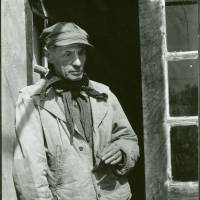
Christ-schmitt, CC BY-SA 4.0, via Wikimedia Commons
Roger Bissière (born in Villeréal, Lot-et-Garonne, on 22 September 1886; died at Boissièrette, Lot, on 2 December 1964) is often described as the elder statesman of the post-war School of Paris. A critic and teacher before he was widely recognised as a painter, he shaped a generation of students at the Académie Ranson, withdrew from painting during the war, and re-emerged with sewn tapestries and luminous grids of colour and sign. Awarded the Grand Prix National des Arts in 1952, he showed at the first three documenta exhibitions and received a special honourable mention at the 1964 Venice Biennale. His printed work – woodcuts, aquatints and original lithographs – is small but closely tied to his painting.
Le Coin des Arts currently offers a group of original prints by Roger Bissière from the 1950s: the aquatint L’Étoile (1953), numbered in Roman numerals from an edition of fifteen; two lithographs of 1956, Le Château and Lumière dans la forêt, each signed in pencil and numbered from an edition of 75 on BFK Rives wove paper; and the aquatint Composition 60. Each sheet was chosen for the quality of the impression, its numbering, provenance and condition.
The son of a notary, Bissière boarded at the lycée in Cahors and then at the Lycée Michel-Montaigne in Bordeaux. He began to paint at around seventeen, abandoned law, spent a year in Algiers (1904-05) and trained at the École des Beaux-Arts in Bordeaux under Paul Quinsac before entering Gabriel Ferrier’s studio in Paris in 1910. Short stays in London (1911) and Rome followed before he settled in Paris. From 1913 to 1919 he wrote the ‘Beaux-Arts et curiosité’ column of the weekly L’Opinion. In January 1919 he married Lucie Lotte, known as ‘Mousse’. In 1920 the dealer Léonce Rosenberg commissioned from him a book on Georges Braque, published by L’Effort Moderne – the first monograph on the painter. Essays on Seurat, Ingres and Corot appeared in L’Esprit Nouveau, and in 1921 the Galerie Paul Rosenberg gave him his first solo exhibition.
From 1923 Bissière exhibited regularly at the Galerie Druet and began teaching at the Académie Ranson. In 1934 he opened a fresco workshop there, attended by Alfred Manessier, Jean Le Moal and Jean Bertholle; the Musée Granet’s chronology also lists Maria Helena Vieira da Silva and Arpad Szenes among his pupils. Before 1937 he also showed in London at the Leicester Galleries. For the 1937 Exposition Internationale he led a team of former students decorating the Railway and Merchant Navy pavilions, within the group gathered around Robert and Sonia Delaunay.
In April 1939 he left Paris for the old presbytery at Boissièrette, where Mousse and their son Marc-Antoine had settled. Crushed by the war, he stopped painting and farmed. In late 1945 he designed seven appliqué hangings, sewn and embroidered by Mousse, and returned to painting in a deliberately ‘primitive’ figurative manner. The exhibition at the Galerie René Drouin (December 1947 – January 1948) was a commercial failure, though Jean Dubuffet admired it. In July 1950 he began painting in egg tempera on rough wooden panels; shown as Quelques images sans titre at the Galerie Jeanne Bucher in October 1951, these works finally won over critics and collectors, and the gallery showed him regularly from then on.
The Grand Prix National des Arts followed on 23 December 1952. In 1954 he returned to oil, valuing its transparency. He took part in documenta in Kassel in 1955, 1959 and 1964, and in 1957-58 a retrospective toured Germany and the Netherlands. The Musée d’Art moderne de la Ville de Paris held a retrospective in 1959. He designed stained glass for the churches of Develier and Cornol in the Swiss Jura and for the north and south towers of Metz Cathedral. After Mousse’s death on 13 October 1962 he painted the Journal en images, small panels dated day by day. At the 32nd Venice Biennale (20 June – 18 October 1964) the French pavilion showed three hangings and forty-one paintings; the painting prize went to Robert Rauschenberg, while Bissière received an honourable mention for the ‘historical and artistic importance’ of his work. He died at Boissièrette that December.
The Tate holds an untitled etching and aquatint of 1955 by Bissière, a good example of the gridded, softly coloured intaglio prints of his late period. Britain is also the setting of a cautionary episode: between 1985 and 1995 the forger John Myatt, working for John Drewe, painted pictures in the style of Bissière, alongside fake Chagalls, Giacomettis and Nicholsons. As The Art Newspaper reported in 1999, Drewe slipped photographs of his forgeries into the records of the Tate Archive and other London institutions to fabricate provenance – a reminder that documentation must be checked as carefully as the work itself.
Bissière’s most ambitious print project is the Cantique à notre frère Soleil of St Francis of Assisi: eleven colour woodcuts, exhibited at Jeanne Bucher from 19 November 1954 and, according to the 1970 Luxembourg catalogue, printed on a hand press by Marcel Fiorini. Through the 1950s and early 1960s he produced aquatints – some in sugar-lift – and lithographs whose patchwork of colour echoes his canvases. In 1962 he contributed the etching Centro to the album Paroles peintes I (Éditions O. Lazar-Vernet), and in December 1964 the review XXe Siècle (no. 24) included a lithograph printed by Mourlot.
To our knowledge there is no published catalogue raisonné of the prints. The standard reference for his oeuvre is the three-volume catalogue raisonné by Isabelle Bissière and Virginie Duval (Ides et Calendes, Neuchâtel, 2001), whose second volume records 2,912 works from 1943-44 to 1964. A print is therefore best identified by the publication it comes from and by a clear edition record.
Edition and numbering. Editions are numbered in Arabic numerals (for example out of 75) or, for small runs, in Roman numerals: an impression marked VI/XV belongs to an edition of about fifteen. See the printing.
Signature. Editions published in his lifetime are signed in pencil; anything printed after December 1964 cannot carry his own signature. See the signature and what is an original print.
Review and album plates. The XXe Siècle lithograph and the Paroles peintes etching are genuine prints, but were issued unsigned and unnumbered; they should be priced accordingly.
Look-alikes. Lithographs ‘after’ paintings with a printed signature are reproductions. Prints by his son, the painter-printmaker Louttre.B (Marc-Antoine Bissière), can also bear the family name.
Paper and condition. The 1956 lithographs are on BFK Rives, which can tone with age. Look for full margins and no light-staining, and choose UV-filtering glazing when framing.
Provenance. A Galerie Jeanne Bucher label or an early invoice helps – but, as the Drewe case shows, paperwork must be genuine too. Our guarantees are set out on our authenticity page.
The gallery also selects prints by artists close to Bissière: his pupils Alfred Manessier and Vieira da Silva, Georges Braque, Jean Bazaine and Gustave Singier. Explore the School of Paris and lyrical abstraction and our engravings and lithographs.
Isabelle Bissière and Virginie Duval, Roger Bissière, catalogue raisonné, 3 vols, Ides et Calendes, Neuchâtel, 2001 · Joseph-Émile Muller, Roger Bissière, Musée d’Histoire et d’Art, Luxembourg, 1970 · Tate – Roger Bissière · The Art Newspaper – the Drewe and Myatt fraud (1999) · Musée Granet – biographical chronology · Galerie Jeanne Bucher Jaeger – Roger Bissière · Ceysson & Bénétière – Bissière, 2026 · MNAHA Luxembourg – Bissière catalogue, 1970

Secure payment
3DSecure 2.2

Free DHL Express delivery from €1,200
Carefully prepared parcel
Parcel tracking

Shipment insured
for the value of the artwork, covering theft and damages

Fairest prices
Certificate of authenticity
Two galleries in Paris
Receive an email as soon as a new artwork is added for this artist
Your message has been sent ! We will get back to you as soon as possible.
Please fill in the form if you need further information such
Please fill in your email address, an email will be sent with a link to update your password.
You can now place orders and track your orders.
To save your wishlist, you can log in or create an account :
This is a 100% custom-made frame, carefully crafted by a professional framer. Finishes are available in light oak, white wood or black wood, with or without mat board and plexiglass. Delivery times may vary depending on the order, with an average lead time of 10 days.
This option will be offered during the cart step.


