(1895-1975)
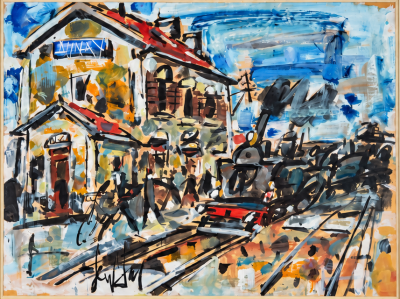
GEN PAUL
La gare d'Aulnay
Gouache (modern) LCD8595
3 200.00€

GEN PAUL
Les joueurs de cartes
Ink LCD8562
2 400.00€

GEN PAUL
Le Moulin Rouge, 1974
Mixed media (modern) LCD8604
1 400.00€

GEN PAUL
Musical clowns
Ink LCD6769
850.00€

GEN PAUL
Portrait
Drawing (modern) LCD6768
650.00€

GEN PAUL
The Flute Player
Pastel (modern) LCD7690
1 600.00€

GEN PAUL
The Flautist
Pastel (modern) LCD7234
1 700.00€

GEN PAUL
The Violinist
Ink LCD6766
950.00€

GEN PAUL
Horse racing
Ink LCD4792
950.00€

GEN PAUL
The accordion-playing
Pastel (modern) LCD7531
1 800.00€

GEN PAUL
Porte Saint Denis, 1975
Lithograph LCD7104
450.00€

GEN PAUL
The Violinist
Sold
Looking for a similar artwork?
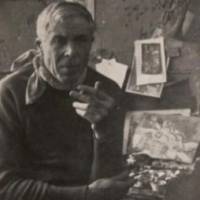
Portrait de Gen Paul © Comité Gen Paul
Gen Paul, born Eugène Paul in Paris on 2 July 1895 and died there on 30 April 1975, is the archetypal artist of Montmartre. Born in the rue Lepic and buried in the Saint-Vincent cemetery a few streets away, he lost his right leg in the First World War and went on to develop a vigorous, largely self-taught Expressionism: quick, nervous line, strong colour and a fondness for movement. His favourite subjects – Paris streets, racecourses, clowns and, above all, musicians – are at their most immediate in his ink drawings, pastels, gouaches and prints.
Le Coin des Arts currently offers mainly unique works on paper by Gen Paul: the inks Clowns musiciens (c. 1970), Le Violoniste and Course hippique; the pastels Le joueur de flûte traversière, Le Flûtiste and L’accordéoniste; a drawing, Portrait; and the lithograph Porte Saint-Denis (1975), signed in pencil. Each sheet has been chosen for the energy of its line, its provenance and its condition.
Eugène Paul was born at 96 rue Lepic. His mother was an embroiderer and his father a café musician, who died when the boy was about ten; the young Eugène was then apprenticed as a decorative painter for interiors. He drew constantly but received no real academic training. He volunteered when war broke out and was first wounded in 1914. In June 1915 shell fragments shattered his right leg, which had to be amputated. He would wear an artificial leg for the rest of his life.
Back in Paris, he painted his first oil in 1916, the Moulin de la Galette seen from his window, and first signed a canvas ‘Gen-Paul’ in 1918. The Montmartre etcher and printer Eugène Delâtre introduced him to intaglio printmaking; his early aquatints were signed Paul Trelade, an anagram of his teacher’s name. From 1920 he showed at the Salon d’Automne and the Salon des Indépendants. His first solo exhibition was held at the Galerie Bing in 1926, and in 1928 the same gallery hung his work alongside Picasso and Soutine. The years 1925–29 produced his most sought-after canvases. According to the chronology published by the Rehs Galleries, his paintings were also shown in the mid-1920s at the Savill Gallery in London and in Antwerp. Travels in Spain, where he studied Goya, Velázquez and El Greco, sharpened the tension of his painting.
Gen Paul was made a Chevalier of the Légion d’honneur in 1934. For the 1937 Paris International Exhibition he painted a large mural for the Pavilion of the Wines of France. In 1939 the French State bought his Violoniste en rouge for the Musée du Luxembourg; it now belongs to the Musée national d’art moderne (Centre Pompidou) and is on long-term loan to Granville. During the Occupation he illustrated two novels by his Montmartre neighbour Louis-Ferdinand Céline for the publisher Denoël: the new edition of Voyage au bout de la nuit (March 1942, fifteen drawings) and Mort à crédit (sixteen drawings). Céline later portrayed him as the painter Jules in Féerie pour une autre fois (1952). That association has coloured the critical reception of Gen Paul ever since.
After 1945 he travelled frequently to the United States, painting jazz players and concert musicians. Music became his defining theme. His 1950 pastel Django, a portrait of Django Reinhardt, was used in 1969 for the Vogue box set devoted to the guitarist. In 1952 the Galerie Drouant-David in Paris mounted a retrospective. In 1974 Pierre Davaine’s monograph appeared, and Gen Paul painted six gouaches of Paris for a Philips Data Systems calendar, En 1975, Gen Paul se souvient de Paris. He died in Paris on 30 April 1975.
In Britain, the Warrington Museum & Art Gallery holds a flower piece, Fleurs, recorded by Art UK. His works are otherwise concentrated in France – the Centre Pompidou, the Musée d’Art moderne de Paris, Les Abattoirs in Toulouse and the Musée de Montmartre, which devoted an exhibition to him in 2018–19 – and in Switzerland, at the Kunstmuseum Bern and the Petit Palais in Geneva. Earlier retrospectives were held in Menton (1993) and, for the centenary, at the Couvent des Cordeliers in Paris (1995).
Printmaking runs through his whole career. Trained by Delâtre, he etched aquatints and etchings of Montmartre – its windmills, the Lapin Agile, the Maison de Mimi Pinson – some later gathered in an album. After the war he turned to colour lithography: musicians, street scenes and music-hall subjects. Part of this output consists of lithographs after his gouaches, signed in pencil by the artist. The Porte Saint-Denis is one such print: it comes from the 1975 Philips calendar, reproduces a gouache of 1974 and was issued in an edition of 220 on Canson paper. As far as we know, no catalogue raisonné of his prints has been published, so there are no standard catalogue numbers to quote. The Comité Gen Paul, however, is preparing a catalogue raisonné of his work and issues notices of inclusion.
Unique work or print. An ink drawing, gouache or pastel is unique; a lithograph exists in several impressions. Under a glass, pastel shows a loose, powdery surface, while a lithograph shows a regular printed grain. See what is an original print.
Authentication. For unique works the reference today is a notice of inclusion from the Comité Gen Paul; auction catalogues cite Patrick Offenstadt as its contact. Older certificates signed by the artist’s widow also circulate. Keep all such documents with the work.
Subject and quality. Musicians, clowns and racecourse scenes recur throughout his post-war output, and he returned to them many times. The best sheets are those in which the line is fast and unhesitating and the composition fills the paper; dated or dedicated drawings help to place a work within his career.
Provenance. A gallery label, a previous auction or a known collection adds both security and value. Recent sales in Paris have offered drawings with a documented history and a Comité notice: it is a sensible standard to expect.
Signature. Gen Paul signed quickly, sometimes at the top of the sheet, at times with a date or a dedication. On a print, distinguish the pencil signature from one printed in the image: the signature.
Edition. A numbered impression signed in pencil is preferable to an unsigned one; ‘H.C.’ proofs lie outside the commercial edition. See the printing.
Books. The illustrations in the Denoël editions of Céline and in the 1974 monograph are reproductions; only the original drawings, or the rare copies coloured by hand, are autograph works.
Condition. Pastel and ink are sensitive to light, rubbing and damp. A pastel should be glazed with a spacer so that nothing touches the surface: see framing and our authenticity guarantees.
Le Coin des Arts selects works by Gen Paul for the freedom of their line and the freshness of their colour. His world sits naturally beside the clowns of Bernard Buffet, the musicians of Marc Chagall, the Paris of Léonard Foujita and Jean Carzou, and Pablo Picasso, with whom he was exhibited at Bing in 1928. Explore also modern art and engravings and lithographs.
Pierre Davaine, Gen Paul, IGE, 1974 · Jeanine Warnod, Gen Paul, exhibition catalogue, Musée des Beaux-Arts, Menton, 1993 · André Roussard and Carlo a Marca, Gen Paul, centenary catalogue, Couvent des Cordeliers, Paris, 1995 · Art UK – Gen Paul · Centre Pompidou – Violoniste en rouge · Rehs Galleries – Gen Paul biography

Secure payment
3DSecure 2.2

Free DHL Express delivery from €1,200
Carefully prepared parcel
Parcel tracking

Shipment insured
for the value of the artwork, covering theft and damages

Fairest prices
Certificate of authenticity
Two galleries in Paris
Receive an email as soon as a new artwork is added for this artist
Your message has been sent ! We will get back to you as soon as possible.
Please fill in the form if you need further information such
Please fill in your email address, an email will be sent with a link to update your password.
You can now place orders and track your orders.
To save your wishlist, you can log in or create an account :
This is a 100% custom-made frame, carefully crafted by a professional framer. Finishes are available in light oak, white wood or black wood, with or without mat board and plexiglass. Delivery times may vary depending on the order, with an average lead time of 10 days.
This option will be offered during the cart step.