
(1901-1980)


MARINI Marino
Horses and Riders V, 1972
Lithograph LCD6588
2 400.00€


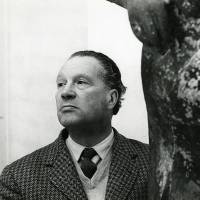
Portrait de Marino Marini par Paolo Monti, 1958 - Fondo Paolo Monti, Civico Archivio Fotogragico of MilanCC BY-SA 4.0
Marino Marini (born 27 February 1901 in Pistoia, Tuscany; died 6 August 1980 in Viareggio) was one of the defining Italian sculptors of the twentieth century. His horses and riders, his Pomonas, jugglers and portrait heads, rooted in Etruscan, Roman and Tuscan sculpture, won him the Grand Prize for Sculpture at the 1952 Venice Biennale and a lasting following in Britain, where he was close to Henry Moore. He was also a painter and a committed printmaker, leaving several hundred etchings, aquatints and original lithographs in which the rider is pared down, decade by decade, to an ever more urgent sign.
Le Coin des Arts currently offers two original prints by Marino Marini: Les jongleurs (1978), an etching and aquatint from his final years, and Chevaux et cavaliers V (1972), a colour lithograph from the Chevaux et cavaliers series printed by Mourlot in Paris. Each sheet has been chosen for the quality of the impression, the edition, its provenance and its condition.
Marini was born in Pistoia with a twin sister, Egle. In 1917 he enrolled at the Accademia di Belle Arti in Florence, studying drawing and painting under Galileo Chini and later sculpture under Domenico Trentacoste; it was in Florence, around 1920, that he pulled his first intaglio prints. He showed at the Venice Biennale for the first time in 1928. In 1929 he moved to Milan at the invitation of Arturo Martini, whom he succeeded as teacher of sculpture at the art school of the Villa Reale in Monza, a post he held until 1940. The following year he travelled to Paris and to London. Recognition in Italy came quickly: third prize at the first Rome Quadriennale in 1931 and first prize for sculpture at the second, in 1935, when his bronze Pugile (Boxer) entered the Galleria d’Arte Moderna in Turin. In 1937 a wooden Boxer earned him the Grand Prix for sculpture at the Paris Exposition internationale.
A visit to Bamberg Cathedral in 1934, and to its medieval stone Bamberg Rider, gave Marini the subject of a lifetime. On 14 December 1938 he married Mercedes Pedrazzini, whom he called ‘Marina’. In 1940 he modelled his first great Pomona, and in 1941 he was appointed to the chair of sculpture at the Accademia di Brera in Milan. After the bombing of Milan destroyed many of his works, he settled in December 1942 at Tenero, near Locarno, in Swiss Ticino. In exile he spent time with Alberto Giacometti, Fritz Wotruba, Germaine Richier and Hermann Haller, exhibited in Basel, Bern and Zürich, and between 1943 and 1945 made his first lithographs, a group of about forty. In spring 1946 he returned to Milan and to teaching at Brera.
His solo room at the 1948 Venice Biennale was the turning point. There he formed a friendship with Henry Moore, which would later be marked by Marini’s portrait of Moore (1962). Marini’s first exhibitions in England came in 1951: a solo show at Erica Brausen’s Hanover Gallery in London and his inclusion in the Open Air Sculpture Exhibition in Battersea Park. In 1952 the Galerie Welz in Salzburg showed him alongside Moore and Wotruba, and in 1958 the Hanover Gallery hung him with Giacometti, Matisse and Moore. The Tate holds his bronze Horseman (1947), a drawing in ink and pastel, Rider (1948), and a Portrait Bust of Christian Faerber; the British Museum collects his prints, among them Pomona (1950), L’Annunciazione (1958), Giocoliere from Idea e spazio (1963), L’idea del cavaliere (1968) and Bunter Reiter I (1975).
The New York dealer Curt Valentin, met in Venice, gave Marini his first American solo exhibition in 1950, and Peggy Guggenheim had a plaster rider cast in bronze as The Angel of the City for her palazzo on the Grand Canal. The Grand Prize for Sculpture at the 1952 Biennale was followed in 1954 by the Feltrinelli Prize of the Accademia dei Lincei. From the mid-1950s the rider rears and falls in the Miracles and Warriors: Rotterdam bought a Large Miracle in 1955 for its memorial to the victims of Nazism, and The Hague unveiled a commissioned monument in 1959. Marini took part in the first three editions of documenta in Kassel (1955, 1959, 1964), had his first exhibition of paintings in Milan in 1963 and his first Italian retrospective at the Palazzo Venezia in Rome in 1966.
Portraits remained central — Stravinsky, Arp, Mies van der Rohe. In 1972 Milan made him an honorary citizen and his gift of works founded the Museo Marino Marini at the Galleria d’Arte Moderna; that year he also designed sets and costumes for Stravinsky’s Rite of Spring at La Scala. In 1974 a cast of the mutilated Pomona of 1940 was installed in the Uffizi. Marini died at Viareggio on 6 August 1980. His widow established the Fondazione Marino Marini in Pistoia in 1983, and the Museo Marino Marini opened in Florence, in the former church of San Pancrazio, on 21 October 1988.
According to the British Museum, Marini’s printed œuvre comprises 236 etchings and aquatints, 163 lithographs and three screenprints. After his early Florentine intaglio plates he turned to lithography in Switzerland, then returned to etching in 1946 with The Hanged Man, an image of wartime violence. By the 1970s his lithographs had become compositions of broad flat colour, often on gold, silver or black grounds. The Chevaux et cavaliers lithographs of 1972 were printed by Mourlot in Paris and published by XXe Siècle with Leon Amiel, New York. Of particular interest to British collectors are the late colour portfolios Marino from Shakespeare (1977-1978), etchings with aquatint and drypoint on Arches published in London by ZWR.
The standard reference is Giorgio and Guido Guastalla, Marino Marini. Catalogo ragionato dell’opera grafica (incisioni e litografie) 1919-1980 (Graphis Arte, Livorno, 1990), with a preface by Mario De Micheli; an English edition, Catalogue Raisonné of the Graphic Works, followed in 1993. Lithographs carry an ‘L’ prefix: ‘Guastalla L105’ identifies lithograph no. 105.
Catalogue raisonné. Ask for the Guastalla number. It confirms the technique, date, publisher and edition size.
Edition and numbering. Editions are usually small: 50 for the Chevaux et cavaliers lithographs, 75 for Marino from Shakespeare I, plus artist’s proofs and impressions numbered in Roman numerals. See the printing.
Signature. Marini signed in pencil with his first name, ‘MARINO’, in capitals, usually lower right. A signature in the plate is no substitute. See the signature.
Paper and condition. Late editions are on large sheets with full margins; the flat colour fields and black grounds scuff easily, so check for rubbing, light-staining and old hinges, and choose conservation framing.
Pitfalls. Exhibition posters, reproductions and plates from books or magazines are not original prints. Our guarantees are set out on our authenticity page; see also what is an original print.
We select Marini’s prints alongside those of the sculptors whose paths crossed his: Henry Moore, Alberto Giacometti, Fritz Wotruba, Jean Arp and Henri Matisse. Explore modern art and our engravings and lithographs.
Giorgio and Guido Guastalla, Marino Marini. Catalogo ragionato dell’opera grafica (incisioni e litografie) 1919-1980, Graphis Arte, Livorno, 1990 · Martin Hopkinson, Italian Prints 1875-1975, British Museum · British Museum – Marino Marini · Tate – Marino Marini · Fondazione Marino Marini – Biography · documenta – II. documenta

Secure payment
3DSecure 2.2

Free DHL Express delivery from €1,200
Carefully prepared parcel
Parcel tracking

Shipment insured
for the value of the artwork, covering theft and damages

Fairest prices
Certificate of authenticity
Two galleries in Paris
Receive an email as soon as a new artwork is added for this artist
Your message has been sent ! We will get back to you as soon as possible.
Please fill in the form if you need further information such
Please fill in your email address, an email will be sent with a link to update your password.
You can now place orders and track your orders.
To save your wishlist, you can log in or create an account :
This is a 100% custom-made frame, carefully crafted by a professional framer. Finishes are available in light oak, white wood or black wood, with or without mat board and plexiglass. Delivery times may vary depending on the order, with an average lead time of 10 days.
This option will be offered during the cart step.