
(1881-1955)

LEGER Fernand
The Camper, 1954
Wood engraving LCD7870
4 800.00€

LEGER Fernand
Nature morte aux fruits, 1948
Lithograph LCD7534
3 500.00€

LEGER Fernand
Composition with dominos, 1947
Stencil LCD6524
4 500.00€

LEGER Fernand
Nature morte, 1951
Lithograph LCD6162
1 900.00€

LEGER Fernand
Chevreuse
Silkscreen LCD5921
2 800.00€

LEGER Fernand
The Red Bird in the Wood, 1953
Aquatint LCD5640
3 500.00€

LEGER Fernand
Untitled, 1951
Silkscreen LCD3429
2 800.00€

Fernand LEGER
The Well, 1951
Sold

Fernand LEGER
Composition on a yellow background, 1954
Sold
Looking for a similar artwork?
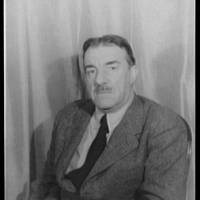
Portrait de Fernand Léger par Carl Van Vechten, 1936 - Domaine public via Library of Congress
Fernand Léger was born in Argentan, Normandy, on 4 February 1881 and died at Gif-sur-Yvette, south-west of Paris, on 17 August 1955. One of the great figures of Cubism and of modern art between the wars, he brought machines, cities, manufactured objects and working people into painting, in flat, unmixed colour held in place by bold black outlines. Tate describes him as a forerunner of Pop Art. Alongside his paintings, films, murals, stained glass and ceramics, he left a substantial body of original lithographs and illustrated books, and a number of prints made after his gouaches. He is also one of the modern masters whose market is most crowded with posthumous editions, so every sheet deserves a careful look.
At Le Coin des Arts we currently hold several Léger prints, each chosen for the quality of the impression, the edition, provenance and condition: the colour lithograph Nature morte aux fruits (1948), a second lithographed Nature morte (1951), the stencil-coloured Composition aux dominos (1947), the aquatint L’Oiseau rouge dans le bois (1953), the screenprint Chevreuse and a woodcut, Le Campeur. Each catalogue entry states plainly whether the sheet is an original print, a signed interpretive print or a posthumous edition.
The son of a Norman cattle breeder, Léger was first apprenticed to an architect, in Argentan and then in Caen. He moved to Paris around 1900, worked as an architectural draughtsman, and attended the École des Arts décoratifs and the Académie Julian. Tate notes that his first surviving paintings and drawings date from 1905 and that his Norman roots remained important to him. He first showed at the Salon d’Automne in 1907. At La Ruche, the artists’ colony in Montparnasse, his neighbours included Robert Delaunay, Marc Chagall, Archipenko, Soutine and the poet Blaise Cendrars. Around 1910–11 he joined the Cubists of the Section d’Or circle; the critic Louis Vauxcelles nicknamed his cylindrical idiom “Tubism”. Between 1912 and 1914 he painted some forty Contrasts of Forms, and in 1913 he signed a contract with Daniel-Henry Kahnweiler.
Called up on 2 August 1914, Léger served on the front as a sapper and then a stretcher-bearer, drawing Soldiers Playing Cards near Verdun in 1916. He was hospitalised in 1917 and discharged, then signed with Léonce Rosenberg’s Galerie de l’Effort Moderne. Contact with soldiers and with the hardware of war led to his “mechanical period”: The City (1919) and Discs in the City. He illustrated Cendrars, designed sets for Marcel L’Herbier’s L’Inhumaine and, in 1924, co-directed the film Ballet mécanique with Dudley Murphy, with music by George Antheil and photography involving Man Ray. He contributed to the review L’Esprit Nouveau and worked with Le Corbusier and Charlotte Perriand. In 1928 Tériade wrote the first monograph on him.
British audiences met Léger’s work in depth at the Tate Gallery, which held a Léger exhibition from 17 February to 19 March 1950, while the artist was still at the height of his post-war output. The Tate collection now includes The Acrobat and his Partner (1948) and Two Women Holding Flowers (1954), two late paintings that sum up his return to the human figure. Among the many students he taught over the years was the British constructivist Marlow Moss. More recently, Tate Liverpool staged Fernand Léger: New Times, New Pleasures (23 November 2018 – 17 March 2019), billed as the first major UK exhibition of his work in thirty years, with more than forty paintings, murals, textiles and the film Ballet mécanique.
Léger first crossed the Atlantic in 1931; the Museum of Modern Art in New York gave him a retrospective in 1935. In 1937 he painted panels for the CGT trade union at the Paris International Exhibition. From 1940 to late 1945 he lived in exile in the United States, painting his Divers and Cyclists and teaching at Mills College in California. He joined the French Communist Party in 1945 and returned to Paris, where he reopened his teaching studio. The post-war years brought large public commissions: the façade of the church at Assy, the windows of the Sacré-Cœur at Audincourt, work for the university of Caracas and for the United Nations in New York. He painted The Constructors (1950) and La Grande Parade, and from about 1949 made polychrome ceramics at Biot with the Brice workshop. After his death in 1955, his widow Nadia Léger and his assistant Georges Bauquier opened the Musée national Fernand Léger at Biot in 1960.
His earliest printed work accompanies Cendrars’s texts, notably La Fin du monde filmée par l’ange N.-D. (1919), with stencil-coloured illustrations. The core of his graphic work, however, dates from after 1945 and is almost entirely in lithography, printed at the Mourlot workshop in Paris. In 1949 he made lithographs for Rimbaud’s Les Illuminations, published in Lausanne by Louis Grosclaude (Éditions des Gaules). In 1950 Tériade published Cirque: 83 lithographs, 34 of them in colour, printed by Mourlot (MoMA gives the edition as 300; the Stedelijk Museum gives 280). Galerie Louise Leiris issued his colour lithographs, such as Nature morte aux fruits (1948, edition of 75).
Léger also authorised and signed interpretive prints made by craftsmen from his gouaches: stencil prints published by Guy Spitzer (Composition aux dominos, 1947, 300 impressions), aquatints from the Lacourière workshop (L’Oiseau rouge dans le bois, 1953, 125 impressions), Maeght lithographs such as La Partie de campagne, and screenprints (Chevreuse, after a drawing dated August 1951). The standard catalogue raisonné is Lawrence Saphire, Fernand Léger: The Complete Graphic Work (New York, Blue Moon Press, 1978). Original prints carry a plain number (“Saphire 18” for Nature morte aux fruits); prints after his works sit in a separate section prefixed “E” (“Saphire E19” for L’Oiseau rouge dans le bois, “Saphire E8” for Chevreuse).
Lifetime or posthumous? This is the first question to ask. Anything printed after August 1955 is posthumous. The best-known case is La Ville: 29 lithographs begun in 1954, completed by Nadia Léger, Fernand Mourlot and Tériade, and published in 1959 with a stamped signature in an edition of 180. Many further lithographs and screenprints were issued after his death from his gouaches and drawings.
Signature. A pencil or ink signature in Léger’s hand is quite different from a signature printed in the image or a stamp. See our notes on the signature.
Edition. Signed editions generally run from 75 to 300 impressions; check the number against Saphire (the printing).
The “E” question. A signed interpretive print is genuine, but it is not an original lithograph and is priced accordingly.
Book plates. Sheets from Cirque or Les Illuminations are true lithographs but unsigned in pencil; they should be sold as book plates.
Reproductions. “After Léger” sheets, offset prints and exhibition posters are not original prints (what is an original print?).
Condition. Léger’s reds, yellows and blues fade in daylight; look for full margins, no mount burn or foxing, and use UV-filtering glazing (framing). Our guarantees are set out under authenticity.
We select Léger prints whose status is clearly documented. Continue with Pablo Picasso, Georges Braque, Robert Delaunay, Le Corbusier and Marc Chagall, or explore modern art and our illustrated books.
Lawrence Saphire, Fernand Léger: The Complete Graphic Work, Blue Moon Press, New York, 1978 · Tate – Fernand Léger, 1950 · Tate Liverpool – New Times, New Pleasures · Tate – Five things to know about Fernand Léger · Musée national Fernand Léger, Biot · Centre Pompidou – Fernand Léger · Stedelijk Museum – Cirque

Secure payment
3DSecure 2.2

Free DHL Express delivery from €1,200
Carefully prepared parcel
Parcel tracking

Shipment insured
for the value of the artwork, covering theft and damages

Fairest prices
Certificate of authenticity
Two galleries in Paris
Receive an email as soon as a new artwork is added for this artist
Your message has been sent ! We will get back to you as soon as possible.
Please fill in the form if you need further information such
Please fill in your email address, an email will be sent with a link to update your password.
You can now place orders and track your orders.
To save your wishlist, you can log in or create an account :
This is a 100% custom-made frame, carefully crafted by a professional framer. Finishes are available in light oak, white wood or black wood, with or without mat board and plexiglass. Delivery times may vary depending on the order, with an average lead time of 10 days.
This option will be offered during the cart step.



