
(1908-1994)
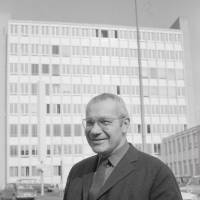
Fotograf: Vogt, Marcel, CC BY-SA 4.0, via Wikimedia Commons
Max Bill (born 22 December 1908, Winterthur; died 9 December 1994, Berlin) was the leading Swiss exponent of Concrete art: a Bauhaus-trained painter, sculptor, architect, typographer, product designer and theorist who believed a work of art should be built from rules decided in advance rather than from inspiration. Co-founder and first rector of the Ulm School of Design, he applied the same logic to a stool, a clock, a building or a print. His screenprints and lithographs – progressions of colour, rotated squares, variations on a single figure – are among the most accessible ways to own his work.
Le Coin des Arts currently offers several original screenprints by Max Bill: two untitled sheets of 1972, Carré (‘Square’, 1970) and a further untitled print of 1970. Each has been chosen for crisp, even colour fields, clean margins, edition details and overall condition – in Bill’s case a single faded tone is enough to upset the balance of the design.
Bill trained as a silversmith at the Kunstgewerbeschule in Zurich from 1924 to 1927. In 1925 he won first prize in a poster competition for the jubilee of the chocolate maker Suchard; expelled from the school before completing his apprenticeship, he used the prize money to enrol at the Bauhaus in Dessau in April 1927. There he was taught by Josef Albers, Wassily Kandinsky, Paul Klee, László Moholy-Nagy and Oskar Schlemmer. Back in Switzerland he settled in Zurich in 1929, working first and foremost as a graphic designer. In 1931 he married the cellist and photographer Binia Spoerri, and in 1932–33 he built his own house and studio in Zurich-Höngg, his first realised building.
In Paris Bill met Hans Arp and Piet Mondrian and joined Abstraction-Création, first exhibiting with the group in 1933 – a circle that also counted the British artists Barbara Hepworth and Ben Nicholson among its members. He met Georges Vantongerloo, made his first sculptures and in 1935 produced his first Endless Ribbon, a looping form related to the Möbius strip that he would revisit for the rest of his life. He designed the Swiss pavilion at the 1936 Milan Triennale, helped found the Swiss modernist association Allianz in 1937, and in 1944 organised the international exhibition Konkrete Kunst at the Kunsthalle Basel. His 1949 essay on ‘the mathematical approach in contemporary art’ became a key text of the movement.
In 1951 Bill showed at the Museu de Arte de São Paulo and won the grand prize for sculpture at the first São Paulo Biennial with Tripartite Unity, a decisive moment for Brazilian Concrete art. At the same time he co-founded the Hochschule für Gestaltung in Ulm, designed its buildings and served as its first rector; with Hans Gugelot he created the Ulm stool (1954), and later clocks and watches for Junghans. In 1952 he entered the international competition for a Monument to the Unknown Political Prisoner, organised from London. He took part in the first three editions of documenta in Kassel (1955, 1959, 1964). After disagreements with the younger staff at Ulm he gave up the rectorship in 1956 and reopened his Zurich studio the following year.
British readers first met Bill through Margit Staber’s monograph Max Bill, published in London by Methuen in 1964. His first solo exhibition in the United Kingdom, Max Bill: Paintings & Sculpture, opened at the Hanover Gallery, run by Erica Brausen, on 2 November 1966, with a catalogue essay by Max Bense. The Tate holds his oil painting Accents from six zones (1955), and Amgueddfa Cymru – Museum Wales owns his screenprint for the Munich Olympic Games, given in 1972 by the Organising Committee. In 2011 Annely Juda Fine Art mounted Max Bill: Five Decades, some sixty works from the 1930s to the 1980s, presented by the gallery as his first London solo show in nearly thirty years.
Bill sat on Zurich’s municipal council from 1961 and in the Swiss National Council from 1967 to 1971, and was the architect of a section of the Lausanne national exhibition, Expo 64. From 1967 to 1974 he held the chair of environmental design at the Hochschule für bildende Künste in Hamburg. Retrospectives followed at the Kunsthaus Zürich (1968–69) and, in 1974, across the United States, starting at the Albright-Knox Art Gallery in Buffalo. His large public works include the Pavillon-Skulptur on Zurich’s Bahnhofstrasse (1983) and Continuity, a five-metre granite band in front of Deutsche Bank in Frankfurt (1986). Awarded the Praemium Imperiale for sculpture in 1993, he married the art historian Angela Thomas in 1991 and died of a heart attack at Berlin-Tegel airport on 9 December 1994, returning from a presentation of his extension design for the Bauhaus-Archiv.
Printmaking runs through Bill’s career. In 1938 the Paris publisher Éditions des Chroniques du Jour issued Quinze variations sur un même thème, a portfolio of sixteen sheets in lithography in an edition of 120, in which a spiral generates, step by step, triangle, square, pentagon and octagon. In 1942 he contributed a linocut to the Zurich anthology 10 Origin (Allianz-Verlag, edition of 100), alongside Arp, Kandinsky and Magnelli. From the 1960s screenprinting, with its flat, saturated colour and hard edges, became his medium of choice: sheets published by Domberger in Stuttgart, by the Erker-Presse in St Gallen and by San Lazzaro’s XXe Siècle in Paris, and the 1976 portfolio Vier Zürcher Konstruktionen shared with Camille Graeser, Verena Loewensberg and Richard Paul Lohse.
Two catalogues matter to collectors. Max Bill. Das druckgrafische Werk bis 1968, edited by Herbert Bessel for the Albrecht-Dürer-Gesellschaft and the Kunsthalle Nürnberg exhibition of 1968–69, covers the prints up to 1968 only. Max Bill. Die grafischen Reihen (Hatje, 1995, foreword by Angela Thomas Bill) presents his graphic work with the artist’s own commentary. Where no reliable number exists, a precise description – date, size, edition, publisher – is the best reference.
Edition. Signed screenprints are normally numbered in pencil, in Arabic or Roman numerals; artist’s proofs also exist. See our notes on the printing.
Signature. Original sheets are signed and usually dated in pencil, lower right, sometimes with a dedication. A signature printed in the image points to a poster. See the signature.
Posters versus prints. Bill designed a great many exhibition posters, often themselves screenprinted. For Munich 1972, Edition Olympia issued a signed and numbered edition of 200 alongside posters with a printed signature and cheap reproductions; only the first counts as an original print.
Publisher’s marks. An Erker-Presse blindstamp or a Domberger or XXe Siècle imprint helps identification. A plate taken from a calendar or a book should be described as such.
Condition. Large areas of pure colour show every scuff, crease and trace of light damage. Check the evenness of the colour and the margins for foxing, and choose framing with UV-filtering glazing. Our guarantees are set out on the authenticity page.
The gallery selects Bill’s screenprints for quality of printing and condition. Explore them alongside Josef Albers, Hans Arp, Gottfried Honegger, Auguste Herbin and Victor Vasarely, or browse modern art and our engravings and lithographs.
Margit Staber, Max Bill, Methuen, London, 1964 · Herbert Bessel (ed.), Max Bill. Das druckgrafische Werk bis 1968, Albrecht-Dürer-Gesellschaft, Nuremberg, 1968 · Max Bill. Die grafischen Reihen, Hatje, Stuttgart, 1995 · Tate – Max Bill · Annely Juda Fine Art – Max Bill: Five Decades (2011) · Bauhaus Kooperation – Max Bill · Praemium Imperiale – Max Bill

Secure payment
3DSecure 2.2

Free DHL Express delivery from €1,200
Carefully prepared parcel
Parcel tracking

Shipment insured
for the value of the artwork, covering theft and damages

Fairest prices
Certificate of authenticity
Two galleries in Paris
Receive an email as soon as a new artwork is added for this artist
Your message has been sent ! We will get back to you as soon as possible.
Please fill in the form if you need further information such
Please fill in your email address, an email will be sent with a link to update your password.
You can now place orders and track your orders.
To save your wishlist, you can log in or create an account :
This is a 100% custom-made frame, carefully crafted by a professional framer. Finishes are available in light oak, white wood or black wood, with or without mat board and plexiglass. Delivery times may vary depending on the order, with an average lead time of 10 days.
This option will be offered during the cart step.


