
(1886-1966)

ARP Hans
Soleil recerclé, 1966
Wood engraving LCD5741
2 500.00€


ARP Hans
Symmetrical Shape with Flakes Arranged by Chance, 1955
Lithograph LCD7441
2 400.00€


ARP Hans
Documenta Geigy Das Unbehagen in der Kunst (Planche VII), 1965
Wood engraving LCD7032
2 400.00€
6


ARP Hans
Untitled
Wood engraving LCD4448
2 400.00€

ARP Hans
Re-circled sun, 1966
Wood engraving LCD4090
2 400.00€


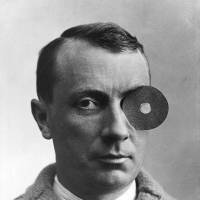
Unknown author, Public domain, via Wikimedia Commons
Hans Arp, also known as Jean Arp (1886-1966), ranks among the founding figures of modern art. Poet, sculptor, painter and printmaker, he helped launch Dada in Zurich, exhibited alongside the Surrealists and went on to become one of the leading voices of abstraction. His vocabulary of soft, rounded, organic shapes – drawn from chance and from nature – reshaped twentieth-century sculpture. An Alsatian by birth, he used “Hans” when writing in German and “Jean” when writing in French, a dual identity that runs through his entire œuvre.
Le Coin des Arts, our gallery in Paris, offers a selection of original prints by Jean Arp, chiefly woodcuts and lithographs, each chosen for the quality of the impression, its provenance and its condition.
Arp was born in Strasbourg on 16 September 1886, when the city belonged to the German Empire. He trained at the school of decorative arts in Strasbourg, then at the art school in Weimar, before enrolling at the Académie Julian in Paris – whose academic teaching he found disappointing. After his family moved to Weggis in Switzerland, he co-founded the Moderner Bund in 1911, met Paul Klee and, in 1912, showed with the Blaue Reiter in Munich alongside Kandinsky. That same year he cut his very first print: a self-portrait woodcut, still Expressionist in feeling.
Having taken refuge in neutral Zurich during the First World War, Arp joined Hugo Ball, Tristan Tzara, Marcel Janco and Richard Huelsenbeck at the Cabaret Voltaire in 1916 – the moment Dada was born. There he made his first collages arranged “according to the laws of chance”, painted reliefs in cut wood, and a large number of woodcuts for Dada reviews and publications, among them the illustrations for Tzara’s Vingt-cinq poèmes (1918).
In Zurich he also met the artist Sophie Taeuber, whom he married in 1922 and with whom he produced works “for four hands”. In 1919-1920 he led the Cologne Dada group with Max Ernst, and in 1925 he took part in the first Surrealist exhibition, held at the Galerie Pierre in Paris.
Between 1926 and 1928 Arp, Sophie Taeuber and Theo van Doesburg redesigned the interior of the Aubette in Strasbourg, a landmark of abstract art. The couple then settled in Clamart, near Meudon, in a house and studio designed by Sophie Taeuber. Arp joined Cercle et Carré and then Abstraction-Création, founded in 1931 with, among others, Auguste Herbin.
From 1930 onwards he produced his “torn papers” and turned to sculpture in the round – plaster, marble, then bronze. His Human Concretions, smooth forms poised between body, plant and stone, made him one of the most influential sculptors of the century. British artists took notice early: in 1933 Barbara Hepworth and Ben Nicholson visited his studio on their trip to France. A drawing by Arp belonged to one of the albums offered for sale at the International Surrealist Exhibition at the New Burlington Galleries, London, in 1936; Roland Penrose bought it, and it is now in the National Galleries of Scotland. In 1938 Peggy Guggenheim also included his work in a group show at her London gallery. It was Arp, incidentally, who coined the word “stabiles” for the static sculptures of his friend Alexander Calder.
During the Second World War he sheltered in Grasse with Sophie Taeuber, Alberto Magnelli and Sonia Delaunay, then in Switzerland. Sophie Taeuber died in an accident in Zurich on 13 January 1943; deeply shaken, Arp did not fully resume work until his return to Meudon in 1946.
The post-war decades brought recognition: an exhibition at Peggy Guggenheim’s New York gallery in 1944, the Constellation for the Harvard Graduate Center in 1949 and the relief for the UNESCO headquarters in Paris in 1958. He won the International Grand Prize for Sculpture at the Venice Biennale in 1954 and was honoured with major retrospectives at the Museum of Modern Art, New York (1958) and the Musée National d’Art Moderne, Paris (1962). He was made a Chevalier of the Légion d’honneur in 1960 and received the Grand Prix National des Arts in 1963.
After marrying Marguerite Hagenbach in 1959, he divided his last years between Meudon and Locarno in Switzerland. He died in Basel on 7 June 1966. His house and studio in Clamart is now home to the Fondation Arp, while the Arp Museum Bahnhof Rolandseck in Germany is devoted to his work and that of Sophie Taeuber-Arp. In the UK, Tate holds several of his works, including Constellation According to the Laws of Chance (c.1930) and the Torn-Up Woodcut (1920-54).
Printmaking ran through Arp’s whole career, from 1912 until his death. He never regarded a print as a reproduction but as a natural extension of his collages and reliefs: the same cut-out, floating, balanced forms travel from paper to woodblock and lithographic stone.
The woodcut was his first medium: in the Dada years his black-and-white blocks illustrated reviews and collections of poetry. He returned to it throughout his life, and some compositions were cut in colour by the printmaker Karl Schmid. After the war, lithography gave him flat areas of pure colour – black, blue, red, ochre – in which his organic shapes seem to drift across the sheet. He also worked in intaglio, and the engraver Jean Signovert translated several of his collages into etching and engraving.
Arp’s printed work is catalogued by Wilhelm F. Arntz in Hans (Jean) Arp. Das graphische Werk 1912-1966 (1980). The catalogue lists 426 entries and separates original prints from reproductive prints made after his works. Each print carries a number, usually quoted as “Arntz no.”: this is the first reference any collector should check.
Poet as much as artist, Arp illustrated many books – his own and those of friends such as Tristan Tzara, Richard Huelsenbeck and Benjamin Péret. Among the most sought-after are Le Siège de l’air (1946), with drawings made jointly by Arp and Sophie Taeuber, Le Voilier dans la forêt (Louis Broder, 1957) and Soleil recerclé (1966), illustrated with woodcuts.
Arp holds a unique place in the history of art: a key figure of Dada, Surrealism and abstraction, he influenced generations of sculptors and painters and remains central to modern art. His prints, far more affordable than his sculptures, offer a way to own an original work by one of modernism’s founders.
When assessing an Arp lithograph or woodcut, look carefully at the technique, the print run and its justification (numbered impression, artist’s proof or hors commerce), whether it is pencil-signed, the Arntz catalogue number, whether the sheet is an original print or a reproductive one, whether it comes from a book or a portfolio, and finally its provenance and condition. With Arp, large flat areas of colour and generous white margins show up the slightest mark, so the condition of the paper is decisive.
Original print or reproduction? Arp’s forms have been widely reproduced. An original print is an engraving or lithograph conceived by the artist to be printed, issued in a limited run, usually signed and numbered by hand on good-quality paper, and recorded in the catalogue raisonné. A plate taken from an illustrated book can be original without being signed: only the book’s justification of the edition confirms it.
Le Coin des Arts selects its original prints by Jean Arp with close attention to authenticity, provenance and condition, and advises collectors on choosing a work, on framing and on conservation. You may also enjoy the work of his fellow travellers represented by the gallery, including Max Ernst, Man Ray, Joan Miró and Sonia Delaunay.
Fondation Arp, Clamart · Arp Museum Bahnhof Rolandseck, Remagen · Tate, Jean Arp · Wilhelm F. Arntz, Hans (Jean) Arp. Das graphische Werk 1912-1966, Gertrud Arntz-Winter, 1980 · Eduard Trier, Hans Arp. Skulpturen 1957-1966, Gerd Hatje, 1968.

Secure payment
3DSecure 2.2

Free DHL Express delivery from €1,200
Carefully prepared parcel
Parcel tracking

Shipment insured
for the value of the artwork, covering theft and damages

Fairest prices
Certificate of authenticity
Two galleries in Paris
Receive an email as soon as a new artwork is added for this artist
Your message has been sent ! We will get back to you as soon as possible.
Please fill in the form if you need further information such
Please fill in your email address, an email will be sent with a link to update your password.
You can now place orders and track your orders.
To save your wishlist, you can log in or create an account :
This is a 100% custom-made frame, carefully crafted by a professional framer. Finishes are available in light oak, white wood or black wood, with or without mat board and plexiglass. Delivery times may vary depending on the order, with an average lead time of 10 days.
This option will be offered during the cart step.

