(1928)
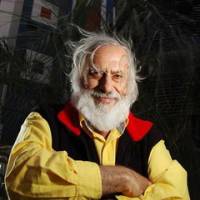
Portrait de Yaacov Agam par Edward Kaprov, 2010 - CC BY-SA 3.0
Yaacov Agam (born Yaacov Gibstein in Rishon LeZion, then Mandatory Palestine, in 1928; died 21 June 2026, aged 98) was one of the founding figures of kinetic art and Op Art. Based in Paris from 1951, he built pictures that cannot be seen whole from any single point: walk past them and the composition changes. He exhibited in the landmark 1955 show Le Mouvement at Galerie Denise René, designed a complete room for President Pompidou at the Élysée Palace and the great fountain at La Défense, and was awarded the Israel Prize in 2026. His screenprints and lenticular Agamographs brought that moving image into the editioned print.
Le Coin des Arts follows Yaacov Agam’s work closely and offers his original prints as they become available, chosen, like everything we handle, for quality of impression, edition, provenance and condition. To be notified when a new work arrives, simply ‘follow the artist’ on this page.
The son of the rabbi and kabbalist Yehoshua Gibstein, Agam studied from 1946 to 1949 at the Bezalel Academy in Jerusalem under Mordecai Ardon, himself a former Bauhaus student. In 1949 he moved to Zürich to work with Johannes Itten, who had taught the Bauhaus preliminary course, and there encountered the Swiss concrete art of Max Bill. From these teachers he took a view of colour and form as a system governed by rules, a system he would soon set in motion.
Settling in Paris in 1951, Agam spent time in Jean Dewasne’s studio, a centre of geometric abstraction. His first solo exhibition, at the Galerie Craven from 30 October to 12 November 1953, introduced two inventions: transformable pictures, whose elements the viewer could rearrange, and ‘polymorphic’ paintings built from triangular slats painted on each face, revealing different images as one moves. In April 1955 he joined Victor Vasarely, Jesús Rafael Soto, Jean Tinguely, Pol Bury, Alexander Calder, Marcel Duchamp and Robert Jacobsen in Le Mouvement at Denise René, the exhibition now regarded as the birth certificate of kinetic art.
Britain saw Agam’s work early. In April 1959 Halima Nałęcz’s Drian Galleries in London staged Transformable Painting | Painting in Movement. The gallery’s records, now in the Tate Archive, preserve the press release, private view card and catalogue leaflet, a Tel Aviv Museum catalogue of 1958–59, letters from the artist, and photographs of the opening showing Agam beside the painter Victor Pasmore, a leading figure of British constructivism, with Denise René in attendance. International honours followed: a prize for artistic research at the São Paulo Biennial in 1963, documenta III in Kassel in 1964, and The Responsive Eye at the Museum of Modern Art, New York, in 1965.
In 1971 Georges Pompidou commissioned Agam to transform the antechamber of the private apartments at the Élysée Palace. Built between 1972 and 1974, the Salon Agam combined painted aluminium walls, a lit glass ceiling, sliding Transacryl panels, a polished steel sculpture and a carpet woven by the Gobelins. Unfinished when Pompidou died, dismantled under his successor, it is now installed at the Centre Pompidou, which also gave Agam a retrospective at the Musée national d’art moderne in 1972. At La Défense, his Fontaine monumentale, designed in 1975 and inaugurated in 1977, sets 66 jets in a basin faced with Venetian enamels; Tel Aviv’s Fire and Water Fountain in Dizengoff Square followed in 1986. In 1996 UNESCO awarded him the Jan Amos Comenius Medal for his method of visual education, and in November 2017 the Yaacov Agam Museum of Art, designed by the architect David Nofar, opened in his home town; twenty-nine coloured pillars there are dedicated to his first wife, Clila.
In the 1980s Agam turned to holography and computer-generated imagery, still pursuing the same question: how an image can unfold in time as well as space. The Centre Pompidou returned to his ideas with the workshop-exhibition Agam. Images vivantes, shown from 26 September 2020 to 16 August 2021. Early in 2026 he received the Israel Prize for the visual arts. He died on 21 June 2026, and his coffin lay in state at the museum in Rishon LeZion before the funeral. He is survived by three children, among them the New York-based artist Ron Agam.
Screenprinting suited Agam perfectly: flat, saturated colour and razor-sharp edges for his bands, grids and gradations. Museum examples include Coordination II (1975) at MoMA, from an edition of 153, the portfolio Message de paix (1980) at the Metropolitan Museum, and Suite 3 (1974), numbered from an edition of 140. A notable British-published project is his Haggadah of 1985, issued in London by Capepark Ltd: 58 screenprints pulled by hand at the Atelier Arcay in Paris, the colour separations made by the artist himself, in an edition of 584 copies. The Agamograph carries his polymorphic paintings into print: an image printed in interlaced strips beneath a lenticular screen, which shifts as the viewer moves. Screenprints on Perspex or on folded and relief supports belong to the category of multiples. There is no published catalogue raisonné of Agam’s prints, so each sheet is identified by title, date, suite, publisher and numbering. See our guide to what makes an original print.
Edition size. Agam’s editions are often large, typically 99 to over 150 impressions plus artist’s proofs and hors commerce copies. Check that the number tallies with the publisher’s stated edition; see the printing.
Signature. Original impressions are signed ‘Agam’ in pencil. A signature printed in the image is not a hand signature, and since his death in June 2026 no further sheets can be signed.
Condition of Agamographs. Look for a well-bonded lens free of scratches, yellowing or lifting; the original frame is often integral to the work.
Provenance. His screenprints circulated in very large numbers, particularly in the United States from the 1970s. Ask for a gallery invoice, a publisher’s certificate or documented ownership history.
What is not a print. Offset exhibition posters, reproductions and decorative lenticular cards are not original prints. Our authenticity guarantee and bespoke framing are explained on dedicated pages.
The gallery offers prints by Agam’s fellow pioneers of geometric and kinetic art: Victor Vasarely, Jesús Rafael Soto, Josef Albers, Max Bill and Auguste Herbin. Explore the Kinetic Art and Op Art movement or browse our engravings and lithographs.
Frank Popper, Agam, Harry N. Abrams, New York, revised edition 1980 · Tate Archive – Drian Galleries records, Agam file · Tate Archive – Victor Pasmore and Yaacov Agam, 1959 · Shapero Rare Books – Agam Haggadah, 1985 · Centre Pompidou – Salon Agam · Museum Tinguely – Le Mouvement · MoMA – Coordination II

Secure payment
3DSecure 2.2

Free DHL Express delivery from €1,200
Carefully prepared parcel
Parcel tracking

Shipment insured
for the value of the artwork, covering theft and damages

Fairest prices
Certificate of authenticity
Two galleries in Paris
Receive an email as soon as a new artwork is added for this artist
Your message has been sent ! We will get back to you as soon as possible.
Please fill in the form if you need further information such
Please fill in your email address, an email will be sent with a link to update your password.
You can now place orders and track your orders.
To save your wishlist, you can log in or create an account :
This is a 100% custom-made frame, carefully crafted by a professional framer. Finishes are available in light oak, white wood or black wood, with or without mat board and plexiglass. Delivery times may vary depending on the order, with an average lead time of 10 days.
This option will be offered during the cart step.