
(1907-2000)

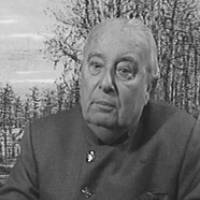
Pantalaskas, CC BY-SA 3.0, via Wikimedia Commons
Jean Carzou (born Karnik Zouloumian in Aleppo on 1 January 1907; died in the Dordogne on 12 August 2000) was a French painter of Armenian descent and one of the best-known figurative artists of post-war Paris. Trained as an architect, he built pictures out of a mesh of fine, needle-sharp lines: lace-like cities, harbours, cathedrals and machines, peopled by slender women and steeped in a single dominant colour. Stage designer, illustrator of fine press books and, from 1977, member of the Académie des Beaux-Arts, he was also a prolific lithographer and etcher whose original prints are recorded in a dedicated catalogue raisonné.
Le Coin des Arts follows Carzou’s printed work closely and offers his original lithographs and etchings when good impressions become available, chosen for printing quality, edition, provenance and condition. At present the gallery holds a single piece: the poster for his 1973 exhibition at Galerie Tamenaga in Paris. To be clear, this is a poster – a period document printed in quantity – not a signed and numbered original print. Use the ‘follow the artist’ button to be told when a lithograph arrives.
Karnik Zouloumian lost his father as a boy and moved with his mother and sister to Egypt, where he attended the French lycée in Cairo. In 1924 a grant from the Armenian community took him to Paris to study at the École Spéciale d’Architecture. He qualified at the end of the decade but chose painting instead, dropping in at the Académie de la Grande Chaumière while remaining largely self-taught. His professional name was coined from the first syllables of his given name and surname – Car-Zou – with ‘Jean’ added for Parisian ears. He earned his living from textile designs and political cartoons, one of which, published in Aux Écoutes in December 1933, showed Hitler as a German Father Christmas. After a spell of experiment – collage, geometric abstraction, brushes with Surrealism – he married Jeanne Gabrielle Blanc, known as Nane, in 1936; their son Jean-Marie, later a television director, was born in 1938. His first solo show opened in 1939 at the Galerie Contemporaine on the rue de Seine.
Carzou’s mature manner emerged after the Liberation. From 1946 he showed with the Galerie Drouant-David; in 1949 he won the first of three Hallmark Prizes, and the French State bought La Baie des songes, now in the Musée National d’Art Moderne. His exhibition devoted to Venice (1953) was a popular triumph, and in 1955 the magazine Connaissance des Arts placed him among the ten leading painters of the post-war generation. Britain met his work early: the London dealers Arthur Tooth & Sons gave him his first London exhibition of paintings and drawings from 1 to 26 June 1954. In 1957 the Galerie David et Garnier unveiled L’Apocalypse, a cycle three years in the making, haunted by war and catastrophe, and in 1958 he took the Grand Prix ‘Europe’ at the first Bruges Biennale.
A wider public discovered him in 1952 through his sets and costumes for Rameau’s Les Indes galantes at the Paris Opéra. There followed Le Loup for Roland Petit’s company (1953), Giselle (1954) and Athalie at the Comédie-Française (1955), then, after a long pause, Offenbach’s La Périchole (1969). He designed the 1954 Château Mouton Rothschild label, tapestry cartoons for the Gobelins manufactory and panels for the liner France. In the 1960s and 1970s he was one of the most sought-after illustrators of French fine press editions, from Hemingway’s L’Adieu aux armes (1964) and Camus’s Carnets (1965) to Rimbaud’s Les Illuminations (1969). English literature had its place too: Carzou illustrated Shakespeare, notably La Nuit des rois (Twelfth Night, 1974), and made lithographs for Hamlet. Exhibitions followed in Geneva (1966), Cologne (1969) and, in February–March 1973, at Galerie Tamenaga in Paris, which showed him again in 1984–85 and 1994.
In December 1977 Carzou was elected to the Académie des Beaux-Arts, to the seat of the painter Jean Bouchaud. His reception address on 4 April 1979 caused a stir with its attack on modernism, Cézanne and Cubism included. An officer of the Légion d’honneur, he embarked in the mid-1980s on the largest work of his career: a painted cycle on the theme of the Apocalypse covering the walls of the church of the former Couvent de la Présentation at Manosque, in Provence. Inaugurated in 1991, it is now the Centre Carzou; the artist described it as ‘the cycle of the human adventure’. Widowed in 1998, he spent his last years in the Dordogne and died on 12 August 2000, aged 93. His seat at the Académie passed to Zao Wou-Ki, who delivered his eulogy in 2003.
Carzou’s dense cross-hatching translated naturally into print. Lithography dominates: single colour sheets of Paris, Venice and harbours, suites and book plates. Several series were printed at the Mourlot workshop, among them the 1964 lithographs for L’Adieu aux armes; Robert Rey’s L’Apocalypse, published by André Sauret in 1959, contains original lithographs. He also worked in intaglio: drypoints for André Verdet’s Cœur épris – Cruel amour (1965) and copperplate engravings for Les Illuminations (1969). The reference catalogue is Maguy Furhange, Carzou graveur et lithographe (Nice, Éditions d’Art de Francony), published in French, English and German in two volumes: I, 1948–1962 (1971, preface by Roger Caillois), and II, 1963–1968 (1975). An earlier catalogue of the prints was issued in Geneva by Pierre Cailler in 1962. A citation such as ‘Furhange’ plus a number points to the 1971–75 volumes. Prints made after 1968 are not covered, so the publisher’s documentation and exhibition catalogues matter all the more.
Original lithograph or poster? Exhibition posters such as the 1973 Tamenaga design were printed in quantity, without a pencil signature or edition number. They are attractive period pieces, not original prints.
Edition and numbering. Several lithographs of the 1950s were published in editions of 100, alongside artist’s proofs. Check that the number matches the stated edition: see the printing.
Signature. Impressions are signed in pencil and sometimes dated by hand. A signature printed in the stone is no substitute: see the signature and what is an original print.
Book plates. Many unsigned lithographs on the market come from illustrated books and are sold loose. They are genuine lithographs, but worth far less than a signed, numbered impression.
Paper and condition. Some impressions were pulled on Japan paper, others on wove. Carzou’s saturated colours are vulnerable to light: look for fading, foxing and trimmed margins, and choose conservation framing.
Catalogue and provenance. For a print of 1948–68, ask for the Furhange reference; for later sheets, insist on documented provenance and beware of photomechanical reproductions. Our authenticity page sets out our guarantees.
Le Coin des Arts selects Carzou’s prints for freshness of impression and condition. His work sits well beside that of Bernard Buffet, another Drouant-David painter of the 1950s, Zao Wou-Ki, his successor at the Académie, Léonard Foujita, Marc Chagall and Jean Cocteau. See also modern art, engravings and lithographs and illustrated books.
Maguy Furhange, Carzou graveur et lithographe / Carzou Engraver and Lithographer, Nice, Éditions d’Art de Francony, vol. I (1948–1962), 1971; vol. II (1963–1968), 1975 · Catalogue raisonné de l’œuvre gravé et lithographié de Carzou, Geneva, Pierre Cailler, 1962 · Robert Rey, Carzou. L’Apocalypse, Paris, André Sauret, 1959 · Jean Marcenac, Carzou, Paris, Hazan, 1972 · Bénézit Dictionary of Artists, ‘Carzou, Jean’, Oxford Art Online · Zao Wou-Ki, installation address at the Académie des Beaux-Arts (eulogy of Jean Carzou), 2003 · Centre Pompidou – La Baie des songes (1949) · Catalogues of Carzou’s exhibitions

Secure payment
3DSecure 2.2

Free DHL Express delivery from €1,200
Carefully prepared parcel
Parcel tracking

Shipment insured
for the value of the artwork, covering theft and damages

Fairest prices
Certificate of authenticity
Two galleries in Paris
Receive an email as soon as a new artwork is added for this artist
Your message has been sent ! We will get back to you as soon as possible.
Please fill in the form if you need further information such
Please fill in your email address, an email will be sent with a link to update your password.
You can now place orders and track your orders.
To save your wishlist, you can log in or create an account :
This is a 100% custom-made frame, carefully crafted by a professional framer. Finishes are available in light oak, white wood or black wood, with or without mat board and plexiglass. Delivery times may vary depending on the order, with an average lead time of 10 days.
This option will be offered during the cart step.

