
(1907-2000)

CARZOU Jean
Galerie Tamenaga, 1973
Poster AF1
50.00€
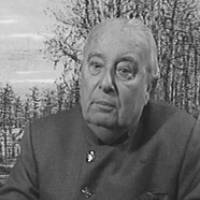
Pantalaskas, CC BY-SA 3.0, via Wikimedia Commons
Jean Carzou was born Karnik Zouloumian in Aleppo on January 1, 1907, to an Armenian family, and died in southwestern France on August 12, 2000. A trained architect turned painter, he became one of the most recognizable figurative artists of postwar Paris, with a signature look: webs of razor-thin lines, lacy cityscapes, harbors and machines, elongated female figures, and a single dominant color flooding the whole image. He designed for the Paris Opera, illustrated dozens of fine press books, was elected to the Académie des Beaux-Arts in 1977, and produced a large body of original lithographs and etchings documented in a catalogue raisonné. The New York Times marked his death with an obituary in August 2000.
Le Coin des Arts tracks Carzou’s printmaking and offers his original lithographs and etchings when strong impressions come up, selected for print quality, edition, provenance, and condition. Right now the gallery has one piece: the Galerie Tamenaga exhibition poster from Paris, 1973. To be upfront, it is a poster, printed in quantity for the show, not a signed and numbered original print. Click “follow the artist” to get an alert when a lithograph comes in.
After his father died, young Karnik moved with his mother and sister to Egypt and went to the French lycée in Cairo. In 1924, a scholarship from the Armenian community sent him to Paris to study at the École Spéciale d’Architecture. He earned his degree in the late 1920s, then switched to painting, sitting in at the Académie de la Grande Chaumière but mostly teaching himself. He built his name from the first syllables of his first and last names, Car-Zou, and added “Jean.” To pay the bills he designed fabrics and drew political cartoons, including a 1933 caricature of Hitler as Santa Claus for Aux Écoutes. In 1936 he married Jeanne Gabrielle Blanc, known as Nane; their son Jean-Marie was born in 1938. His first solo show came in 1939 at the Galerie Contemporaine on rue de Seine.
Success arrived after the war. From 1946 he exhibited with Galerie Drouant-David. In 1949 he won the first of three Hallmark Prizes, and the French state bought his canvas La Baie des songes, now at the Centre Pompidou. His 1953 Venice show was a hit, and in 1955 Connaissance des Arts named him one of the ten best painters of the postwar generation. In 1957 he unveiled L’Apocalypse, a cycle shaped by war and catastrophe. Then came America: Wildenstein & Co. in New York presented his paintings and watercolors from March 11 to April 11, 1959.
Carzou became a household name in France in 1952 with his sets and costumes for Rameau’s Les Indes galantes at the Paris Opera, followed by Roland Petit’s ballet Le Loup (1953), Giselle (1954), and Athalie at the Comédie-Française (1955). In 1966 he designed for After Eden, John Butler’s ballet for the New York–based Harkness Ballet. He also created the 1954 Château Mouton Rothschild wine label, tapestry designs for the Gobelins, and panels for the ocean liner France. In the 1960s and 1970s publishers lined up for his illustrations, and American writers figure prominently: Ernest Hemingway’s A Farewell to Arms (L’Adieu aux armes, 1964, with 17 lithographs), Edgar Allan Poe’s The Murders in the Rue Morgue (1969), and F. Scott Fitzgerald’s The Great Gatsby (1976), alongside Camus, Rimbaud, and Ionesco. In February 1973, Galerie Tamenaga in Paris gave him the exhibition commemorated by the poster now at the gallery.
Carzou was elected to the Académie des Beaux-Arts in December 1977, taking the seat of painter Jean Bouchaud, and was formally received on April 4, 1979, with a speech that blasted modernism from Cézanne to Cubism. In the mid-1980s he began his largest project: a monumental painted Apocalypse covering the walls of the church of the former Présentation convent in Manosque, Provence. Inaugurated in 1991, it is now the Centre Carzou. He died on August 12, 2000, at 93; his Académie seat went to Zao Wou-Ki.
Beyond his 1959 Wildenstein show in New York, Carzou is represented in several U.S. public collections, including the Art Institute of Chicago, the Nelson-Atkins Museum of Art in Kansas City, the Fine Arts Museums of San Francisco, the University of Michigan Museum of Art, and the Mount Holyoke College Art Museum. For American collectors, his color lithographs remain an accessible way into French postwar figuration.
Carzou’s graphic style was made for printmaking. Lithography is the core of his output: color sheets of Paris, Venice, and harbors, portfolios, and book illustrations. Several series were printed by the famed Paris shop Mourlot, including the 1964 A Farewell to Arms lithographs, and André Sauret published Robert Rey’s L’Apocalypse (1959) with original lithographs. He also made intaglio prints, such as drypoints for André Verdet (1965) and copperplate engravings for Rimbaud’s Les Illuminations (1969). The standard reference is Maguy Furhange, Carzou graveur et lithographe (Nice, Éditions d’Art de Francony), a trilingual catalog raisonné in two volumes: Vol. I, 1948–1962 (1971), and Vol. II, 1963–1968 (1975). A citation like “Furhange” plus a number refers to it. An earlier catalog was published by Pierre Cailler in Geneva in 1962. Prints after 1968 are not covered, so publisher paperwork and provenance are key.
Poster vs. original lithograph. Exhibition posters, like the 1973 Tamenaga, were printed in large runs with no pencil signature or numbering. They’re great period pieces, but they are not fine art prints. See what is an original print.
Edition size. Several 1950s lithographs were issued in editions of 100, plus artist’s proofs. Make sure the number fits the stated edition: see the printing process.
Signature. Look for a pencil signature, sometimes with a handwritten date. A signature printed in the image doesn’t count: see the signature.
Book plates. Many unsigned Carzou lithographs on the market were removed from illustrated books. They’re real lithographs, but worth much less than signed, numbered impressions.
Paper and condition. Some impressions are on Japan paper, others on wove. His saturated colors fade in light, so check for toning, foxing, and trimmed margins, and use conservation framing.
Documentation. For 1948–68 prints, ask for the Furhange number; for later ones, ask for provenance, and watch out for photomechanical reproductions. Our authenticity page explains our guarantees.
Le Coin des Arts picks Carzou prints for fresh impressions and sound condition. Explore related artists: Bernard Buffet, Zao Wou-Ki, Marc Chagall, Léonard Foujita, and Jean Cocteau, plus modern art and engravings and lithographs.
Maguy Furhange, Carzou graveur et lithographe / Carzou Engraver and Lithographer, Nice, Éditions d’Art de Francony, Vol. I (1948–1962), 1971; Vol. II (1963–1968), 1975 · Robert Rey, Carzou. L’Apocalypse, Paris, André Sauret, 1959 · Jean Marcenac, Carzou, Paris, Hazan, 1972 · “Jean Carzou, Painter and Illustrator, 93,” The New York Times, August 24, 2000 · Zao Wou-Ki, installation address at the Académie des Beaux-Arts, 2003 · Centre Pompidou – La Baie des songes · Catalogs of Carzou’s exhibitions

Secure payment
3DSecure 2.2

Free DHL Express delivery from €1,200
Carefully prepared parcel
Parcel tracking

Shipment insured
for the full value of the artwork, covering theft and damage

Fairest prices
Certificate of authenticity
Two galleries in Paris
Receive an email as soon as a new artwork is added for this artist
Your message has been sent ! We will get back to you as soon as possible.
Please fill in the form if you need further information such
Please fill in your email address, an email will be sent with a link to update your password.
You can now place orders and track your orders.
To save your wishlist, you can log in or create an account :
This is a 100% custom-made frame, carefully crafted by a professional framer. Finishes are available in light oak, white wood or black wood, with or without mat board and plexiglass. Delivery times may vary depending on the order, with an average lead time of 10 days.
This option will be offered during the cart step.



