
(1923-1997)
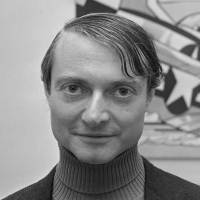
Eric Koch for Anefo, CC BY-SA 3.0, via Wikimedia Commons
Roy Lichtenstein was born in Manhattan on October 27, 1923, and died in New York City on September 29, 1997. He is the Pop artist who made the comic book a museum subject: thick black outlines, primary colors, speech balloons and hand-painted Benday dots that mimic cheap commercial printing. It makes sense, then, that he was also one of the most inventive American printmakers of his generation. His fine art prints – screenprints, lithographs, woodcuts and mixed-media editions published by Gemini G.E.L., Tyler Graphics, Graphicstudio and the Leo Castelli Gallery – are documented in Mary Lee Corlett's catalog raisonné and held by the major American museums.
Le Coin des Arts follows Lichtenstein's work and offers his original prints whenever strong impressions come our way, chosen for printing quality, edition, provenance and condition. Want to know when a new piece arrives? Click "follow the artist" on this page.
A New Yorker by birth, Lichtenstein took watercolor classes at Parsons School of Design in 1937. In 1939 he saw Picasso's Guernica at the Museum of Modern Art and visited the World's Fair in Queens. After high school he studied with Reginald Marsh at the Art Students League, then started at Ohio State University in Columbus in September 1940 under Hoyt L. Sherman, whose lessons on perception stayed with him for life. Drafted on February 6, 1943, he trained at Camp Hulen, Texas, shipped out to Europe in December 1944 with the 69th Infantry Division and was honorably discharged on January 11, 1946.
On the G.I. Bill he finished his BFA at Ohio State in June 1946 and his MFA in 1949, then taught there until he was denied tenure in 1950. His first prints date from these years: the woodcut To Battle (1950) took a prize at the Ohio State Fair, and in 1951 the Brooklyn Museum showed and bought his work in its fifth National Print Annual. The 1956 lithograph Ten Dollar Bill already treats a mass-produced image as art. After a first New York solo show at the Carlebach Gallery (1951), he taught at SUNY Oswego (1957-1960), painting in an Abstract Expressionist idiom, and then at Douglass College, Rutgers University, in New Jersey, where Allan Kaprow and the happenings crowd pushed him toward something new.
That something was Look Mickey, painted in June 1961 from a children's book illustration and now in the National Gallery of Art in Washington. Kaprow introduced him to Ivan Karp, and Leo Castelli took him on; his first solo show there ran February 10 to March 3, 1962. Romance and war images followed – Drowning Girl (1963) is at MoMA – along with the offset poster Crak! for his fall 1963 Castelli show. In 1965 he contributed Sweet Dreams, Baby!, a screenprint in an edition of 200, to the portfolio 11 Pop Artists, published by Original Editions and printed by Knickerbocker Machine & Foundry in New York. In 1966 he moved into a studio at 190 Bowery and represented the United States at the Venice Biennale with Helen Frankenthaler, Ellsworth Kelly and Jules Olitski.
Lichtenstein's mature printmaking is a story of American workshops. At Gemini G.E.L. in Los Angeles he published his first serial prints in 1969: the Haystack and Rouen Cathedral series, riffs on Monet, worked with master printer Kenneth Tyler (Cathedral #1 combines lithography and screenprint). Gemini's role was celebrated in 2016-2017 at the Skirball Cultural Center in Los Angeles with Pop for the People: Prints by Gemini G.E.L. In Mount Kisco, New York, Tyler Graphics published the nine Reflections prints in 1990, each one layering lithography, screenprint, woodcut, metalized PVC collage and embossing, followed by the Nudes in 1994. At Graphicstudio, the University of South Florida workshop in Tampa run by Donald Saff, he made the Brushstroke Faces (1989), and with Saff Tech in Oxford, Maryland, enamel prints such as the Water Lily series from 1990.
The National Gallery of Art mounted The Prints of Roy Lichtenstein from October 30, 1994, to January 8, 1995 – 85 prints, seven sculptures and a portfolio, curated by Ruth E. Fine – before it traveled to LACMA and the Dallas Museum of Art. The reference book is Mary Lee Corlett, The Prints of Roy Lichtenstein: A Catalogue Raisonné 1948-1997 (Hudson Hills Press with the National Gallery of Art, 2nd revised edition, 2002). Dealers cite it by number: "Corlett 67" is Haystack #3. Posters and ephemera are listed in a separate section – "Corlett II.3" is a poster version of Crak!. The Roy Lichtenstein Foundation also publishes a free online catalog raisonné of more than 5,500 works, prints included.
His first traveling retrospective opened at the Pasadena Art Museum on April 18, 1967, and went on to Amsterdam and London. The Solomon R. Guggenheim Museum gave him his first New York retrospective (September 19 to November 16, 1969), organized by Diane Waldman, and a second one from October 8, 1993, to January 16, 1994. He married Dorothy Herzka in 1968, worked between Southampton, Long Island, and a studio at 745 Washington Street from 1988, and kept reinventing himself: Mirrors and Entablatures, brushstrokes, Interiors. Honors included election to the American Academy of Arts and Letters (1979), the Kyoto Prize and the National Medal of Arts, presented by President Clinton on October 5, 1995. He died of complications from pneumonia at NYU Medical Center. In 2012-2013 Lichtenstein: A Retrospective traveled from the Art Institute of Chicago to the National Gallery of Art, London and Paris.
Check the Corlett number first. Title, date, medium, sheet size and edition should all match the catalog raisonné or the Foundation's online entry.
Edition size. Lifetime editions are pencil-numbered, plus a small run of proofs: 200 for Sweet Dreams, Baby!, 68 plus 16 artist's proofs for Reflections on Conversation (the printing process).
Signature. Look for a pencil signature. A signature printed in the image is not a hand signature, and nothing hand-signed can be later than 1997 (the signature).
Paper and chop marks. Rives BFK, Somerset and other quality papers are typical, often with the publisher's blindstamp, such as Tyler Graphics'.
Posters are not prints. Crak! and the Castelli and museum announcements are offset lithographs. Some Crak! posters are signed, yet they belong in a different price bracket from a numbered Gemini or Tyler edition.
Watch for fakes. In March 2008, federal prosecutors in Chicago charged seven people in schemes selling thousands of counterfeit prints, mostly on eBay, made in Spain and Italy with forged signatures of Lichtenstein, Picasso, Miró, Chagall and others. Buy with documented provenance. See our authenticity page.
Condition and framing. Big sheets and metalized collages are fragile and fade-prone; ask for a condition report and use UV-filtering glazing (framing).
We approach Lichtenstein's prints the way we approach those of Alex Katz, Sam Francis, Adolph Gottlieb and Josef Albers. Explore our engravings and lithographs, posters and contemporary art.
Mary Lee Corlett, The Prints of Roy Lichtenstein: A Catalogue Raisonné 1948-1997, Hudson Hills Press / National Gallery of Art, 2002 · National Gallery of Art – The Prints of Roy Lichtenstein · MoMA – Roy Lichtenstein · MoMA – Sweet Dreams, Baby! · Roy Lichtenstein Foundation – Awards · Roy Lichtenstein: A Catalogue Raisonné · U.S. Attorney's Office, Northern District of Illinois – counterfeit prints case (2008)

Secure payment
3DSecure 2.2

Free DHL Express delivery from €1,200
Carefully prepared parcel
Parcel tracking

Shipment insured
for the full value of the artwork, covering theft and damage

Fairest prices
Certificate of authenticity
Two galleries in Paris
Receive an email as soon as a new artwork is added for this artist
Your message has been sent ! We will get back to you as soon as possible.
Please fill in the form if you need further information such
Please fill in your email address, an email will be sent with a link to update your password.
You can now place orders and track your orders.
To save your wishlist, you can log in or create an account :
This is a 100% custom-made frame, carefully crafted by a professional framer. Finishes are available in light oak, white wood or black wood, with or without mat board and plexiglass. Delivery times may vary depending on the order, with an average lead time of 10 days.
This option will be offered during the cart step.