
(1890-1976)

MAN RAY
Cadeau, 1974
Sculpture LCD6804
2 500.00€

MAN RAY
Les Grand trans-parents, 1975
acrylic glass LCD8498
1 800.00€

MAN RAY
La nuit de Saint Jean de Luz, 1968
Sold
Looking for a similar artwork?
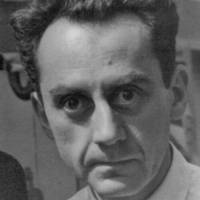
Portrait de Man Ray par Carl Van Vechten, 1934 - Domaine public Library of Congress
Born Emmanuel Radnitzky in Philadelphia on August 27, 1890, Man Ray is the American artist who carried New York Dada to Paris and became one of the inventors of Surrealist photography. Painter, photographer, filmmaker and creator of provocative objects, he gave the twentieth century the rayograph, the solarized portrait and Gift (Cadeau), a household iron armed with a row of tacks. He died in Paris on November 18, 1976. Collectors today pursue three distinct bodies of work: his fine art prints (pochoirs, lithographs, etchings), his authorized multiples, and his photographs, where the difference between a vintage and a later print can be worth a fortune.
Le Coin des Arts currently offers one Man Ray: an example of Cadeau, the 1974 multiple in cast iron and nails that re-creates the lost object of 1921. It is an editioned sculpture, not a print, signed and numbered on the handle. We follow the artist’s market and add original prints when strong impressions come up – click “follow the artist” to hear first.
Man Ray was the eldest child of Jewish immigrants from the Russian Empire; his father, Melach Radnitzky, worked as a tailor. The family moved to Brooklyn in 1897. After Boys’ High School he passed up an architecture scholarship to become an artist. By 1911 he was a regular at Alfred Stieglitz’s 291 gallery, and in 1912 – the year the family changed its name to Ray – he signed up for classes at the Ferrer Center, an anarchist-run free school. The 1913 Armory Show introduced him to European modernism, including Marcel Duchamp’s work.
In 1915 the Daniel Gallery in New York gave him his first solo show. He began photographing – at first to document his paintings – and formed a lifelong friendship with Marcel Duchamp. In 1916 he helped Walter Arensberg found the Society of Independent Artists; in 1920 he, Duchamp and Katherine Dreier launched the Société Anonyme to bring modern art to American audiences. That same year he and Duchamp put out the one and only issue of New York Dada. In July 1921 he left for Paris.
Man Ray arrived in Paris on July 22, 1921. Late that year, on opening day of his show at Philippe Soupault’s Librairie Six, he made Gift: a flatiron with 14 tacks glued to the sole. By his own account, the composer Erik Satie helped him buy the materials; the object was gone by the end of the day. In 1922 came Les Champs délicieux, an album of his first cameraless photographs, and a studio on rue Campagne-Première. He became the portraitist of the avant-garde and shot for Vanity Fair, Vogue (from 1924) and Harper’s Bazaar (from 1935). He made films – Le Retour à la raison (1923), Emak Bakia (1926), Les Mystères du château de Dé (1929) – often starring Kiki de Montparnasse. He showed in the first Surrealist group exhibition at the Galerie Pierre in 1925 with Arp, Masson, Miró and Picasso. With his assistant Lee Miller, from 1929, he developed solarization; in 1931 he produced the Électricité portfolio for the Paris power company; and with Paul Éluard he published Facile (1935) and Les Mains libres (1937).
American institutions took notice early: the Museum of Modern Art included him in Fantastic Art, Dada, Surrealism in 1936. When war reached France in 1940, Man Ray returned to the United States and settled in Hollywood, where he met Juliet Browner. They married in 1946 in a double ceremony with Max Ernst and Dorothea Tanning, and in 1948 he showed at the Copley Galleries in Beverly Hills. After he moved back to Paris in 1951, the Los Angeles County Museum gave him a retrospective in 1966, and the Metropolitan Museum of Art presented 125 of his photographs in 1973. MoMA owns a version of Gift from about 1958 (James Thrall Soby Fund) and plates from Revolving Doors; the Smithsonian American Art Museum also holds a Gift. The market followed: in 2022 his Le Violon d’Ingres (1924) sold for $12.4 million, a record for any photograph at auction.
Back in Paris, in a studio on the rue Férou, Man Ray showed at Berggruen in 1951, won the gold medal for photography at the 1961 Venice Biennale, and published his autobiography, Self Portrait, in 1963. In Italy the dealer Luciano Anselmino made him the star of his Turin gallery, Il Fauno, re-editing his objects and rare books and editing the first volume of the catalog of his prints. Man Ray died in Paris on November 18, 1976. In 1994 his studio and a large archive of negatives entered the Centre Pompidou.
Revolving Doors (1926) is the key early print: a portfolio of 10 color pochoirs after collages of 1916-1917, published by the Éditions Surréalistes, Paris, in an edition of 105. The 1931 Électricité portfolio – ten photogravures, partly from rayographs, commissioned by the Paris electricity company for its shareholders – sits halfway between photography and printmaking. From the 1960s on, Man Ray made lithographs and etchings, often in color and in runs of around 100, frequently reworking older images. The reference catalog is Man Ray. Opera grafica, vol. I, edited by Luciano Anselmino (Turin, 1973): “Anselmino 18” means Revolving Doors. The objects catalog is Man Ray: objets de mon affection (Philippe Sers, 1983), where Cadeau is no. 28.
How many Gifts are there? Man Ray considered the five or six he made himself before 1963 to be originals. Galleria Schwarz in Milan issued ten in 1963, another edition followed in 1972, and in 1974 came the commercial edition of 5,000, numbered on the handle, with a justification card naming Luciano Anselmino as publisher.
Get the catalog number. An Anselmino reference pins down date, medium and edition size.
Check the signature. Later prints are hand-signed in pencil and numbered. See the signature.
Know your photograph. Vintage prints date from the time of the negative. Later prints were made under the artist’s control after the war, notably by Pierre Gassmann of the Picto lab from around 1958. Posthumous prints exist and have sometimes been sold as lifetime prints; paper, studio stamps and provenance tell them apart.
Multiples. For the 1974 Cadeau, look for the signature and number on the handle, the justification card and the original box.
Authentication. The Man Ray Expertise Committee (Andrew Strauss and Timothy Baum) issues the opinions major auction houses rely on. Posters and offset reproductions are not original prints. See our authenticity guarantee and framing options.
Le Coin des Arts presents Man Ray among the Dada, Surrealist and modern artists we handle, including Max Ernst, Alexander Calder, Joan Miró, Pablo Picasso and Roberto Matta. Learn more about Surrealism or browse our engravings and lithographs.
Luciano Anselmino, Man Ray. Opera grafica, vol. I, Turin, 1973 · Jean-Hubert Martin, Rosalind Krauss and Brigitte Hermann, Man Ray: objets de mon affection, Philippe Sers, 1983 · Man Ray, Self Portrait, 1963 · Steven Manford, “Man Ray Photographs: The Problems Have Not Gone Away,” IFAR Journal, vol. 20, 2019 · MoMA – Gift · MoMA – Revolving Doors · Peggy Guggenheim Collection – Man Ray · Centre Pompidou – Man Ray press kit

Secure payment
3DSecure 2.2

Free DHL Express delivery from €1,200
Carefully prepared parcel
Parcel tracking

Shipment insured
for the full value of the artwork, covering theft and damage

Fairest prices
Certificate of authenticity
Two galleries in Paris
Receive an email as soon as a new artwork is added for this artist
Your message has been sent ! We will get back to you as soon as possible.
Please fill in the form if you need further information such
Please fill in your email address, an email will be sent with a link to update your password.
You can now place orders and track your orders.
To save your wishlist, you can log in or create an account :
This is a 100% custom-made frame, carefully crafted by a professional framer. Finishes are available in light oak, white wood or black wood, with or without mat board and plexiglass. Delivery times may vary depending on the order, with an average lead time of 10 days.
This option will be offered during the cart step.



