
(1921-2006)

APPEL Karel
Blue Cat, 1978
Lithograph LCD7954
1 500.00€


APPEL Karel
Sunshine Cat, 1978
Lithograph LCD7957
1 500.00€

APPEL Karel
About a Cat, 1978
Lithograph LCD7959
1 500.00€


APPEL Karel
Innocent cat, 1978
Lithograph LCD7838
1 500.00€


APPEL Karel
Enfant et chien, 1970
Lithograph LCD6749
1 400.00€
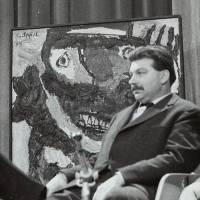
Portrait de Karel Appel par Anefo/NationaalArchief, 1959 — CC0
Explosive color, raw energy and a childlike sense of wonder: Karel Appel (1921–2006) brought all three to post-war art. The Dutch-born painter, sculptor, printmaker and poet co-founded the CoBrA movement, then built a truly transatlantic career between Paris and New York. Children, animals and faces leap out of his thickly painted, unmixed colors, as if drawn in a single gesture. From his CoBrA days to his final works, Appel chased a “barbaric” kind of painting that could recapture the fresh vision of a child.
Le Coin des Arts, a fine art print gallery in Paris, offers original artwork by Karel Appel on paper, especially hand-signed, limited edition color lithographs, chosen for print quality, provenance and condition.
Appel was born in Amsterdam on April 25, 1921, the son of a barber in a working-class neighborhood. He completed his first painting at 14. During the German occupation he studied at the Rijksakademie van Beeldende Kunsten, where he met Constant and Corneille, two artists who would become lifelong allies. In 1946 he had his first solo show, in Groningen. While his early pictures echo Picasso, Matisse and Jean Dubuffet, he was already looking for something more immediate, and in 1947 began brightly painting assemblages of found objects.
Appel, Constant and Corneille created the Dutch Experimental Group and its magazine Reflex in 1948. On November 8 of that year, at a Paris café, they teamed up with Belgian poet Christian Dotremont and Danish painter Asger Jorn to launch CoBrA, named for Copenhagen, Brussels and Amsterdam. Pierre Alechinsky soon joined them. Rejecting both academic art and geometric abstraction, the group championed spontaneity and drew on folk art, children’s drawings and so-called “primitive” art.
The 1949 CoBrA show at Amsterdam’s Stedelijk Museum sparked a scandal. That same year Appel’s mural Vragende kinderen (“Questioning Children”) for the Amsterdam City Hall cafeteria triggered so many complaints that it stayed covered for ten years. In 1950 Appel moved to Paris, where drawings by patients at the Sainte-Anne psychiatric hospital inspired his Psychopathological Notebook, a work later shown at the Los Angeles County Museum of Art in 1992. CoBrA disbanded in 1951, but its spirit stayed with him for life.
After the critic Michel Tapié linked him to “art autre” and Art Informel in 1952, Appel’s reputation crossed the Atlantic fast. In 1953 Guggenheim director James Johnson Sweeney bought two of his paintings and included him in Younger European Painters. In 1954, the year he won the UNESCO Prize at the Venice Biennale, the Martha Jackson Gallery in New York gave him his first American solo exhibition, and in 1955 the Museum of Modern Art featured him in The New Decade: 22 European Painters and Sculptors.
His first trip to New York, in 1957, was a revelation. He met the Abstract Expressionists, became friends with Willem de Kooning and painted portraits of jazz greats including Miles Davis, Dizzy Gillespie, Count Basie and Sarah Vaughan. From then on he split his time between Europe and the U.S. Major honors followed: the international painting prize at the São Paulo Biennial (1959) and the Guggenheim International Award (1960). In 1961 Jan Vrijman filmed him hurling paint at a canvas for De werkelijkheid van Karel Appel (“The Reality of Karel Appel”), scored with music by Dizzy Gillespie; the short won the Golden Bear at the 1962 Berlin Film Festival.
Appel’s sculpture grew out of his CoBrA assemblages and the ceramics he made with Asger Jorn in 1954. In the early 1960s he worked with charred olive-tree roots, and later with painted wood and aluminum. He bought the Château de Molesmes in Burgundy in 1964. In 1983 he acquired a studio on 18th Street in New York big enough for very large formats, and in 1989 he bought land in Connecticut and built a house there, alongside homes in Paris, Tuscany and Switzerland. Other milestones include murals painted with local residents in Villa El Salvador, Peru, in 1976, the Visage-Paysage series, the joyful “Circus” period of the late 1970s, opera sets for De Nederlandse Opera, theatrical installations such as Singing Donkeys, and a 1990 retrospective at the Gemeentemuseum in The Hague.
Appel’s prints are not copies of his paintings; they are a continuation of them. His goal was to bring the punch of his color and the freedom of his line straight onto paper. His favorite medium was lithography, but he also made woodcuts, etchings and screenprints.
He collaborated with leading Paris print shops such as Mourlot and Clot, Bramsen et Georges, and with publishers like Galerie Lelong. Look for vivid flat fields of red, yellow, blue and green outlined in black, from which his signature subjects emerge: faces, birds, cats, figures and imaginary landscapes.
Among the most collectible portfolios are the late-1970s circus prints, especially The Appel Circus with its clowns, bareback riders and animals, the Cats series (1978) and Night Faces on Broadway (1975), a direct product of his New York years. His exhibition posters, often printed in lithography, are also popular with collectors.
There is currently no single catalogue raisonné of Appel’s prints. The Karel Appel Foundation, which the artist created in Amsterdam in 1999, preserves and documents his work and is the go-to authority on identification.
Named an Officer of the Légion d’honneur in 2003, Appel moved to Zurich, where he died on May 3, 2006, at age 85. He is buried in Paris, at Père-Lachaise cemetery. Major exhibitions have continued since: the Cobra Museum in Amstelveen in 2001 and 2008 (Jazz 1958–1962), Karel Appel: A Gesture of Color at The Phillips Collection in Washington, D.C., in 2016, and Karel Appel. L’art est une fête ! at the Musée d’Art moderne de Paris in 2017. In the U.S., his work is in the collections of the Museum of Modern Art and the Guggenheim in New York, the Hirshhorn Museum in Washington, D.C., SFMOMA and the Albright-Knox in Buffalo, as well as the Stedelijk Museum and the Centre Pompidou in Europe.
Together with Corneille and Pierre Alechinsky, Appel is one of the most widely available CoBrA artists in the print market. With edition sizes ranging from a few dozen to a few hundred, his color lithographs are an accessible entry point to a major 20th-century painter.
Key points to check: the technique, the edition size and how each impression is marked (numbered, artist’s proof, H.C.), whether the work is hand-signed (see signature), the publisher and print shop, whether it belongs to a series or portfolio, plus provenance and condition. Appel’s bright colors should look as vivid as the day they were printed, with no fading or light damage.
Is it an original print or a reproduction? Appel’s imagery has circulated widely as posters and offset reproductions. An original print is designed by the artist specifically for printmaking, produced as a limited edition and usually hand-signed and numbered on quality paper. A poster typically includes text and is not numbered.
Every Karel Appel print at Le Coin des Arts is vetted for authenticity, provenance and condition, and our team can help you choose a piece and plan museum-quality framing and care. The gallery ships worldwide by insured DHL Express, free of charge on orders from €1,200. You may also enjoy the gallery’s other CoBrA artists, including Corneille, Pierre Alechinsky and Jean-Michel Atlan.
Karel Appel Foundation, Amsterdam · Musée d’Art moderne de Paris, Karel Appel. L’art est une fête !, press kit, 2017 · The Phillips Collection, Karel Appel: A Gesture of Color, 2016 · Jan Vrijman, De werkelijkheid van Karel Appel, film, 1961.

Secure payment
3DSecure 2.2

Free DHL Express delivery from €1,200
Carefully prepared parcel
Parcel tracking

Shipment insured
for the full value of the artwork, covering theft and damage

Fairest prices
Certificate of authenticity
Two galleries in Paris
Receive an email as soon as a new artwork is added for this artist
Your message has been sent ! We will get back to you as soon as possible.
Please fill in the form if you need further information such
Please fill in your email address, an email will be sent with a link to update your password.
You can now place orders and track your orders.
To save your wishlist, you can log in or create an account :
This is a 100% custom-made frame, carefully crafted by a professional framer. Finishes are available in light oak, white wood or black wood, with or without mat board and plexiglass. Delivery times may vary depending on the order, with an average lead time of 10 days.
This option will be offered during the cart step.