
(1929-2026)
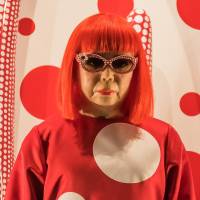
Portrait de Yayoi Kusama par Susanne Nilsson, 2015 - CC BY-SA 2.0
Yayoi Kusama was born on March 22, 1929, in Matsumoto, Japan, and died on August 14, 2026, in Tokyo at age 97. The artist behind the Infinity Net paintings, the polka dots, the pumpkins and the mirrored Infinity Rooms spent her formative years as an artist in the United States, from Seattle to Lower Manhattan, and American museums – MoMA, the Whitney, the Hirshhorn – played a central part in her rediscovery. Her fine art prints, mostly screenprints made after her return to Japan, are among the most sought-after contemporary editions on the market. They are also among the most frequently faked.
Le Coin des Arts follows Kusama's work and offers her original prints whenever good impressions with solid provenance come our way, checked for printing quality, edition, provenance and condition. Want to know when one arrives? Click "follow the artist" on this page.
Kusama grew up in Matsumoto, in Nagano Prefecture, where her family ran a plant nursery and seed farm. In 1948 she left home to study traditional Japanese-style painting (nihonga) for about a year at the Kyoto Municipal School of Arts and Crafts. She showed her work for the first time in 1952 and held solo exhibitions in Matsumoto and Tokyo during the 1950s. Looking for a way out, she wrote to Georgia O'Keeffe, who answered with advice about the New York art world.
Kusama arrived in the United States in 1957. Her first American show took place that year at the Zoe Dusanne Gallery in Seattle; by 1958 she was in New York, where O'Keeffe persuaded her own dealer to buy several works and help her through hard times. The 1959 solo show at the Brata Gallery – huge white Infinity Net canvases – drew a strong review from Donald Judd, and both Judd and Frank Stella bought paintings. In 1961 she moved her studio into the same building as Judd and the sculptor Eva Hesse. Soft sculptures, Accumulations and the first mirrored rooms followed in the 1960s. In 1966 she showed Narcissus Garden at the Venice Biennale. Back in New York, her happenings took polka dots onto naked bodies, into the streets and, in 1969, into the sculpture garden of the Museum of Modern Art with the Grand Orgy to Awaken the Dead. She even launched her own fashion label, the Kusama Fashion Company, whose clothes were sold at Bloomingdale's in 1968.
She moved back to Japan in 1973. In 1977 she voluntarily took up residence in a Tokyo hospital and lived there for the rest of her life, while continuing to work – a choice she made public herself. She published poetry and fiction, starting with the novel Manhattan Suicide Addict (1978), and in 1979 she exhibited her first prints.
American institutions led the comeback. In 1989, a retrospective organized by Alexandra Munroe at New York's Center for International Contemporary Arts offered the first critical survey of her career. After she represented Japan at the 1993 Venice Biennale, Love Forever: Yayoi Kusama, 1958-1969 opened at LACMA in 1998 and traveled to MoMA (1998-99). Narcissus Garden appeared in Central Park as part of the 2004 Whitney Biennial, and in summer 2012 the Whitney Museum of American Art hosted the last stop of the retrospective organized by Tate Modern and the Museo Reina Sofía. In 2017, Yayoi Kusama: Infinity Mirrors, a 50-year survey, opened at the Hirshhorn Museum in Washington, D.C., before touring the country; in January 2020 the museum announced new Kusama acquisitions for its permanent collection. That same year a 1960 net painting, Lake Michigan, sold for $5.3 million at Sotheby's New York. Her New York gallery, David Zwirner, presented Every Day I Pray for Love (2019) and I Spend Each Day Embracing Flowers (2023). She received Japan's Praemium Imperiale in 2006 and opened her own museum in Tokyo in 2017. Her studio says she kept painting until shortly before her death.
Assume the risk is real. In September 2026, Tokyo's Ota Fine Arts warned of a sharp rise in counterfeit Kusama works – mostly prints – sold through auctions, online platforms and secondary-market galleries in Japan and abroad, sometimes with forged Ota labels, invoices and certificates of authenticity. The gallery also made clear that it does not verify works it did not sell itself, so buyers must do their own due diligence. In 2018 the Yayoi Kusama Foundation publicly condemned exhibitions of fake Kusama works in several Chinese cities, one of which, in a Shanghai shopping mall, was shut down.
Don't count on a studio certificate. The registration program run by Kusama Yayoi Co., Ltd. specifically excludes editions such as prints and doesn't answer inquiries about them. Even for unique works, its registration card is not a certificate of authenticity. A print sold with a so-called studio certificate deserves extra scrutiny.
Match the catalog raisonné. Title, year, medium, size, paper and edition size must line up with the catalog entry.
Check signature and numbering. Most editions are signed and numbered in pencil, often titled and dated too. More on the signature and the printing process.
Follow the paper trail. An invoice from the publisher or a known gallery, or a published auction record, is worth as much as the image itself. A price far below public results is a red flag.
Know what isn't a print. Posters, digital reproductions, museum products and fashion collaborations are not original prints.
Inspect condition. Flat screenprinted color shows scuffs, creases and fading; look at the sheet unframed. See our authenticity and framing pages.
Her first two prints, including Standing in the Visionary Field, were published in 1979. Screenprinting – flat, bright color and endless repetition – became her main print medium, carrying pumpkins, flowers, nets, hats and waves. She also made lithographs (Pumpkin, 1982, lithograph and collage), black-and-white etchings and woodcuts, including a Mount Fuji series cut in the ukiyo-e tradition. The big black-and-white Love Forever screenprints of the mid-2000s rank among her most ambitious suites. Japan's Matsumoto City Museum of Art holds one of the largest collections of her prints and mounted the first exhibition devoted to them in 2022; the show traveled to Kagoshima in 2024 and to the Kyoto City KYOCERA Museum of Art in 2025 with some 330 works. The key reference is the catalog raisonné Kusama Yayoi zen hangashū / All Prints of Kusama Yayoi 1979-2004 (Tokyo: Abe Shuppan, 2005); dealers and auction houses often cite a print as "Abe" plus its plate number.
We only offer a Kusama print when its provenance checks out and it matches the catalog exactly. Explore related artists: Roy Lichtenstein, Sam Francis, Adolph Gottlieb, Kumi Sugai and Niki de Saint Phalle, or browse contemporary art and our fine art prints and lithographs.
Kusama Yayoi zen hangashū / All Prints of Kusama Yayoi 1979-2004, Tokyo, Abe Shuppan, 2005 · MoMA – Love Forever: Yayoi Kusama, 1958-1969 · Whitney Museum – Yayoi Kusama, 2012 · Sotheby's – 21 Facts About Yayoi Kusama · Artnet News – Fake Kusama shows in China, 2018 · Ota Fine Arts – Counterfeit notice · Kusama Yayoi Registration terms · Yayoi Kusama – official website

Secure payment
3DSecure 2.2

Free DHL Express delivery from €1,200
Carefully prepared parcel
Parcel tracking

Shipment insured
for the full value of the artwork, covering theft and damage

Fairest prices
Certificate of authenticity
Two galleries in Paris
Receive an email as soon as a new artwork is added for this artist
Your message has been sent ! We will get back to you as soon as possible.
Please fill in the form if you need further information such
Please fill in your email address, an email will be sent with a link to update your password.
You can now place orders and track your orders.
To save your wishlist, you can log in or create an account :
This is a 100% custom-made frame, carefully crafted by a professional framer. Finishes are available in light oak, white wood or black wood, with or without mat board and plexiglass. Delivery times may vary depending on the order, with an average lead time of 10 days.
This option will be offered during the cart step.


