
(1919-2022)

SOULAGES Pierre
Lithograph No. 40, 1978
Lithograph LCD8534
10 000.00€

SOULAGES Pierre
Lithographie n°4, 1957
Lithograph LCD8578

SOULAGES Pierre
Lithograph No. 13, 1964
Lithograph LCD8380

SOULAGES Pierre
Lithograph No. 23, 1969
Lithograph LCD8047

SOULAGES Pierre
Lithograph No. 27, 1969
Lithograph LCD8252

SOULAGES Pierre
Etching XXXV, 1979
Etching LCD8499
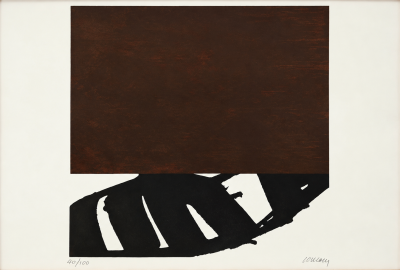
SOULAGES Pierre
Lithograph No. 43, 1995
Lithograph LCD8033
13 000.00€

SOULAGES Pierre
Lithograph No. 11, 1963
Lithograph LCD7878
17 000.00€

SOULAGES Pierre
Etching XIII, 1957
Etching LCD7910

SOULAGES Pierre
Lithograph n°8, 1958
Lithograph LCD7806

SOULAGES Pierre
Lithographie n°29, 1972
Lithograph LCD5561
9 000.00€

SOULAGES Pierre
Etching II, 1952
Etching LCD7746

SOULAGES Pierre
Etching XXX, 1974
Etching LCD7439

Pierre SOULAGES
Etching XXXVI, 1979
Sold

Pierre SOULAGES
Lithograph 3, 1957
Sold

Pierre SOULAGES
Etching XXIX, 1974
Sold
Looking for a similar artwork?
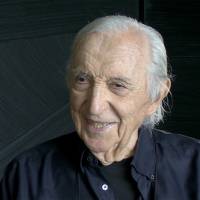
NVP3D, CC BY-SA 3.0, via Wikimedia Commons
Pierre Soulages (1919–2022) was one of the leading figures of French abstraction and of 20th-century art. A painter of black and light and the creator of Outrenoir (often translated as “ultrablack”), he developed an instantly recognizable body of work over more than seventy years. While his monumental paintings hold an essential place in the history of contemporary art, his work as a printmaker and lithographer is also a fundamental part of his output.
Le Coin des Arts gallery in Paris regularly offers original works by Pierre Soulages, including lithographs, etchings, and screenprints, which provide another way into his explorations of black, texture, paper, and light.
Pierre Soulages was born on December 24, 1919, in Rodez, in the Aveyron region of southern France. From an early age he was drawn to the austere landscapes of his native region, to the prehistoric statue-menhirs at the Musée Fenaille, and to the Romanesque architecture of the abbey church of Sainte-Foy in Conques.
In the late 1930s, a stay in Paris introduced him to the work of Cézanne and Picasso. After a brief stint at the École des Beaux-Arts in Paris, followed by studies in Montpellier, he devoted himself fully to painting in the years right after World War II.
Beginning in 1946, Soulages developed an abstract style defined by powerful dark forms. His celebrated walnut stain works on paper (brous de noix), made with a material traditionally used by cabinetmakers, already reveal his interest in deep browns, in black, and in the contrast created by the light of the paper.
By the late 1940s, his work was being exhibited in France and then internationally, including in the United States. He quickly became one of the major figures of postwar European abstract painting.
Black holds an essential place in Pierre Soulages’s work, yet for him it is never a uniform surface or a mere absence of color.
The artist worked the paint so that light would react differently depending on texture, relief, the direction of the grooves, and the position of the viewer. The same work can therefore change dramatically in appearance depending on the lighting and the movement of the eye.
In 1979, this research took a decisive turn. Soulages made paintings entirely covered in black and realized that their true subject was no longer simply the pigment, but the light that the black surface absorbs, reflects, or diffuses.
He named this approach Outrenoir, literally a black that leads “beyond black.” The surfaces become alternately matte, glossy, smooth, or ridged, turning light into an active element of the work.
Pierre Soulages’s printed work is a particularly important chapter of his artistic career. In the early 1950s he began experimenting with intaglio printmaking, before going on to create a major body of lithographs and screenprints.
Soulages never regarded a print as a mere reproduction of his painting. In his view, each technique has its own constraints, accidents, and possibilities, which should lead to the creation of an independent work.
This approach is key to understanding a Pierre Soulages lithograph or etching. The goal is not to reproduce an existing painting on paper, but to explore what the lithographic stone, copper, acid, ink, press, and paper can produce.
His printed work includes more than one hundred original prints, made as etchings, lithographs, and screenprints. Today this body of work is a field of its own within his oeuvre and is documented in a catalogue raisonné: Soulages, l’œuvre imprimé, edited by Pierre Encrevé and Marie-Cécile Miessner (Bibliothèque nationale de France, 2003; new edition BnF / Musée Soulages, 2011).
For Soulages, etching became a true field of experimentation.
The technique relies on the action of acid on a metal plate, usually copper. Yet Soulages did not try to control the process entirely. On the contrary, he let the bite of the acid transform the plate profoundly and made use of the sometimes unexpected effects produced by the metal.
In some works, the acid goes so far as to eat through the copper plate. What might be considered a technical accident then becomes part of the composition: the bare paper appears directly in the image and interacts with the printed areas.
Pierre Soulages’s etchings therefore stand out for their strong physical presence. The ink, the plate mark left by the pressure of the plate, the whiteness of the paper, its thickness, and its texture all play a part in how the work is perceived.
In his lithographs, Pierre Soulages recaptures the power of the large forms that characterize his painting, while developing a visual language specific to the lithographic process.
Black remains central, but many compositions also combine reds, blues, yellows, browns, or ochers. These colors create tensions and balances that give some sheets a character very different from the Outrenoir paintings the artist is most often associated with today.
His lithographs are generally more intimate in size than his large canvases, yet their compositions often retain a sense of monumentality.
Since the paper, its texture, and its margins play a full part in the work, the condition of an original Pierre Soulages lithograph should be assessed carefully: quality of the paper, freshness of the colors, framing, and storage conditions.
Between 1986 and 1994, Pierre Soulages carried out one of the most important projects of his career: the 104 stained-glass windows of the abbey church of Sainte-Foy in Conques.
For this monumental ensemble, he designed a translucent glass that diffuses natural light without relying on traditional colored stained glass. The project directly extends his research into the relationship between matter and light.
In 2009–2010, the Centre Pompidou in Paris devoted a major retrospective to him, bringing together more than one hundred works.
In 2014, the Musée Soulages opened in Rodez, built around the major donations made by Pierre and Colette Soulages.
To mark his 100th birthday, the Louvre held an exceptional exhibition of his work in the Salon Carré in 2019–2020.
Pierre Soulages kept working until the final years of his life. He died on October 25, 2022, at the age of 102.
Original prints by Pierre Soulages offer a way to approach his work through a relatively limited, coherent, and clearly identifiable body of work within his career.
When evaluating a Soulages lithograph, etching, or screenprint, several factors matter: the technique, the edition size, the signature, the reference number in the catalogue raisonné of the printed work, the provenance, and the condition of the paper and colors.
Each original Soulages print is listed there under a number, often cited as “BnF no.” This reference is the first thing to check before any purchase.
Original lithograph or poster? Many Pierre Soulages exhibition posters circulate on the market, and some are wrongly sold as original lithographs. An original print is normally hand-signed in pencil and numbered, or marked “artist’s proof,” printed on fine art paper with margins, and listed in the catalogue raisonné. A poster usually carries text (the name of the museum or gallery, exhibition dates) and is not numbered. A poster signed by the artist is still a poster.
Le Coin des Arts selects and offers original prints by Pierre Soulages from Paris, paying particular attention to their authenticity, provenance, and condition.
The gallery also advises collectors on choosing a work, as well as on its framing, display, and conservation.
Musée Soulages, Rodez · Pierre Encrevé and Marie-Cécile Miessner (eds.), Soulages, l’œuvre imprimé, Bibliothèque nationale de France, 2003; new edition BnF / Musée Soulages, 2011 · Centre Pompidou, Paris · Musée du Louvre, Paris.

Secure payment
3DSecure 2.2

Free DHL Express delivery from €1,200
Carefully prepared parcel
Parcel tracking

Shipment insured
for the full value of the artwork, covering theft and damage

Fairest prices
Certificate of authenticity
Two galleries in Paris
Receive an email as soon as a new artwork is added for this artist
Your message has been sent ! We will get back to you as soon as possible.
Please fill in the form if you need further information such
Please fill in your email address, an email will be sent with a link to update your password.
You can now place orders and track your orders.
To save your wishlist, you can log in or create an account :
This is a 100% custom-made frame, carefully crafted by a professional framer. Finishes are available in light oak, white wood or black wood, with or without mat board and plexiglass. Delivery times may vary depending on the order, with an average lead time of 10 days.
This option will be offered during the cart step.



