
(1875-1963)

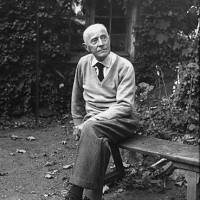
Photographe inconnu - CC BY-SA 4.0, via Wikimedia Commons
Jacques Villon, born Gaston Duchamp in Damville, Normandy, on July 31, 1875, and died in Puteaux, outside Paris, on June 9, 1963, was a Cubist painter and one of the great fine art printmakers of modern France. He was the older brother of Marcel Duchamp and the sculptor Raymond Duchamp-Villon, and America discovered all three at the 1913 Armory Show. By the 1930s Villon was arguably better known in the United States than at home. His prints run from 1891 to the 1950s and include two very different bodies of work: his own original etchings, drypoints and lithographs, and a large group of reproductive color aquatints after other artists’ paintings.
Right now, Le Coin des Arts has Villon’s Le Pigeonnier normand (The Norman Dovecote, 1954), an original color lithograph on a Normandy theme, and we add other Villon prints when strong impressions in good condition, with a clear edition and provenance, become available. Click “follow the artist” on this page to hear about new arrivals.
Villon grew up in a well-off family in Normandy. His grandfather Émile Nicolle, a businessman and amateur artist, taught him drypoint in 1891. In 1894 he moved to Montmartre with his brother Raymond, briefly studied law, and switched to art, adopting the name Jacques Villon after the medieval poet François Villon. He studied in Fernand Cormon’s studio (1895) and at the Académie Julian (1904-1905). For more than ten years he drew cartoons for Paris papers such as Le Courrier français, Gil Blas and L’Assiette au beurre, and he designed several posters. Starting in 1899, the publisher Edmond Sagot issued his large color aquatints of Parisian society, Montmartre and street fairs, prints that owe a debt to Degas and Toulouse-Lautrec. In 1903 he helped organize the drawing section of the very first Salon d’Automne, and in 1907 he etched the Bain de Minne series.
In 1906 Villon moved to Puteaux. Around 1911 his studio hosted regular discussions with his brothers, Albert Gleizes, Jean Metzinger, Francis Picabia, Fernand Léger and Robert Delaunay. The group showed as the Section d’Or at the Galerie La Boétie in October 1912, a name Villon helped choose. In 1913 he made seven large Cubist drypoints, including L’Équilibriste (The Tightrope Walker). That same year, everything he showed at the Armory Show in New York sold. American interest continued, with shows at the Société Anonyme in New York in 1921 and at the Brummer Gallery in 1928. He made his first trip to the United States in 1935. During World War I he served in a camouflage unit.
To make a living in the 1920s, Villon accepted a commission from the Paris gallery Bernheim-Jeune in 1922: large color aquatints reproducing modern paintings by Cézanne, Van Gogh, Renoir, Matisse, Picasso, Modigliani, Maximilien Luce and others. The Museum of Modern Art counted about 140 of them in 1953 and noted that the copper plates belonged to the Louvre. Living artists often countersigned the sheets. Villon’s aquatint after Luce’s 1893 painting – the canvas is now at the Yale University Art Gallery – was published in 1929 in an edition of 200. These prints show remarkable craft, but they are reproductions of other artists’ compositions, and they sell for far less than Villon’s own prints.
After experiments with abstraction in the early 1930s, Villon returned to the figure around 1935 and was made a chevalier of the Legion of Honor in 1938. His breakthrough came with dealer Louis Carré, who showed him in Paris in December 1944 and later in New York. In 1950 he won first prize at the Carnegie International in Pittsburgh, and in 1951 the Musée National d’Art Moderne in Paris gave him a retrospective. In 1953 MoMA organized his first New York retrospective, Sixty Years of Work: 100 prints from 1891 to 1951, assembled by curator William S. Lieberman, with loans from collector Ludwig Charell, the Yale University Art Gallery and the Boston Public Library. MoMA itself already owned more than 100 Villon prints. He received the painting prize at the 1956 Venice Biennale and designed stained glass for Metz Cathedral from 1955. A year after his death, the Museum of Fine Arts, Boston held Jacques Villon, Master of Graphic Art (1964), with a catalog by Peter A. Wick. Yale’s Beinecke Library holds the Francis Steegmuller collection on Villon, and the National Gallery of Art in Washington has many of his prints.
Villon worked mainly in intaglio: drypoint, etching and aquatint, often on the same plate and in several states. His Cubist plates – L’Équilibriste (1913), La Table d’échecs (1920), Les Trois Ordres (1939) – build forms from fine networks of lines, a graphic version of Cubism that few printmakers matched. After World War II he turned increasingly to color lithography, with several sheets printed at the Mourlot workshop in Paris, and illustrated books such as Jacques Lassaigne’s Éloge de Jacques Villon (1955).
There are two catalogs raisonnés. The first is Jacqueline Auberty and Charles Pérussaux, Jacques Villon, catalogue de son œuvre gravé (Paris: Paul Prouté et ses fils, 1950). The standard reference today is Colette de Ginestet and Catherine Pouillon, Jacques Villon. Les estampes et les illustrations. Catalogue raisonné (Paris: Arts et Métiers Graphiques, 1979), which also lists the reproductive aquatints. When a dealer writes “Ginestet & Pouillon 663,” that number points to the catalog entry with states, edition size and dimensions.
Check whose composition it is. “After Cézanne,” “after Picasso” or a second signature means a reproductive aquatint. It is genuine, but it is not an original Villon design.
Look at the signature and edition. Edition impressions are hand-signed in pencil “Jacques Villon”; the number should match the edition in the catalog. See the signature and the printing process.
Use the catalog raisonné. Ginestet & Pouillon identifies states, papers and dimensions.
Inspect condition. Early color aquatints can show light stain, foxing or trimmed margins. Use UV-filtering glazing when framing.
Watch for look-alikes. Posters, unsigned magazine plates, later impressions and photomechanical reproductions are common. See our authenticity page.
Le Coin des Arts selects Villon prints for impression quality and condition. Explore related artists Fernand Léger, Robert Delaunay, Georges Braque, Pablo Picasso and Jean Bazaine, or browse modern art and our etchings and lithographs.
Colette de Ginestet and Catherine Pouillon, Jacques Villon. Les estampes et les illustrations. Catalogue raisonné (Paris: Arts et Métiers Graphiques, 1979) · Jacqueline Auberty and Charles Pérussaux, Jacques Villon, catalogue de son œuvre gravé (Paris: Paul Prouté, 1950) · Peter A. Wick, Jacques Villon, Master of Graphic Art (Boston: Museum of Fine Arts, 1964) · MoMA – press release, Jacques Villon retrospective, 1953 · National Gallery of Art – Jacques Villon print · Peggy Guggenheim Collection – Jacques Villon

Secure payment
3DSecure 2.2

Free DHL Express delivery from €1,200
Carefully prepared parcel
Parcel tracking

Shipment insured
for the full value of the artwork, covering theft and damage

Fairest prices
Certificate of authenticity
Two galleries in Paris
Receive an email as soon as a new artwork is added for this artist
Your message has been sent ! We will get back to you as soon as possible.
Please fill in the form if you need further information such
Please fill in your email address, an email will be sent with a link to update your password.
You can now place orders and track your orders.
To save your wishlist, you can log in or create an account :
This is a 100% custom-made frame, carefully crafted by a professional framer. Finishes are available in light oak, white wood or black wood, with or without mat board and plexiglass. Delivery times may vary depending on the order, with an average lead time of 10 days.
This option will be offered during the cart step.

