
(1898-1986)

MOORE Henry
The Three Marys, 1981
Lithograph LCD8368
1 300.00€

MOORE Henry
The Visitation, 1981
Lithograph LCD8367
1 300.00€

Henry MOORE
Three Sculptures Ideas, 1981
Sold
Looking for a similar artwork?
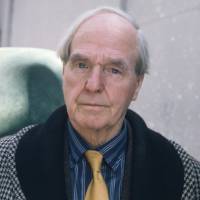
Portrait de Henri Moore par Allan Warren, 1973 - CC BY-SA 3.0
Henry Moore is the British sculptor whose monumental bronzes became landmarks of American public space. Born in 1898 in Castleford, Yorkshire, and working for most of his life at Perry Green, Hertfordshire, he became an international star in his own lifetime: a retrospective at the Museum of Modern Art in 1946, a monumental bronze at Lincoln Center, and major works in Dallas and Washington, D.C. He died in August 1986. Beyond his reclining figures and family groups, Moore produced a large body of original fine art prints – mostly color lithographs and etchings – that today offer collectors a direct way into his work.
Right now, Le Coin des Arts has two late color lithographs by Moore, both drawn in 1981 and released in 1983: “The Three Marys” (CGM 627, eight colors) and “Visitation” (CGM 629, six colors). Each comes from an edition of just 50 numbered impressions, printed on T.H. Saunders paper by Curwen Prints Ltd in London. The images are intimate in scale – 225 × 251 mm (about 8 7/8 × 9 7/8 in.) for The Three Marys, 251 × 225 mm for Visitation. We picked them for print quality, color, and condition.
Moore first trained as a teacher – not by choice – and then served in the army in World War I. Back home, a grant for veterans let him enroll in 1919 at the Leeds School of Art and then at the Royal College of Art in London. There he met Irina Radetsky; they married in 1929. Through the 1920s he studied old and modern art alike and worked out a personal idiom based on carving. By the 1930s, he ranked among Europe’s leading avant-garde sculptors.
World War II pushed Moore toward drawing. Starting in 1940, during the Blitz, he sketched Londoners sleeping in subway stations. These Shelter Drawings, such as Pink and Green Sleepers (1941), earned him an appointment as an official war artist. That same year, after bombs damaged his Hampstead house, he and Irina moved to Hoglands, a farmhouse at Perry Green that became their home and his studio for good.
The turning point came in 1946 – the year his daughter Mary was born – with a major retrospective at MoMA in New York. Two years later he won the International Prize for Sculpture at the 1948 Venice Biennale. American commissions followed. His Reclining Figure for Lincoln Center (1963–65) was completed at the Noack foundry in Berlin and installed in New York in 1965. In 1978, Three Forms Vertebrae was dedicated in Dallas, alongside architect I. M. Pei, and the National Gallery of Art in Washington, D.C. holds his Knife Edge Mirror Two Piece (1976–78). Casts of Large Two Forms stand at the Neuberger Museum of Art in Purchase, New York, and at the Art Gallery of Ontario in Toronto.
In the 1960s Moore’s forms grew larger and more abstract. Big shows at the Tate in London (1968) and at the Forte di Belvedere in Florence (1972) sealed his reputation. In 1978 he gave 36 sculptures to the Tate. A year earlier, in 1977, at 79, he had set up the Henry Moore Foundation with his family to support the arts, especially sculpture. As carving got harder physically, he turned more and more to lithography to develop ideas – which is exactly where our 1981 prints fit in. He worked until his death at Perry Green in August 1986.
Moore’s print catalog starts in 1931, but his output took off from the late 1960s as demand grew worldwide. His main lithography partner was Curwen in London. A good early example is Thirteen Standing Figures (1958), a color lithograph printed by the Curwen Press for publisher George Rainbird; the National Gallery of Art in Washington owns an impression (gift of Ruth Kainen), and the Cleveland Museum of Art and the Detroit Institute of Arts also hold the work. For etching, he used the Paris shop Lacourière et Frélaut, which printed the signed etching in the deluxe Elephant Skull album (1970), published in Geneva by Gérald Cramer. Late lithographs like ours were printed by Curwen Prints Ltd and published by the Raymond Spencer Company for the Foundation. In between came ambitious portfolios such as Stonehenge (1973, published 1974 by Ganymed in London), whose lithographs were partly printed by J. Wolfensberger in Zurich.
The go-to catalog raisonné is Henry Moore: Catalogue of Graphic Work by Gérald Cramer, Alistair Grant, and David Mitchinson, in four volumes: 1931–1972 (Geneva, 1973), 1973–1975 (1976), 1976–1979 (1980), and 1980–1984 (Patrick Cramer). Prints are cited by “CGM” numbers. “LH” numbers are something else: they refer to Moore’s sculpture catalog. The Foundation’s free online catalog lists colors, paper, printer, publisher, and edition size for each print.
Start with the CGM number. It lets you check the title, date, colors, image size, printer, and paper. If a sheet doesn’t match, ask why.
Edition size. Late lithographs often come in small editions – 50 impressions, numbered 1/50 to 50/50, for The Three Marys and Visitation. The numbering should match the catalog (see the printing process).
Signature. A numbered impression should normally carry Moore’s pencil signature. Check it carefully (see the signature).
Watch out for posters and reproductions. Exhibition posters and photomechanical reproductions are everywhere. Illustrated books can be misleading too: the regular edition of Elephant Skull (2,500 unsigned copies) has only reproductions, while just 150 deluxe copies contain an original signed etching.
Check the publisher line. For late lithographs, the catalog records the publisher – often the Raymond Spencer Company for the Henry Moore Foundation – and the printer, Curwen Prints Ltd. Documentation from the sale, an old gallery label, or an invoice adds to provenance.
Paper and condition. Light creams, buffs, and yellows fade in sunlight. Look for full margins, no foxing, and no mat burn. Read more on authenticity, framing, and what makes a print original.
We choose Moore’s prints with the same standards we apply to other sculptors who made prints, including Alexander Calder, Alberto Giacometti, Marino Marini, and Eduardo Chillida. Explore our engravings and lithographs and the modern art collection.
Henry Moore: Catalogue of Graphic Work, vols. 1–3, Gérald Cramer, Alistair Grant, and David Mitchinson, Geneva, 1973–1980 · Henry Moore: Catalogue of Graphic Work, vol. 4, 1980–1984, Patrick Cramer, Geneva · Henry Moore Foundation – Biography · Henry Moore Foundation – Visitation (CGM 629) · National Gallery of Art – Thirteen Standing Figures · National Gallery of Art – Knife Edge Mirror Two Piece

Secure payment
3DSecure 2.2

Free DHL Express delivery from €1,200
Carefully prepared parcel
Parcel tracking

Shipment insured
for the full value of the artwork, covering theft and damage

Fairest prices
Certificate of authenticity
Two galleries in Paris
Receive an email as soon as a new artwork is added for this artist
Your message has been sent ! We will get back to you as soon as possible.
Please fill in the form if you need further information such
Please fill in your email address, an email will be sent with a link to update your password.
You can now place orders and track your orders.
To save your wishlist, you can log in or create an account :
This is a 100% custom-made frame, carefully crafted by a professional framer. Finishes are available in light oak, white wood or black wood, with or without mat board and plexiglass. Delivery times may vary depending on the order, with an average lead time of 10 days.
This option will be offered during the cart step.



