
(1921-2012)

MATHIEU Georges
Galerie Jacques Dubourg, 1961
Poster AF15
200.00€
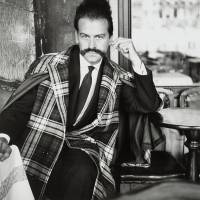
Portrait de Georges Mathieu par Barbara Niggl Radloff, 1961 - Aus dem Archiv des Münchner Stadtmuseums, Sammlung Fotografie, Archiv Barbara Niggl Radloff, Inventarnr. FM-2019/1.6.4.47 CC BY-SA 4.0
Georges Mathieu (January 27, 1921, Boulogne-sur-Mer – June 10, 2012, Boulogne-Billancourt) was the French painter behind lyrical abstraction, Europe’s answer to gestural painting in the years when Abstract Expressionism was taking shape in New York. He painted huge canvases in front of live audiences, sometimes in under an hour, gave them titles drawn from medieval French history, and pushed abstraction into design: airline posters, porcelain, tapestries and the French 10-franc coin. His lithographs capture the same lightning-fast, calligraphic line.
Le Coin des Arts tracks Mathieu’s work and offers his original prints when good impressions come up. Right now the gallery has one piece: the poster for his 1961 show at the Galerie Jacques Dubourg in Paris – an authentic period poster, not an original print. Hit the “follow the artist” button to hear about new arrivals.
Mathieu was born Georges Victor Adolphe Mathieu d’Escaudœuvres, a banker’s son, in Boulogne-sur-Mer on the Channel coast. He studied English and law at the University of Lille and taught English in Douai from 1942. With no art school training, he began painting in oils that same year. By 1946 he was showing abstract canvases at the Salon des moins de trente ans in Paris.
After moving to Paris in 1947, Mathieu set out to give the new gestural painting a name and a program. In December 1947 he helped launch a group show of fourteen painters at the Galerie du Luxembourg, first planned under the title “Towards Lyrical Abstraction.” In 1948 he co-organized “H.W.P.S.M.T.B.” at the Galerie Colette Allendy with Camille Bryen and critic Michel Tapié, its title built from the initials of Hartung, Wols, Picabia, Stahly, Mathieu, Tapié and Bryen.
Mathieu looked hard at America. In 1951 he took part in “Véhémences confrontées” at the Galerie Nina Dausset in Paris, an exhibition that put the Paris abstractionists face to face with Jackson Pollock and Willem de Kooning. A year later, in 1952, the Stable Gallery in New York gave him his first U.S. solo show of paintings, and published The Significant Message of Georges Mathieu. From 1953 he also ran the Paris magazine of the transatlantic shipping line United States Lines. The Museum of Modern Art in New York owns his Painting of 1947, one of his earliest abstract canvases.
In 1954 Mathieu turned painting into an event. La Bataille de Bouvines (April 25, 1954) opened a series of “battles.” On October 10, 1954, outside dealer Jean Larcade’s house in Saint-Germain-en-Laye, he painted Les Capétiens partout! – nearly 10 feet by 20 – in one hour and twenty minutes, squeezing paint straight from the tube; he staged this process for photographers, notably for Life magazine. The canvas now belongs to the Centre Pompidou. The same year New York’s Kootz Gallery showed his work. In 1956 he painted a 13-by-40-foot canvas before some 2,000 people at the Théâtre Sarah-Bernhardt in Paris, and in London he painted The Battle of Hastings. In 1957 he painted Seventh Avenue in New York and exhibited in Tokyo and Osaka. In 1959 he showed at documenta II in Kassel and painted Le Massacre de la Saint-Barthélemy in less than thirty minutes, with American jazz drummer Kenny Clarke keeping time.
The 1960s made Mathieu a public figure in France. After his 1961 exhibition at the Galerie Jacques Dubourg came a large retrospective at the Musée d’Art Moderne de la Ville de Paris (1963), about a hundred canvases at the Galerie Charpentier (1965) and a show at the Musée National d’Art Moderne (1967). He designed a Gobelins tapestry for the French pavilion at Expo 67 in Montreal, decoration for the Sèvres porcelain works, and in 1967 a series of travel posters for Air France, with destinations including New York. On July 31, 1974, his design was picked from 342 entries for the French 10-franc coin, minted until 1987. He was elected to the Académie des Beaux-Arts in 1975 and formally inducted on January 28, 1976.
New York continued to show him – at Wildenstein in 1979 and at Findlay in 1987, according to his gallery chronology. Mathieu died on June 10, 2012, in Boulogne-Billancourt and is buried in Montmartre Cemetery. A 2002 retrospective at the Jeu de Paume in Paris launched a revival that has gone international: a retrospective at the Long Museum in Shanghai in 2024, then “Georges Mathieu. Gesture, Speed, Movement” at the Monnaie de Paris, co-organized with the Centre Pompidou, from April 11 to September 7, 2025. In U.S. public collections, besides MoMA’s 1947 Painting and a 1958 ink drawing from the John S. Newberry Collection, the Solomon R. Guggenheim Museum holds an Untitled oil of 1959.
Check the signature. Mathieu hand-signed his lithographs in pencil, lower right, often with a date. A signature printed in the image does not count. See the signature.
Look for the edition number. Signed editions are usually numbered by hand at lower left (for example 45/100); artist’s proofs read “E.A.” See the printing process.
Don’t expect a catalog number. There is no published catalogue raisonné of Mathieu’s prints, so ask for a full description – date, technique, printer, edition size – instead.
Paper and margins. Arches or Rives wove with full margins is the norm; trimmed or sun-faded sheets lose value.
Condition and provenance. Bright color grounds fade easily, so check for discoloration as well as folds and foxing. A paper trail back to a period gallery is a plus.
Posters are not prints. Air France and exhibition posters are often listed as “original lithographs.” They are vintage posters, sometimes lithographically printed but produced in quantity with a printed signature. Watch out for modern offset reproductions too. Read our authenticity guarantee and our framing advice.
Mathieu’s prints are mainly lithographs, a medium that keeps the speed and spring of his brushwork: swooping lines, hooks and splatters set against white or saturated grounds. Leading Paris shops printed them, including the Mourlot workshop, generally on Arches or Rives paper. Exhibition posters – the Galerie Jacques Dubourg in 1961, the Galerie Charpentier in 1965 – and the 1967 Air France series form a separate, popular collecting field, but they are not original prints.
Authentication is handled by the Comité Georges Mathieu, set up in 2014 by Édouard Lombard, who holds the artist’s moral rights. It is the only body authorized to issue certificates of authenticity and is compiling the files for a future catalogue raisonné. Until that exists, date, printer, edition and provenance are what identify a Mathieu print.
The gallery also offers prints by artists who exhibited with Mathieu: Camille Bryen, Hans Hartung, Jean-Paul Riopelle, Karel Appel and Pierre Soulages. Browse the School of Paris and lyrical abstraction and our engravings and lithographs.
The Significant Message of Georges Mathieu, Stable Gallery, New York, 1952 · Georges Mathieu, Le Privilège d’être, 1967 · MoMA – Georges Mathieu, Painting, 1947 · MoMA – Georges Mathieu, Untitled, 1958 · Guggenheim – Georges Mathieu · Tate Etc. – Document: Georges Mathieu · Centre Pompidou – Les Capétiens partout! · Comité Georges Mathieu · Templon – Georges Mathieu chronology

Secure payment
3DSecure 2.2

Free DHL Express delivery from €1,200
Carefully prepared parcel
Parcel tracking

Shipment insured
for the full value of the artwork, covering theft and damage

Fairest prices
Certificate of authenticity
Two galleries in Paris
Receive an email as soon as a new artwork is added for this artist
Your message has been sent ! We will get back to you as soon as possible.
Please fill in the form if you need further information such
Please fill in your email address, an email will be sent with a link to update your password.
You can now place orders and track your orders.
To save your wishlist, you can log in or create an account :
This is a 100% custom-made frame, carefully crafted by a professional framer. Finishes are available in light oak, white wood or black wood, with or without mat board and plexiglass. Delivery times may vary depending on the order, with an average lead time of 10 days.
This option will be offered during the cart step.



