
(1904-1987)

HELION Jean
Strength of the sea VI, 1965
Lithograph LCD4402
345.00€
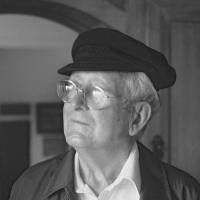
Cyril Deicha, CC BY-SA 4.0, via Wikimedia Commons
Jean Hélion was born Jean Bichier in Couterne, Normandy, on April 21, 1904, and died in Paris on October 27, 1987. He helped launch geometric abstraction in Paris in the early 1930s, then walked away from it in 1939 to paint men in hats, newspaper readers, and street life. Few French artists of his generation were as closely tied to the United States: he married a Virginian, built a studio in rural Virginia, showed in New York and Los Angeles, escaped from a German prison camp and wrote an American bestseller about it. Alongside his paintings he produced original lithographs that track every turn of his career.
Right now Le Coin des Arts has Force de la mer VI, an original lithograph from 1965, hand-signed in pencil and part of a series on the sea. We picked it, as we do every print, for the quality of the impression, the edition, the provenance, and the condition. Want to hear about the next one? Click "follow the artist" on this page.
Raised by his grandmother until he was eight, Hélion joined his parents in Amiens, trained as a pharmacist's assistant, and in 1920 enrolled in chemistry in Lille. He quit and moved to Paris in 1921, drafting for an architect and writing poetry. The paintings of Poussin and Philippe de Champaigne at the Louvre made him decide to paint. The Uruguayan modernist Joaquín Torres-García, who stayed in his studio, introduced him to Cubism, and in 1928 he showed two canvases at the Salon des Indépendants.
After meeting Theo van Doesburg in 1929 and visiting Piet Mondrian's studio, Hélion co-founded Art Concret in 1930 and co-wrote its manifesto. On February 15, 1931, he was a founding member of Abstraction-Création, with Auguste Herbin, Jean Arp, Georges Vantongerloo, and František Kupka. The group soon included the American Alexander Calder. Hélion's Equilibriums and Compositions of these years push Mondrian's grid toward curves and volumes; the Museum of Modern Art owns his Equilibrium (1934). He had his first solo show at the Galerie Pierre Loeb in Paris in 1932.
Hélion first came to the U.S. in 1932 to marry Jean Blair, a Virginian. The New York collector A. E. Gallatin bought his work for the Gallery of Living Art (renamed the Museum of Living Art in 1936), asked his advice, and invited him to lecture at New York University. Hélion showed at the John Becker Gallery in New York in January 1934 and at the Putzel Gallery in Los Angeles in October 1936, in a show organized by Marcel Duchamp. By the mid-1930s he was living in the U.S., splitting his time between Manhattan and Rockbridge Baths, Virginia, where he built a studio on the Maury River; his son Louis was born there on February 9, 1939. That same year, Au cycliste and Figure tombée ended his abstract period.
Hélion went back to France to enlist in 1940. He was captured on June 19, 1940, held at Stettin, and escaped on February 13, 1942. By October he was back in America, lecturing and speaking on the radio for Free France. His account of captivity, They Shall Not Have Me (1943), became a bestseller. In May 1942 the Virginia Museum of Fine Arts in Richmond showed 46 works by Hélion and his brother-in-law, the painter Pierre Daura. The Paul Rosenberg gallery in New York gave him shows in 1944 and 1945. He married Pegeen Vail, Peggy Guggenheim's daughter, in New York – they had three sons – and moved back to Paris for good in 1946.
In Paris, Hélion painted men in hats, nudes, then, from about 1951, still lifes and studio scenes from life. He married Jacqueline Ventadour in 1963, painted the street protests of May 1968, and received a retrospective at the Grand Palais in 1970. Losing his sight, he stopped painting in October 1983. The Centre Pompidou's centennial retrospective (December 8, 2004 – March 6, 2005) traveled to the Museu Picasso in Barcelona and then to the National Academy Museum in New York, its only U.S. venue, through October 9, 2005. Painters such as Roy Lichtenstein, Leland Bell, and Nell Blaine acknowledged his influence. Today his work is in the MoMA, the Metropolitan Museum of Art, the Art Institute of Chicago, the Albright-Knox in Buffalo, and the North Carolina Museum of Art. The largest U.S. holding is at the Eleanor D. Wilson Museum, Hollins University, in Roanoke, Virginia, which received close to 400 works from the Blair family and mounted Jean Hélion: Painting Is a Language (October 3 – December 15, 2024). Hollins's ties to the artist go back to 1944, when a campus exhibition led the university to buy his oil Abstraction (1938). In France, the Musée d'Art Moderne de Paris showed more than 150 of his works in La prose du monde (March 22 – August 18, 2024).
Hélion's first known print is an engraving from 1934, published in 23 Gravures, the portfolio put together by Anatole Jakovski (Éditions Orobitz, Paris, 1935; printed by Tanneur; edition of 50). MoMA holds an impression. After that, he turned mainly to lithography. Hollins owns his lithographs Éléments écartés (1934), Au cycliste (c. 1939), and Fille au mannequin (c. 1955). Later sheets include newspaper readers (1951), the Force de la mer series (1965), Les Feux de mai (1969, color lithograph published by the Association française des amateurs d'estampes), and the portfolio Les Passants (1986).
As far as we know, there is no published catalogue raisonné of Hélion's prints, so you won't find a standard catalog number for them. The go-to monograph is Henry-Claude Cousseau's Hélion (Éditions du Regard, 1992). The Association Jean Hélion is working on a catalogue raisonné of the works on paper.
Check the signature and number. Published lithographs are signed "Hélion" in pencil and numbered, often in small editions (50 for Force de la mer). Learn more about signatures and editions.
Watch for double dates. A print dated "1933-1970" is a later lithograph based on an early abstract design. It's a real print, but it isn't from the 1930s.
Know what you're buying. Portfolio sheets (Les Passants) are original prints; unsigned plates from art magazines are worth much less, and posters or reproductions are not original prints at all.
Ask about provenance and condition. With no print catalog, an old invoice, a publisher's stamp or a Galerie Karl Flinker label helps. Look for full margins, no foxing or fading, and use UV-filtering glazing. See our framing and authenticity pages.
You can also browse prints by Hélion's Abstraction-Création colleagues Alexander Calder, Jean Arp, Auguste Herbin and Sonia Delaunay, and by Roy Lichtenstein, or explore modern art and our engravings and lithographs.
Henry-Claude Cousseau, Hélion, Éditions du Regard, 1992 · Jean Hélion, They Shall Not Have Me, 1943 · Eleanor D. Wilson Museum, Hollins University – Jean Hélion: Painting Is a Language (2024) · MoMA – plate from 23 Gravures · Library of Virginia – Pierre Daura · The Christian Science Monitor – National Academy retrospective, 2005 · Centre Pompidou – Jean Hélion (2004-2005)

Secure payment
3DSecure 2.2

Free DHL Express delivery from €1,200
Carefully prepared parcel
Parcel tracking

Shipment insured
for the full value of the artwork, covering theft and damage

Fairest prices
Certificate of authenticity
Two galleries in Paris
Receive an email as soon as a new artwork is added for this artist
Your message has been sent ! We will get back to you as soon as possible.
Please fill in the form if you need further information such
Please fill in your email address, an email will be sent with a link to update your password.
You can now place orders and track your orders.
To save your wishlist, you can log in or create an account :
This is a 100% custom-made frame, carefully crafted by a professional framer. Finishes are available in light oak, white wood or black wood, with or without mat board and plexiglass. Delivery times may vary depending on the order, with an average lead time of 10 days.
This option will be offered during the cart step.



