
(1908-1994)

BILL Max
Anneau en cinq parties, 1970
Silkscreen LCD8640
750.00€

BILL Max
Untitled, 1972
Silkscreen LCD7588
850.00€

BILL Max
Square, 1970
Silkscreen LCD7549
850.00€

BILL Max
No title, 1972
Silkscreen LCD7345
850.00€

BILL Max
Untitled, 1970
Silkscreen LCD7317
850.00€

Max BILL
Untitled, 1982
Sold
Looking for a similar artwork?
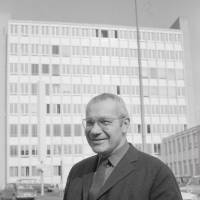
Fotograf: Vogt, Marcel, CC BY-SA 4.0, via Wikimedia Commons
Swiss artist Max Bill was born on December 22, 1908, in Winterthur and died on December 9, 1994, in Berlin. Trained at the Bauhaus, he became the driving force of Concrete art: geometric work built from rules set in advance, with no reference to nature. He was also an architect, a type and poster designer, the co-founder of the Ulm School of Design, and the man behind the Ulm stool and the classic Junghans wall clocks and watches. For collectors, his fine art prints, above all his color screenprints, are the most direct way into a body of work that runs from industrial design to monumental granite sculpture.
Le Coin des Arts currently has four original screenprints by Max Bill: two untitled sheets from 1972, Carré (“Square,” 1970), and another untitled print from 1970. We picked them for sharp, even color, clean margins, clear edition information, and condition. With Bill, that matters: one faded color and the whole system of the composition is off.
Bill started out as an apprentice silversmith at Zurich’s Kunstgewerbeschule (1924–1927). A first prize in a 1925 poster contest for the chocolate company Suchard paid his way to the Bauhaus in Dessau, where he enrolled in April 1927 after being thrown out of the Zurich school. His teachers included Josef Albers (who would later bring Bauhaus teaching to Black Mountain College and Yale), Wassily Kandinsky, Paul Klee, László Moholy-Nagy, and Oskar Schlemmer. He moved to Zurich in 1929 and made his name as a graphic designer. Several of his 1930s posters, including designs for the Neubühl housing exhibition (1931) and the Swiss Werkbund (1934), are now in the Museum of Modern Art, which lists 38 works by Bill online.
In 1931 Bill married cellist and photographer Binia Spoerri. He met Hans Arp and Piet Mondrian, joined the Paris group Abstraction-Création, and showed with it from 1933, the year of his first sculptures. In 1935 he made the first of his Endless Ribbon sculptures, a twisting loop related to the Möbius strip. He designed the Swiss pavilion at the 1936 Milan Triennale, co-founded the Swiss artists’ group Allianz in 1937, and in 1944 organized the international show Konkrete Kunst at the Kunsthalle Basel. His 1949 essay on the mathematical way of thinking in modern art laid out the program.
The year 1951 changed everything. Bill had a show at the Museu de Arte de São Paulo and won the grand prize for sculpture at the first São Paulo Biennial with Tripartite Unity, sparking a generation of Brazilian Concrete artists. He then co-founded the Hochschule für Gestaltung (HfG) in Ulm, West Germany, designed its campus, and served as its first rector; the school was officially inaugurated in 1955. He showed at documenta in Kassel in 1955, 1959, and 1964. Clashes with younger faculty, notably Tomás Maldonado, pushed him out of the rectorship in 1956, and by 1957 he was back in his Zurich studio.
Bill’s first U.S. exhibition took place at the Staempfli Gallery in New York in 1963. The big moment came in 1974: the Albright-Knox Art Gallery in Buffalo organized Max Bill: Painting, Sculpture and Graphics 1928–1974 (September 28 – November 17, 1974), curated by James N. Wood in close cooperation with the artist. Billed as the first comprehensive exhibition of his work in the United States, it brought together more than 140 works and traveled to the Los Angeles County Museum of Art, the San Francisco Museum of Art, and the Corcoran Gallery of Art in Washington, D.C. Today his prints can be seen in American collections such as MoMA, which owns his 1942 linocut from 10 Origin, and the Museum of Fine Arts, Houston, which holds the 1969 screenprint Four Equal Groups Around Four White Squares.
Back home Bill entered politics: Zurich city council from 1961, then the Swiss National Council from 1967 to 1971. From 1967 to 1974 he taught environmental design at the Hochschule für bildende Künste in Hamburg. His public sculptures include the Pavillon-Skulptur on Zurich’s Bahnhofstrasse (1983) and Continuity (1986), a five-meter granite ribbon outside Deutsche Bank in Frankfurt. He also designed the “Bilden und Gestalten” section of Expo 64, the Swiss national exhibition in Lausanne, and was honored with a retrospective at the Kunsthaus Zürich in 1968–69. He married art historian Angela Thomas in 1991, received Japan’s Praemium Imperiale for sculpture in 1993, and died of a heart attack at Berlin’s Tegel Airport, on his way home from presenting his design for an extension of the Bauhaus-Archiv.
Bill’s key early print project is Quinze variations sur un même thème (Paris, Éditions des Chroniques du Jour, 1938): sixteen sheets in lithography, edition of 120, showing how one spiral generates a triangle, a square, a pentagon, and an octagon. It is his method in a single portfolio. From the 1960s on, screenprinting took over: flat, saturated color and razor-sharp edges suited him perfectly. Look for sheets published by Edition Domberger in Stuttgart (including a plate for its 1968 screenprint calendar, edition of 100), the Erker-Presse in St. Gallen, and XXe Siècle in Paris.
The standard reference for the early prints is Max Bill. Das druckgrafische Werk bis 1968, edited by Herbert Bessel for the 1968–69 exhibition at the Kunsthalle Nürnberg; as the title says, it stops in 1968. Max Bill. Die grafischen Reihen (Hatje, 1995), with a foreword by Angela Thomas Bill, covers his graphic series with his own comments. When a dealer quotes a catalog number, ask which book it comes from.
Check the numbering. Signed screenprints are usually numbered in pencil, in Arabic or Roman numerals (the Houston impression is numbered out of LXVI). Artist’s proofs exist too. More on the printing process.
Look for a pencil signature. Original prints are hand-signed and usually dated in pencil, lower right. A signature printed in the image means a poster. See the signature.
Don’t confuse posters with prints. Bill designed many exhibition posters, often screenprinted. His Munich 1972 Olympics design came in three forms from Edition Olympia: 200 signed and numbered impressions, posters with a printed signature, and open-edition reproductions. Only the first is an original print.
Know the publisher. An Erker-Presse blindstamp or a Domberger credit helps confirm what you’re looking at. A plate removed from a calendar or book should be sold as one.
Inspect the condition. Bill’s flat colors show every scratch, crease, and bit of fading. Check the margins for foxing and use UV-filtering glazing for framing. Our guarantees are on the authenticity page.
We select Max Bill prints for printing quality and condition. See them next to Josef Albers, Hans Arp, Victor Vasarely, Auguste Herbin, and Gottfried Honegger, or explore modern art and our engravings and lithographs.
Max Bill, exhibition catalog, Albright-Knox Art Gallery, Buffalo, 1974 · Herbert Bessel (ed.), Max Bill. Das druckgrafische Werk bis 1968, Albrecht-Dürer-Gesellschaft, Nuremberg, 1968 · Max Bill. Die grafischen Reihen, Hatje, Stuttgart, 1995 · Buffalo AKG Art Museum – Max Bill, 1974 · MoMA – Max Bill · Museum of Fine Arts, Houston – Four Equal Groups Around Four White Squares · Praemium Imperiale – Max Bill

Secure payment
3DSecure 2.2

Free DHL Express delivery from €1,200
Carefully prepared parcel
Parcel tracking

Shipment insured
for the full value of the artwork, covering theft and damage

Fairest prices
Certificate of authenticity
Two galleries in Paris
Receive an email as soon as a new artwork is added for this artist
Your message has been sent ! We will get back to you as soon as possible.
Please fill in the form if you need further information such
Please fill in your email address, an email will be sent with a link to update your password.
You can now place orders and track your orders.
To save your wishlist, you can log in or create an account :
This is a 100% custom-made frame, carefully crafted by a professional framer. Finishes are available in light oak, white wood or black wood, with or without mat board and plexiglass. Delivery times may vary depending on the order, with an average lead time of 10 days.
This option will be offered during the cart step.



