
(1902-1968)

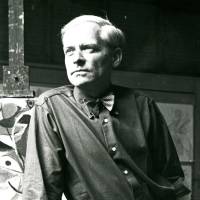
Portrait d'Ernst Wilhelm Nay par Elisabeth Nay-Scheibler, 1948 - CC BY-SA 4.0 Privatarchiv Elisabeth Nay-Scheibler
German painter Ernst Wilhelm Nay was born in Berlin on June 11, 1902, and died in Cologne on April 8, 1968. Banned by the Nazis, he emerged after World War II as one of the most important painters in West Germany and one of the boldest colorists of postwar abstraction. His signature disc paintings (Scheibenbilder) brought him international fame, and in 1960 the Solomon R. Guggenheim Foundation awarded him its prize for Germany. Nay also made fine art prints – color lithographs, etchings and aquatints, screenprints – that translate his painting into pure, saturated color on paper.
Le Coin des Arts tracks Nay’s work and currently offers one original lithograph: La Main (1967), from the last phase of his career, when primary colors and sign-like shapes took over from the discs. We add other Nay prints when strong impressions come up, selected for printing quality, edition, provenance and condition. Click “follow the artist” to be notified.
Nay’s father, Hermann Johannes Nay, a senior official at the Imperial Treasury, was killed in Belgium in 1914. The boy finished high school at the boarding school of Schulpforta in 1921 and took night classes in figure drawing in Berlin. Painter Karl Hofer got him a scholarship to his class at the Berlin academy, where Nay studied from 1925 to 1928. In 1928 a trip to Paris – and the paintings of Poussin – convinced him that color was the basis of everything. Success came quickly: in 1930 the Nationalgalerie in Berlin bought one of his beach scenes, and in 1931 the Prussian Academy of Arts awarded him a nine-month fellowship at the Villa Massimo in Rome. Back in Germany, Munich dealer Günther Franke became his longtime champion.
In 1937, with modern artists under growing pressure in Germany, Lübeck museum director Carl Georg Heise arranged an invitation for Nay to Edvard Munch’s studio near Oslo. Nay spent months on Norway’s Lofoten Islands in 1937 and again in 1938, painting the Arctic coast in heavy outlines and hot color. That same year, two of his paintings were shown in the Nazi “Degenerate Art” exhibition; ten more were confiscated and he was barred from exhibiting. Drafted in 1940, he worked as a mapmaker in occupied France and kept painting. He was released from American captivity in May 1945.
His Berlin studio destroyed, Nay moved to Hofheim am Taunus, near Frankfurt, where he painted the mythological Hecate paintings. He showed at the Venice Biennale in 1948, had his first retrospective at the Kestner-Gesellschaft in Hanover in 1950, and in 1951 moved to Cologne for good. In 1955 he published his color theory, Vom Gestaltwert der Farbe, and began the Scheibenbilder: rhythmic fields of round color spots that made him internationally known. The same year brought documenta I in Kassel; in 1956 he had the German pavilion in Venice to himself. He went on to documenta II (1959) and documenta III (1964), where three giant ceiling-hung “eye paintings” caused an uproar, and he also exhibited at the São Paulo Biennial. From 1965 his late style reduced painting to primary colors and emblematic signs.
Honors followed at home, too: the Berlin Art Prize in 1964 and, in 1967, the Grand Cross of the Order of Merit of the Federal Republic of Germany. A touring retrospective went from Stuttgart to Berlin, Mannheim and Vienna in 1966–67. Nay died of heart failure in Cologne on April 8, 1968, at 65. Since then, his reputation has only grown: memorial shows in Cologne, Berlin, Frankfurt and Hamburg in 1969, a centenary exhibition in 2002, the Schirn Kunsthalle’s survey of the 1960s paintings in 2009, and a major retrospective at the Hamburger Kunsthalle (March 25–August 7, 2022) that traveled to Duisburg in 2023. The Hamburg museum pointed to recent purchases by Tate Modern and the Centre Pompidou as signs of his renewed standing.
Nay’s American career began in 1955 with a solo show at the Kleemann Galleries in New York. Two years later the Museum of Modern Art included him in “German Art of the 20th Century” (October 2–December 1, 1957), and in 1964 MoMA showed his prints in “Contemporary Painters and Sculptors as Printmakers”. In 1960 the Solomon R. Guggenheim Foundation gave him its national award for Germany. Today MoMA lists seven works by Nay in its online collection, including a 1957 etching, drypoint and aquatint in an edition of 35, gift of Mrs. Gertrud A. Mellon. The National Gallery of Art in Washington holds a 1952 color lithograph from the collection of Ruth Cole Kainen, given in 2012.
The catalog raisonné of the prints is Karlheinz Gabler, E. W. Nay. Die Druckgraphik 1923-1968 (Stuttgart: Belser, 1975). Dealers and museums cite it as “Gabler” plus a number. Examples: the Washington lithograph of 1952 is Gabler 39; Algraphie 1953-2 (edition of 40) is Gabler 43; the color aquatint of 1963 is Gabler 68; a large 1968 color lithograph is Gabler 92. Many of Nay’s prints carry plain descriptive titles – technique, year, number – so always match title and Gabler number together.
Most of the prints are lithographs, some drawn on aluminum plates (algraphy), but Nay also worked in intaglio. His 1963 color aquatint was printed in Paris by Georges Visat for the Overbeck-Gesellschaft of Lübeck in an edition of 150. Early 1950s editions are small – often a few dozen impressions – while the color lithographs of the 1960s were issued in larger runs. The 1957 MoMA etching, drypoint and aquatint (edition of 35), made in the years of the disc paintings, is a good example of his work on copper.
Check the Gabler number. It confirms the date, technique, edition size and publisher.
Edition size. Editions range from a few dozen to 150, and up to 300 for some late lithographs. See the printing process.
Signature vs. estate. Lifetime impressions are pencil-signed “Nay,” often with a two-digit year. Some 1968 lithographs, finished around the time of his death, bear instead the handwritten note “Nachlass Nay: Elisabeth Nay,” added by his widow. They are authentic estate impressions, but not artist-signed, and should be priced and described accordingly. See the signature.
Provenance and publisher. Sheets issued by German collectors’ societies such as the Overbeck-Gesellschaft, or with an estate or Gabler-collection inscription, have a documented history – ask for it.
Condition. Nay’s intense colors fade in light. Look for toning, foxing and old tape, and use museum-quality framing.
Watch out for reproductions. Exhibition posters, offset prints after paintings and book illustrations are not original prints. Read our authenticity guarantee and what makes a print original.
We show Nay alongside other leaders of postwar abstraction: Hans Hartung, Karel Appel, Serge Poliakoff, Adolph Gottlieb and Sam Francis. Browse lyrical abstraction and our engravings and lithographs.
Karlheinz Gabler, E. W. Nay. Die Druckgraphik 1923-1968, Stuttgart: Belser, 1975 · Werner Haftmann, E. W. Nay, 1960 · MoMA – Ernst Wilhelm Nay · National Gallery of Art – Untitled, 1952 · Deutsche Biographie – Nay · Hamburger Kunsthalle – Retrospective 2022

Secure payment
3DSecure 2.2

Free DHL Express delivery from €1,200
Carefully prepared parcel
Parcel tracking

Shipment insured
for the full value of the artwork, covering theft and damage

Fairest prices
Certificate of authenticity
Two galleries in Paris
Receive an email as soon as a new artwork is added for this artist
Your message has been sent ! We will get back to you as soon as possible.
Please fill in the form if you need further information such
Please fill in your email address, an email will be sent with a link to update your password.
You can now place orders and track your orders.
To save your wishlist, you can log in or create an account :
This is a 100% custom-made frame, carefully crafted by a professional framer. Finishes are available in light oak, white wood or black wood, with or without mat board and plexiglass. Delivery times may vary depending on the order, with an average lead time of 10 days.
This option will be offered during the cart step.

