
(1898-1976)

CALDER Alexander
Push the Word, 1978
Lithograph LCD8570
2 600.00€

CALDER Alexander
The crazy girls of Saché, 1975
Lithograph LCD6807
250.00€

CALDER Alexander
Mama citron et Un patriote lithohraphe, 1975
Lithograph LCD6809
250.00€

CALDER Alexander
Joueurs de cartes I et Joueur de cartes II, 1975
Lithograph LCD6806
250.00€
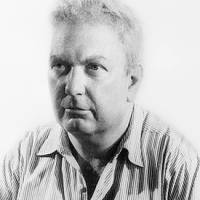
Carl Van Vechten, Public domain, via Wikimedia Commons
Alexander Calder (born July 22, 1898, in Lawnton, Philadelphia; died November 11, 1976, in New York City) invented the mobile and changed the course of American sculpture. An engineer by training, he made his name in Paris in the late 1920s with a wire circus, turned to pure abstraction in 1930, and went on to fill plazas from Chicago to Mexico City with monumental stabiles. He was the youngest artist the Museum of Modern Art had honored with a full retrospective, and in 1952 he won the top sculpture prize at the Venice Biennale. Collectors also prize his graphic work: bold color lithographs, etchings and illustrated books.
Le Coin des Arts has three original color lithographs from 1975 in stock, all from Derrière le miroir no. 212, published by Maeght in Paris and printed by Arte: Les Folles de Saché; Mama citron and Un patriote lithographe; and Joueurs de cartes I and Joueur de cartes II. Witty, figurative and full of primary color, these are late Calder at his liveliest. We picked them for their printing quality, bright color and condition.
Calder was the third sculptor in his family. His grandfather Alexander Milne Calder created the giant William Penn atop Philadelphia City Hall; his father Alexander Stirling Calder was a well-known sculptor, and his mother Nanette Lederer a painter. The family moved constantly, to Arizona, Pasadena, Croton-on-Hudson and San Francisco, where Sandy finished high school. He earned a mechanical engineering degree from the Stevens Institute of Technology in Hoboken, New Jersey, on June 17, 1919, then drifted through jobs, including stoking a ship’s boiler and keeping time at a logging camp in Washington State. In 1922 he enrolled at the Art Students League, studying with John Sloan and George Luks, and by 1924 he was illustrating sporting events and the Ringling Bros. and Barnum & Bailey Circus for the National Police Gazette.
Calder moved to Paris in 1926 and set up a studio on rue Daguerre. That fall he began Cirque Calder, a hand-operated miniature circus he performed for friends and critics; the Whitney Museum later bought it, in 1983, after raising a million dollars in fifteen days. His wire sculptures were first shown in New York at the Weyhe Gallery (February 1928), then in Paris and Berlin in 1929. Sailing to New York in June 1929, he met Louisa James; they married on January 17, 1931. In October 1930 a visit to Piet Mondrian’s studio pushed him into abstraction. His first abstract works appeared at the Galerie Percier in 1931 with a preface by Fernand Léger; Marcel Duchamp named the moving pieces “mobiles,” and Jean Arp called the still ones “stabiles.”
In 1933 the Calders bought a run-down farmhouse in Roxbury, Connecticut, which remained their American base. New York dealer Pierre Matisse showed Mobiles by Alexander Calder in April 1934 and, in 1937, the first large stabiles, Devil Fish and Big Bird. His first retrospective opened in Springfield, Massachusetts, in November 1938. Then, from September 29, 1943, to January 16, 1944, MoMA presented Alexander Calder: Sculptures and Constructions, organized by James Johnson Sweeney and Duchamp and extended by popular demand. Curt Valentin’s Buchholz Gallery showed him in New York in the late 1940s and early 1950s, and the Perls Galleries did so regularly in the 1960s and 1970s. In 1952 Calder represented the United States at the Venice Biennale and won the Grand Prize for sculpture; in 1958 his sculpture Pittsburgh took first prize for sculpture at the Carnegie Institute’s Pittsburgh Bicentennial International.
From 1953 Calder also lived in Saché, France, where he built a large studio in 1963. The Solomon R. Guggenheim Museum mounted a retrospective curated by Thomas M. Messer (November 6, 1964, to January 31, 1965). Public art made him a household name: La Grande Vitesse in Grand Rapids, Michigan (1969), was the first public artwork funded by the National Endowment for the Arts, and Flamingo was dedicated in Chicago’s Federal Center Plaza on October 25, 1974, during “Alexander Calder Day.” He painted Braniff jets and the first BMW Art Car. On October 14, 1976, the Whitney Museum of American Art opened Calder’s Universe, curated by Jean Lipman; Calder died less than a month later. President Gerald Ford awarded him the Presidential Medal of Freedom posthumously in January 1977. The Calder Foundation was established in New York in 1987 by his grandson Alexander S. C. Rower and the Calder family.
Calder’s printed work starts with books: the Fables of Aesop (Harrison of Paris, 1931, 52 drawings) and Three Young Rats and Other Rhymes (Curt Valentin, 1944, edited by Sweeney), both in MoMA’s collection. In 1944 he made The Big I, a soft-ground etching printed at Atelier 17 in New York and published in an edition of 30; impressions are at MoMA, the National Gallery of Art and the Smithsonian American Art Museum (learn more about intaglio printing). Most Calder prints on the market, though, are lithographs made with his Paris dealer Aimé Maeght. The gallery’s journal Derrière le miroir served as his exhibition catalog from no. 31 (July 1950) onward, with original lithographs bound in; the later issues were printed by Adrien Maeght’s Imprimerie Arte. No. 212 (January 1975), with an essay by Brazilian critic Mário Pedrosa, includes Les Folles de Saché, Mama citron, Un patriote and the card players. Maeght also published Fêtes (1971), a Jacques Prévert text with Calder’s embossed etchings. To our knowledge there is no published catalogue raisonné of Calder’s prints, so each sheet is identified by title, date, publisher, printer, issue number and edition size.
Signed or unsigned? Lithographs from Derrière le miroir are genuine original prints, but the regular issue is unsigned, unnumbered and usually folded at the center. Only the small deluxe edition on Arches paper is hand-signed. Expect a big price gap between the two.
The signature. Calder signed his editioned prints in pencil. He died in 1976, so no later print can bear his signature. The Calder Foundation warns that a signature alone authenticates nothing and publishes a list of lithographs and screenprints he never made or authorized.
Check the credits. Look for the Maeght publisher and Arte printer lines, and compare size and colors with a documented impression.
Condition matters. Calder’s flat primary colors reveal any fading or light-staining. Examine the paper tone, the center fold and the margins.
Watch out for. Exhibition posters, “after Calder” reproductions, posthumous screenprints and the small reproductions from the 1964 book Calder’s Circus. Read our authenticity guarantee and see our framing options.
Explore more prints by artists connected with Calder: Joan Miró, Fernand Léger, Jean Arp, Jean Tinguely and Jesús Rafael Soto. Browse kinetic art and Op Art, our fine art prints and lithographs and our illustrated books.
Alexander Calder, Calder: An Autobiography with Pictures, Pantheon Books, New York, 1966 · Jed Perl, Calder: The Conquest of Time, Knopf, 2017 · Jed Perl, Calder: The Conquest of Space, Knopf, 2020 · Calder Foundation – Chronology 1937–1945 · Calder Foundation – Chronology 1963–1976 · MoMA – The Big I · MoMA – Fables of Aesop · Gerald R. Ford Library – Medal of Freedom recipients, 1977 · Calder Foundation – Misattributed works

Secure payment
3DSecure 2.2

Free DHL Express delivery from €1,200
Carefully prepared parcel
Parcel tracking

Shipment insured
for the full value of the artwork, covering theft and damage

Fairest prices
Certificate of authenticity
Two galleries in Paris
Receive an email as soon as a new artwork is added for this artist
Your message has been sent ! We will get back to you as soon as possible.
Please fill in the form if you need further information such
Please fill in your email address, an email will be sent with a link to update your password.
You can now place orders and track your orders.
To save your wishlist, you can log in or create an account :
This is a 100% custom-made frame, carefully crafted by a professional framer. Finishes are available in light oak, white wood or black wood, with or without mat board and plexiglass. Delivery times may vary depending on the order, with an average lead time of 10 days.
This option will be offered during the cart step.



