
(1898-1976)

CALDER Alexander
Push the Word, 1978
Lithograph LCD8570
2 600.00€

CALDER Alexander
The crazy girls of Saché, 1975
Lithograph LCD6807
250.00€

CALDER Alexander
Mama citron et Un patriote lithohraphe, 1975
Lithograph LCD6809
250.00€

CALDER Alexander
Joueurs de cartes I et Joueur de cartes II, 1975
Lithograph LCD6806
250.00€
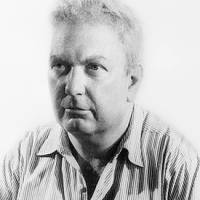
Carl Van Vechten, Public domain, via Wikimedia Commons
Alexander Calder (born 22 July 1898 in the Lawnton district of Philadelphia; died 11 November 1976 in New York) is the sculptor who set modern art in motion. Trained as an engineer, he reached Paris in 1926, entertained the avant-garde with his miniature Cirque Calder, turned to abstraction after seeing Mondrian’s studio and, from 1931, made the hanging sculptures Marcel Duchamp christened mobiles. Winner of the sculpture prize at the 1952 Venice Biennale, he divided his later life between Connecticut and the Loire valley. Alongside mobiles, stabiles and gouaches he left a substantial body of colour lithographs, etchings and illustrated books, many of them published in Paris by Maeght.
Le Coin des Arts currently offers three original colour lithographs from 1975, printed by Arte for Maeght’s Derrière le miroir no. 212: Les Folles de Saché; Mama citron with Un patriote lithographe; and Joueurs de cartes I with Joueur de cartes II. Playful and figurative, they show the late Calder at his most light-hearted, and each sheet has been chosen for the freshness of its colour, the quality of the printing and its condition.
Calder came from three generations of sculptors. His grandfather, Alexander Milne Calder, was born in Aberdeen in 1846, emigrated to Philadelphia in 1868 and modelled the colossal William Penn that crowns its City Hall; his father, Alexander Stirling Calder, was also a sculptor, and his mother, Nanette Lederer, a painter. After a peripatetic childhood between Arizona, California and New York, Sandy Calder chose mechanics, graduating from the Stevens Institute of Technology in Hoboken on 17 June 1919. Odd jobs followed – stoker on a steamer, timekeeper in a logging camp – before he enrolled at the Art Students League in New York in 1922, studying with John Sloan and George Luks, and drew sporting events and the Ringling Bros. circus for the National Police Gazette.
Calder’s road to Paris ran through England. On 2 July 1926 he signed on as a deckhand aboard the Galileo, a British freighter bound for Hull, where he landed on 19 July before taking the noon train to London and continuing to France. By late August he had a studio at 22 rue Daguerre, and that autumn he began the Cirque Calder, a mechanised circus of wire and found materials that he performed for audiences until it filled five suitcases. His wire portraits – Josephine Baker among them – were shown at the Weyhe Gallery in New York (1928), the Galerie Billiet-Pierre Vorms in Paris (1929, with a preface by Jules Pascin) and Neumann-Nierendorf in Berlin. In December 1928 he wrote to Joan Miró proposing a meeting, and in June 1929, crossing to New York, he met Louisa James, whom he married on 17 January 1931.
A visit to Piet Mondrian’s studio in October 1930 changed everything. Calder’s first wholly abstract constructions were shown at the Galerie Percier in April 1931, introduced by Fernand Léger. That autumn Duchamp suggested the word “mobile” for his moving works, exhibited at the Galerie Vignon in February 1932, while Jean Arp coined “stabile” for the static ones. In 1933 the Calders bought an old farmhouse at Roxbury, Connecticut. London saw the new work in December 1937, when the Mayor Gallery mounted Calder: Mobiles and Stabiles; earlier that year he had built the Mercury Fountain for the Spanish Republic’s pavilion at the Paris World’s Fair, where it stood alongside Picasso’s Guernica.
The Museum of Modern Art gave Calder a retrospective in 1943–44, curated by James Johnson Sweeney and Duchamp. In Paris, his 1946 show at the Galerie Louis Carré carried Jean-Paul Sartre’s essay “Les mobiles de Calder”, and his first exhibition at the Galerie Maeght followed in 1950. He represented the United States at the 1952 Venice Biennale and took the Grand Prize for sculpture. From November 1953 he had a house at Saché, in Touraine; in 1958 came the Spirale for UNESCO. British interest grew steadily: gouache shows at the Lincoln Gallery (1961) and Brook Street Gallery (1962) preceded Alexander Calder: Sculpture – Mobiles, organised by the Arts Council of Great Britain at the Tate Gallery from 4 July to 12 August 1962, with a catalogue text by Sweeney.
In 1963 Calder completed a vast studio at Le Carroi, above the Indre valley, and had his monumental stabiles fabricated at an ironworks in Tours. Retrospectives followed at the Guggenheim (1964–65), the Musée National d’Art Moderne in Paris (1965) and the Fondation Maeght (1969). In London, the Grosvenor Gallery showed his mobiles beside Miró’s prints in 1964 and the Institute of Contemporary Arts presented Calder – The Painter in 1966. Public commissions multiplied, from Man at Expo 67 in Montreal to Flamingo in Chicago (1974). Calder died in New York on 11 November 1976, weeks after the Whitney opened Calder’s Universe. Tate holds Antennae with Red and Blue Dots (c.1953), and Tate Modern’s Alexander Calder: Performing Sculpture (11 November 2015 – 3 April 2016) reintroduced him to a new British public.
Calder’s graphic work begins with books: 52 line drawings for the Fables of Aesop (Harrison of Paris, 1931) and 85 illustrations for Three Young Rats (Curt Valentin, 1944). In wartime New York he worked at Atelier 17, the workshop of the English printmaker Stanley William Hayter; his soft-ground etching The Big I (1944), editioned at 30, is in the British Museum as well as at MoMA (see intaglio). The core of his printed œuvre, however, is lithography produced with Aimé Maeght. The gallery’s review Derrière le miroir accompanied his shows from no. 31 (July 1950, two colour lithographs) into the 1970s, the later issues printed at Adrien Maeght’s Imprimerie Arte. No. 212 (January 1975), with a text by the Brazilian critic Mário Pedrosa, contains the lithographs Les Folles de Saché, Mama citron, Un patriote and the card-player sheets. Maeght also published Fêtes (1971), Jacques Prévert’s homage illustrated with embossed etchings. As far as we know, no catalogue raisonné of Calder’s prints has been published; the Calder Foundation in New York records his work in its archive. A print is therefore identified by title, date, publisher, printer, Derrière le miroir number and edition.
Review sheet or deluxe impression? Lithographs bound into Derrière le miroir are original prints on wove paper, unsigned and unnumbered, often with a central fold; only the limited deluxe issue on Arches is signed. Price should reflect the difference.
Signature. Calder signed his editioned prints in pencil. He died in 1976, so nothing printed afterwards can carry his hand. The Calder Foundation stresses that a signature proves nothing on its own and lists lithographs and screenprints he never made or authorised.
Publisher and printer. Check the Maeght and Arte credits, the sheet size and the colours against a reference impression.
Condition. Calder’s flat reds, yellows and blacks show every trace of light-staining; inspect the paper tone, the centre fold and the margins.
Pitfalls. Exhibition posters, “after Calder” reproductions, posthumous screenprints and the small plates from Calder’s Circus (1964) are widespread. Our guarantees are set out on the authenticity page, and our framing service will present your print properly.
The gallery also selects prints by artists whose paths crossed Calder’s: Joan Miró, Fernand Léger, Jean Arp, Pol Bury and Jean Tinguely. Explore kinetic art and Op Art, modern art and our engravings and lithographs.
Alexander Calder, Calder: An Autobiography with Pictures, Pantheon Books, 1966 · Jed Perl, Calder: The Conquest of Time (2017) and Calder: The Conquest of Space (2020) · Achim Borchardt-Hume (ed.), Alexander Calder: Performing Sculpture, exhibition catalogue, Tate Modern, 2015 · Alexander Calder: Sculpture – Mobiles, Arts Council of Great Britain / Tate Gallery, 1962 · Tate – Antennae with Red and Blue Dots · British Museum – Alexander Calder · Calder Foundation – Tate Gallery, 1962 · Calder Foundation – Misattributed works · Toledo Museum of Art – Derrière le miroir no. 212

Secure payment
3DSecure 2.2

Free DHL Express delivery from €1,200
Carefully prepared parcel
Parcel tracking

Shipment insured
for the value of the artwork, covering theft and damages

Fairest prices
Certificate of authenticity
Two galleries in Paris
Receive an email as soon as a new artwork is added for this artist
Your message has been sent ! We will get back to you as soon as possible.
Please fill in the form if you need further information such
Please fill in your email address, an email will be sent with a link to update your password.
You can now place orders and track your orders.
To save your wishlist, you can log in or create an account :
This is a 100% custom-made frame, carefully crafted by a professional framer. Finishes are available in light oak, white wood or black wood, with or without mat board and plexiglass. Delivery times may vary depending on the order, with an average lead time of 10 days.
This option will be offered during the cart step.



