
(1887-1965)

LE CORBUSIER
Marine Deities, 1934
Drawing (modern) LCD7837
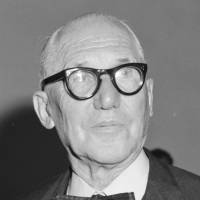
Joop van Bilsen for Anefo, CC0, via Wikimedia Commons
Le Corbusier was born Charles-Édouard Jeanneret at La Chaux-de-Fonds, in the Swiss Jura, on 6 October 1887, and died at Roquebrune-Cap-Martin on the French Riviera on 27 August 1965. Recognised worldwide as one of the founders of modern architecture, he was also a painter, and his practice as a draughtsman, sculptor, tapestry designer and printmaker ran alongside his buildings for half a century. With Amédée Ozenfant he launched Purism; late in life he produced two landmarks of 20th-century printmaking, the lithographed book Le Poème de l’angle droit (1955) and the etched suite Unité (1963–65).
Le Coin des Arts currently offers a unique original drawing by Le Corbusier, Marines, dated 1934, from the decade in which his summers on the Atlantic coast fed his art with boats, shells and pebbles. The gallery follows the artist’s work closely and acquires his original lithographs and etchings as they appear, choosing each sheet for the quality of the impression, its edition, provenance and condition.
His father, Georges-Édouard Jeanneret, enamelled watch dials; his mother, Marie Charlotte-Amélie Perret, was a musician. Between 1900 and 1904 the boy trained at the local art school as an engraver and chaser of watch cases, so that cutting into metal came before architecture. His teacher Charles L’Eplattenier steered him towards building, and by 1906 he was working on the Villa Fallet. Study trips followed: Tuscany and Vienna (1907–08), the Paris office of the concrete pioneers Auguste and Gustave Perret (1908–09), Peter Behrens in Berlin (1910–11), then a long journey through Greece, Asia Minor and southern Italy, recorded in sketchbooks and watercolours. Back home he taught at the art school, opened his own practice in 1912 and built the Villa Schwob, known as the ‘Villa turque’ (1917).
In February 1917 Jeanneret settled for good in Paris, at 20 rue Jacob. With Amédée Ozenfant he defined Purism, a painting of clear contours and standard objects – bottles, glasses, guitars – set out in their manifesto Après le cubisme (1918). His first Purist oil, La Cheminée, dates from that year. In 1920 the two men and the poet Paul Dermée founded the review L’Esprit Nouveau, in which he first used the pseudonym ‘Le Corbusier’ for his architectural articles. The Galerie Druet exhibited their Purist canvases in 1921. In 1922 he went into partnership with his cousin Pierre Jeanneret, and in 1923 published Vers une architecture.
Around 1927 his painting opened up to what he called ‘objects of poetic reaction’: pebbles, bones, roots, shells and, increasingly, the female figure. From 1926 to 1936 he spent each summer at Le Piquey, on the Bassin d’Arcachon, sketching fishing boats, cabins, driftwood and shells and simplifying them later in his Paris studio – the world to which Marines (1934) belongs. He admired the fishermen’s cabins, built to suit their daily routine and the climate, and called them ‘palaces’; around 1930 rubble stone and timber began to appear in his own architecture. These were also the years of the Villa Savoye at Poissy (1928–31), the founding of CIAM in 1928, and the Swiss Pavilion at the Cité universitaire. In 1930 he took French nationality and married Yvonne Gallis. In 1943 he introduced the Modulor, a system of proportion based on the human body.
The post-war decades brought the Unité d’Habitation in Marseille (1947–52), the chapel at Ronchamp, the monastery of La Tourette and, from 1950, Chandigarh. Painting continued in enamels, murals, tapestries and polychrome wooden sculptures made with the Breton cabinetmaker Joseph Savina. British institutions honoured him: he received the Royal Gold Medal of the RIBA and an honorary doctorate from the University of Cambridge. More recently, the touring exhibition Le Corbusier: The Art of Architecture, organised by the Vitra Design Museum, was shown at RIBA – The Crypt, Liverpool (2 October 2008 – 18 January 2009) and then at the Barbican Art Gallery, London, in partnership with the RIBA (19 February – 24 May 2009), with paintings, drawings, tapestries and sculpture alongside the models. In 2016 UNESCO inscribed seventeen sites of his work, in seven countries, on the World Heritage List.
The cornerstone is Le Poème de l’angle droit, conceived between 1947 and 1953 and published in Paris by Tériade in 1955, printed at the Mourlot workshop in an edition of 250. Text and images alike are hand-drawn lithographs; the Museum of Modern Art counts 121 lithographs in its copy, covers included. Most single sheets on the market come from broken copies. Mourlot also printed the six-colour lithograph Le Modulor (1956) after a collage. From 1958 the Zurich dealer and publisher Heidi Weber championed his art; in spring 1960 he introduced her to Fernand Mourlot, who printed their lithographs, among them the Panurge series (1962). The suite Unité comprises twenty etchings, seventeen of them with colour aquatint, worked from 1963 to 1965, printed by Aldo and Piero Crommelynck and published in 1965 by Alain C. Mazo on BFK Rives wove paper. Auction catalogues usually cite Heidi Weber’s 1988 volume as ‘Weber’ with a page number; the paintings are catalogued by Naïma and Jean-Pierre Jornod (Skira, 2005).
Know the source. A plate from the Poème, a Weber-Mourlot lithograph and an etching from Unité are three different things, with different markets. Establish the series, the printer and the date first.
Edition and numbering. The Poème was issued in 250 copies and its plates are generally unsigned. Sheets from Unité are numbered, though not every one is signed, so an unsigned sheet is not in itself suspect. See the printing.
Signature. He signed in pencil, sometimes with a dedication. Some lithographs also carry an ‘L-C’ monogram and date drawn on the stone or plate: that belongs to the image and is not a hand signature. See the signature.
Posthumous sheets and reproductions. Le Corbusier died in 1965; anything printed afterwards cannot bear his autograph signature, whatever drawing it reproduces. Exhibition posters and offset reproductions are plentiful and are not original prints.
Drawings and authentication. For unique works such as Marines, the reference body is the Fondation Le Corbusier in Paris, which holds the artist’s archive; sale catalogues record that it confirms authenticity and issues a certificate on request.
Condition and provenance. Foxing, faded colours and trimmed margins reduce value; a documented history raises it. More on our authenticity and framing pages.
Le Coin des Arts selects work by Le Corbusier alongside other masters of modern art, including Fernand Léger, Georges Braque, Pablo Picasso, Henri Matisse and Henry Moore. Browse our engravings and lithographs and illustrated books.
Le Corbusier. Catalogue raisonné de l’œuvre peint, Naïma and Jean-Pierre Jornod, Skira, 2005 · Le Corbusier – the artist: works from the Heidi Weber collection, Edition Heidi Weber, Zurich, 1988 · Barbican – Le Corbusier: The Art of Architecture · Fondation Le Corbusier – Biography · Historical Dictionary of Switzerland · Nasjonalmuseet – Le Corbusier by the Sea · Encyclopaedia Britannica

Secure payment
3DSecure 2.2

Free DHL Express delivery from €1,200
Carefully prepared parcel
Parcel tracking

Shipment insured
for the value of the artwork, covering theft and damages

Fairest prices
Certificate of authenticity
Two galleries in Paris
Receive an email as soon as a new artwork is added for this artist
Your message has been sent ! We will get back to you as soon as possible.
Please fill in the form if you need further information such
Please fill in your email address, an email will be sent with a link to update your password.
You can now place orders and track your orders.
To save your wishlist, you can log in or create an account :
This is a 100% custom-made frame, carefully crafted by a professional framer. Finishes are available in light oak, white wood or black wood, with or without mat board and plexiglass. Delivery times may vary depending on the order, with an average lead time of 10 days.
This option will be offered during the cart step.



