(1881-1973)

PICASSO Pablo
A man in an Afghan vest pondering the love story of a &ldquo..., 1968
Etching LCD8579
9 500.00€

PICASSO Pablo
Bull and Picador, 1956
Ceramic LCD8331
7 500.00€

PICASSO Pablo
The Fat Prostitute, the Owl Witch and the Traveller in Clogs, 1968
Etching LCD8306
8 000.00€

PICASSO Pablo
Sujet poule, 1954
Ceramic LCD7999
7 000.00€

PICASSO Pablo
Bullfighting, 1953
Ceramic LCD7907
14 000.00€

PICASSO Pablo
Spanish Pitcher, 1954
Ceramic LCD7877
19 500.00€

PICASSO Pablo
Pichet Têtes, 1956
Ceramic LCD6431
7 500.00€

PICASSO Pablo
Picador, 1952
Ceramic LCD5218
3 500.00€

PICASSO Pablo
Sculptor working on a female bust II, 1965
Etching and aquatint LCD5850
8 000.00€

PICASSO Pablo
Galleri Jorgen expose les lithographies de l'Atelier Mo..., 1984
Poster AF71
250.00€

PICASSO Pablo
Picasso et la tauromachie - Musée d'art moderne ..., 1982
Poster AF51
300.00€

Pablo PICASSO
Gentleman, shameful woman and reitre, 1968
Sold
Looking for a similar artwork?
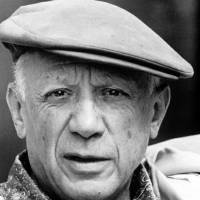
Portrait de Pablo Picasso par la revue Vea y Lea, 1962 - Domaine public
Few artists have shaped modern art as decisively as Pablo Picasso (1881-1973). Painter, sculptor, draughtsman, potter and printmaker, he co-founded Cubism with Georges Braque and spent seven decades reinventing himself, from the Blue Period to the exuberant late canvases painted at Mougins. A towering figure of modern art, he was also one of the greatest printmakers who ever lived, with well over two thousand etchings, aquatints, drypoints, lithographs and linocuts to his name – alongside several hundred designs for edition ceramics produced at Vallauris.
At its Paris galleries, Le Coin des Arts offers original works by Picasso: pencil-signed etchings printed by the Crommelynck brothers, including sheets from the celebrated Suite 347, Madoura edition ceramics and exhibition posters lithographed by the Mourlot workshop – each chosen for the quality of the impression, its provenance and its condition.
Pablo Ruiz Picasso was born in Málaga on 25 October 1881, the son of José Ruiz Blasco, a painter and drawing master who gave him his first lessons. The family moved to A Coruña in 1891 – where the boy exhibited for the first time at the age of thirteen – and to Barcelona in 1895, where he enrolled at the Llotja art school. A brief spell at the Royal Academy of San Fernando in Madrid (1897) was followed by a stay at Horta de Ebro and by the bohemian circle of the café Els Quatre Gats in Barcelona, which hosted his first solo show.
Picasso first saw Paris in October 1900, during the Exposition Universelle, and in April 1904 settled at the Bateau-Lavoir in Montmartre. The beggars and sorrowful figures of the Blue Period (1901-1904) gave way to the harlequins and acrobats of the Rose Period. His first major print, the etching The Frugal Repast (1904), dates from these years; Ambroise Vollard published it in 1913 together with other plates of the Saltimbanques series. A summer at Gósol in the Catalan Pyrenees in 1906 marked a decisive move towards simplified, sculptural form.
Les Demoiselles d’Avignon (1907) broke with centuries of perspective. Working side by side with Georges Braque, Picasso then developed Cubism – first analytical, then, from 1912, synthetic, with the invention of papier collé. The German-born dealer Daniel-Henry Kahnweiler, whose gallery in the rue Vignon opened in 1907, signed an exclusive contract with him in December 1912. In the summer of 1911 Picasso worked at Céret in French Catalonia, where Braque joined him; the town’s museum of modern art, founded in 1950 with his and Matisse’s support, still holds a fine group of his works.
In 1917 Picasso designed the curtain, sets and costumes for Diaghilev’s Parade, to a scenario by Jean Cocteau, and in 1918 he married the dancer Olga Khokhlova, mother of his son Paulo (1921). London saw his stage work on 22 July 1919, when Le Tricorne, with music by Manuel de Falla and Picasso’s sets, costumes and bullfight drop curtain, received its world premiere at the Alhambra Theatre. His relationship with Marie-Thérèse Walter began in 1927; their daughter Maya was born in 1935.
In 1937 he painted Guernica for the pavilion of the Spanish Republic at the Paris International Exhibition. The canvas toured Britain in support of Republican Spain: it was shown at the New Burlington Galleries in October 1938 and at the Whitechapel Art Gallery in January 1939, where the show was opened by Clement Attlee. Guernica remained on loan to MoMA in New York until its return to Spain in 1981 and has hung at the Museo Reina Sofía, Madrid, since 1992.
Picasso joined the French Communist Party in 1944, and his lithographed Dove of 1949 became an emblem of the peace movement. In November 1950 he travelled to Sheffield for the World Peace Congress, leaving behind dove drawings now treasured locally. With Françoise Gilot, mother of Claude (1947) and Paloma (1949), he settled on the Riviera and took up ceramics at Vallauris. He married Jacqueline Roque in 1961 and that year moved to Notre-Dame-de-Vie at Mougins, having bought the Château de Vauvenargues in 1958. He died at Mougins on 8 April 1973.
Britain embraced him early. His friend and biographer Roland Penrose organised the great Tate Gallery retrospective of 6 July – 18 September 1960, which drew queues every day. In 2011 the British Museum acquired a complete set of the Vollard Suite, thanks to a gift from Hamish Parker, and Tate Modern devoted its first Picasso solo exhibition to a single year, Picasso 1932 – Love, Fame, Tragedy (2018).
Intaglio printmaking ran through Picasso’s whole career. 1931 saw his illustrations for Balzac’s Le Chef-d’œuvre inconnu (Vollard) and Ovid’s Metamorphoses (Skira). The Vollard Suite – one hundred etchings, aquatints and drypoints made between 1930 and 1937, populated by the sculptor’s studio, the Minotaur and Rembrandt – was printed around 1939 by Roger Lacourière, with whom Picasso mastered sugar-lift aquatint, used for Buffon’s Histoire naturelle (1942). The Minotauromachy (1935) is among the most celebrated prints of the century.
In 1963 two former Lacourière printers, Aldo and Piero Crommelynck, set up a press at Mougins close to his house. The result was an astonishing late flowering: the Suite 347, etched between 16 March and 5 October 1968, printed in an edition of 50 signed impressions and published by Galerie Louise Leiris, a teeming theatre of musketeers, courtesans, Celestina, painters and models; then the Suite 156 (1970-1972), published after his death. Our Gentilhomme, femme honteuse et reître and Grosse Prostituée, Sorcière à la Chouette et Voyageur en Sabots (both 1968) belong to the Suite 347, while Sculpteur travaillant à un buste de femme II (1965), an etching and aquatint, was also printed by the Crommelyncks.
On 2 November 1945 Picasso walked into Fernand Mourlot’s workshop in the rue de Chabrol, Paris. Within three years he had worked on nearly two hundred stones and zinc plates, defying every rule of lithography; his Bull (December 1945 – January 1946) moves through eleven states from modelled realism to a handful of lines. Mourlot catalogued this output in Picasso lithographe (4 volumes, André Sauret, 1949-1964). At Vallauris, from 1951, the printer Hidalgo Arnéra produced the posters for the town’s annual pottery exhibitions and later for its bullfights, a partnership that led Picasso to the colour linocut and to the bold “reduction” method. The gallery also offers exhibition posters lithographed by Mourlot, such as Picasso et la tauromachie for the Céret museum.
In the summer of 1946 Picasso met Suzanne and Georges Ramié, owners of the Madoura pottery at Vallauris, and from 1947 he worked there almost daily. Between 1947 and 1971 he conceived 633 designs that Madoura issued in editions of 25 to 500: jugs, dishes, plates and vases faithfully reproduced by the pottery’s craftsmen after his prototype. These ceramics carry the stamps “Madoura Plein Feu” and “Edition Picasso”, or “Empreinte originale de Picasso” for pieces cast from a matrix he carved himself. The reference is Alain Ramié’s Picasso: Catalogue of the Edited Ceramic Works 1947-1971 (Galerie Madoura, 1988), cited as “Ramié no.”. Among the pieces in our collection are Picador (1952, Ramié 162), Corrida (1953, Ramié 198), the Pichet espagnol (1954, Ramié 245, edition of 200) and Pichet Têtes (1956, Ramié 368).
With an etching or lithograph, check the technique, the print run and its numbering (50 for the Suite 347), the pencil signature and the catalogue raisonné numbers: Bloch (Georges Bloch, Kornfeld und Klipstein, Bern, 4 volumes, 1968-1979), Geiser/Baer (Picasso peintre-graveur, Bern, 7 volumes, cited “Baer no.” with state and printing), Mourlot for lithographs, Cramer for illustrated books and Czwiklitzer for posters. Printer, publisher, provenance and the condition of the sheet matter just as much. With a ceramic, look at the stamps, the Ramié reference, the fidelity of the decoration to the model, any numbering and the absence of restoration.
Original print or reproduction? No artist has been copied more. Prints “after” Picasso, the posthumous lithographs of the “Marina Picasso Collection” (produced 1979-1982 in editions of 500, pencil-signed by his granddaughter and bearing the estate stamp) and late restrikes are not prints signed by the artist. An original print was made by Picasso himself and appears in the catalogues raisonnés. Exhibition posters, even when lithographed at Mourlot, are neither signed nor numbered and are collected in their own right.
Le Coin des Arts selects every Picasso it offers with close attention to authenticity, provenance and condition, and advises collectors on their choice and on conservation framing and mounting. You may also enjoy the etchings and lithographs of his contemporaries: Georges Braque, Henri Matisse, Joan Miró, Marc Chagall and Jean Cocteau.
Tate Modern, Picasso 1932 – Love, Fame, Tragedy · British Museum, Vollard Suite (2011) · Musée national Picasso-Paris · Museums Sheffield, Picasso and the 1950 World Peace Congress · Georges Bloch, Pablo Picasso: Catalogue de l’œuvre gravé et lithographié, Kornfeld und Klipstein, Bern, 1968-1979 · Bernhard Geiser and Brigitte Baer, Picasso peintre-graveur, Bern, 1933-1996 · Fernand Mourlot, Picasso lithographe, André Sauret, 1949-1964 · Goeppert, Goeppert-Frank and Cramer, Pablo Picasso: The Illustrated Books, Patrick Cramer, Geneva, 1983 · Alain Ramié, Picasso: Catalogue of the Edited Ceramic Works 1947-1971, Galerie Madoura, 1988.

Secure payment
3DSecure 2.2

Free DHL Express delivery from €1,200
Carefully prepared parcel
Parcel tracking

Shipment insured
for the value of the artwork, covering theft and damages

Fairest prices
Certificate of authenticity
Two galleries in Paris
Receive an email as soon as a new artwork is added for this artist
Your message has been sent ! We will get back to you as soon as possible.
Please fill in the form if you need further information such
Please fill in your email address, an email will be sent with a link to update your password.
You can now place orders and track your orders.
To save your wishlist, you can log in or create an account :
This is a 100% custom-made frame, carefully crafted by a professional framer. Finishes are available in light oak, white wood or black wood, with or without mat board and plexiglass. Delivery times may vary depending on the order, with an average lead time of 10 days.
This option will be offered during the cart step.