
(1890-1976)
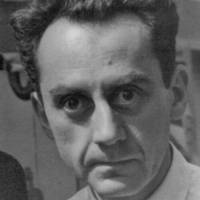
Portrait de Man Ray par Carl Van Vechten, 1934 - Domaine public Library of Congress
Man Ray, born Emmanuel Radnitzky in Philadelphia on 27 August 1890, died in Paris on 18 November 1976. Painter, photographer, film-maker and maker of objects, he was a central figure of New York Dada and then of Surrealism in Paris. His cameraless rayographs, his solarised portraits and his Dada objects – above all Cadeau, a flat-iron studded with tacks – are among the most recognisable images of the twentieth century. For collectors, his legacy also includes a printed œuvre, from the 1926 pochoir portfolio Revolving Doors to the colour lithographs and etchings of his final years, and a family of authorised multiples that re-edited his early objects.
Le Coin des Arts currently holds one work by Man Ray: an example of Cadeau, the 1974 multiple in cast iron and nails re-editing the lost object of 1921 – an editioned sculpture rather than a print, signed and numbered on the handle. The gallery follows the artist’s work and offers original prints when fine impressions become available; use the “follow the artist” button to be notified.
The eldest child of Jewish immigrants from the Russian Empire – his father, Melach Radnitzky, was a tailor – Emmanuel was raised in Philadelphia and, from 1897, in Brooklyn. On leaving Boys’ High School he turned down an architecture scholarship in favour of art. In 1911 he began visiting Alfred Stieglitz’s gallery 291; in 1912, the year the family took the surname Ray, he enrolled at the Ferrer Center, a free school run by anarchists. The Armory Show of 1913 brought him face to face with European modernism, including the work of Marcel Duchamp. Shortly afterwards he married the poet Adon Lacroix and moved to an artists’ colony in New Jersey.
His first solo exhibition was held at the Daniel Gallery, New York, in 1915. In these years he also formed what became a lifelong friendship with Duchamp. Photography, first taken up to record his own canvases, soon became a medium in its own right. In 1920 he founded the Société Anonyme with Duchamp and Katherine Dreier, and with Duchamp issued the single number of New York Dada. He sailed for Europe the following year, arriving in Paris on 22 July 1921.
At the end of 1921 Man Ray showed at Philippe Soupault’s Librairie Six. On the day of the opening he made Cadeau (‘Gift’) – an iron with fourteen tacks glued to its sole – helped, by his own account, by the composer Erik Satie. It was not in the catalogue and had vanished by the end of the day. In 1922 he published his first cameraless images in Les Champs délicieux, took a studio at 31 bis rue Campagne-Première and began photographing for Vanity Fair; Vogue followed in 1924 and Harper’s Bazaar in 1935. Kiki de Montparnasse was his companion for much of the decade and appears in his films, from Le Retour à la raison (1923) to L’Étoile de mer. He exhibited in the first Surrealist exhibition at the Galerie Pierre in 1925. From 1929 his assistant Lee Miller worked with him on solarisation; in 1931 the Paris electricity company commissioned the portfolio Électricité; and with Paul Éluard he published Facile (1935) and Les Mains libres (1937).
Leaving France in 1940, Man Ray settled in Hollywood, where he met Juliet Browner; they married in 1946 in a double wedding with Max Ernst and Dorothea Tanning. In 1951 he returned for good to Paris, to a studio in the rue Férou, and showed at Berggruen. Honours followed: a gold medal for photography at the 1961 Venice Biennale, an exhibition at the Bibliothèque nationale in 1962 and his memoir Self Portrait in 1963. In Turin and later Milan the dealer Luciano Anselmino championed him, re-editing his objects and rare books. He died in Paris on 18 November 1976; the Centre Pompidou received his studio and a large body of negatives in 1994.
London gave Man Ray a solo exhibition at the Institute of Contemporary Arts in 1959. British public collections are rich in his work: the Tate owns an editioned replica of Cadeau dated 1972, displayed at Tate Modern, alongside other replicas of his objects made in 1973 and the painting Pisces (1938); the Victoria and Albert Museum acquired the 1931 Électricité portfolio with Art Fund support. In 2013 the National Portrait Gallery staged “Man Ray Portraits” (7 February – 27 May), curated by Terence Pepper: more than 150 vintage prints from 1916 to 1968, most never before shown in the United Kingdom.
Revolving Doors, published by the Éditions Surréalistes in Paris in 1926, is a portfolio of ten colour pochoirs after collages of 1916-1917, in an edition of 105. Between photography and printmaking sits Électricité (1931): ten photogravures, some from rayographs, some from camera images, made for the shareholders of the Compagnie Parisienne de Distribution d’Électricité – the copy in the V&A shows a hand holding an iron, a toaster and a fan. From the 1960s Man Ray made lithographs and etchings, often in colour and in editions of around a hundred, frequently revisiting earlier motifs. The standard reference is the first volume of Man Ray. Opera grafica, edited by Luciano Anselmino (Turin, 1973); a print is cited by its number, so that “Anselmino 18” is Revolving Doors. Objects are catalogued in Man Ray: objets de mon affection (Philippe Sers, 1983), where Cadeau is no. 28.
For Cadeau the sequence matters. Man Ray regarded the five or six replicas he made himself before 1963 as originals (MoMA’s dates from about 1958); the Galleria Schwarz, Milan, issued ten in 1963; a further edition followed in 1972; and in 1974 came the commercial edition numbered to 5,000, whose justification card names Luciano Anselmino as publisher.
Catalogue number. Ask for the Anselmino reference for any print; it confirms date, technique and edition.
Signature. Later prints are pencil-signed and numbered; check that the signature is by hand. See the signature.
Vintage or later photograph. A vintage print was made at the time of the negative; later prints were made under Man Ray’s supervision after the war, notably by Pierre Gassmann of the Picto laboratory from around 1958; posthumous prints have at times been passed off as lifetime work. Paper, studio stamps and provenance are decisive.
Multiples. For Cadeau, check the signature and number on the handle, the justification card and the original box.
Authentication. The Man Ray Expertise Committee (Andrew Strauss and Timothy Baum) issues the opinions cited by the major auction houses. Offset reproductions and exhibition posters are not original prints. See our authenticity and framing pages.
The gallery selects Man Ray’s work alongside that of his Dada and Surrealist contemporaries: Max Ernst, Hans Arp, Joan Miró, René Magritte and Hans Bellmer. Explore Surrealism and our engravings and lithographs.
Luciano Anselmino, Man Ray. Opera grafica, vol. I, Turin, 1973 · Jean-Hubert Martin, Rosalind Krauss and Brigitte Hermann, Man Ray: objets de mon affection, Philippe Sers, 1983 · Man Ray, Self Portrait, 1963 · Steven Manford, ‘Man Ray Photographs: The Problems Have Not Gone Away’, IFAR Journal, vol. 20, 2019 · Tate – Cadeau · Tate – Man Ray · V&A – Électricité · Peggy Guggenheim Collection – Man Ray · MoMA – Gift

Secure payment
3DSecure 2.2

Free DHL Express delivery from €1,200
Carefully prepared parcel
Parcel tracking

Shipment insured
for the value of the artwork, covering theft and damages

Fairest prices
Certificate of authenticity
Two galleries in Paris
Receive an email as soon as a new artwork is added for this artist
Your message has been sent ! We will get back to you as soon as possible.
Please fill in the form if you need further information such
Please fill in your email address, an email will be sent with a link to update your password.
You can now place orders and track your orders.
To save your wishlist, you can log in or create an account :
This is a 100% custom-made frame, carefully crafted by a professional framer. Finishes are available in light oak, white wood or black wood, with or without mat board and plexiglass. Delivery times may vary depending on the order, with an average lead time of 10 days.
This option will be offered during the cart step.


