(1886-1968)

FOUJITA Léonard
The Morning, 1956
Mixed media (modern) LCD8176
6 000.00€
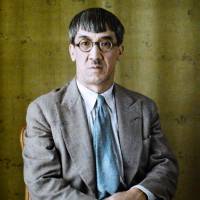
Georges Chevalier, CC BY 4.0, via Wikimedia Commons
Léonard Tsuguharu Foujita (Tokyo 1886 – Zürich 1968) was the great Japanese member of the School of Paris. Settling in Montparnasse in 1913, he forged one of the most recognisable styles of the inter-war years: a smooth, milky white ground over which he drew, with a fine brush and ink, contours of an almost calligraphic delicacy. His nudes, his self-portraits with fringe and round spectacles, his cats and his children made him a celebrity of the Roaring Twenties. A French citizen from 1955 and baptised a Catholic in Reims in 1959, he ended his career decorating a chapel. Alongside paintings and drawings he produced etchings, woodcuts, original lithographs and a remarkable series of illustrated books.
Le Coin des Arts currently offers one unique work by Foujita: Le Matin (1956), in mixed media, made six years after his final return to France. The gallery follows the artist’s market closely and offers original prints when fine impressions with sound provenance become available; use the “follow the artist” button to be notified.
Fujita Tsuguharu was born on 27 November 1886 in the Ushigome district of Tokyo, the son of an army medical officer. On the advice of the writer Mori Ōgai he entered the Tokyo School of Fine Arts, studying Western-style painting under Kuroda Seiki, and graduated in 1910. In 1913 he sailed for France and took a studio in Montparnasse, then home to Modigliani, Soutine, Kisling, Pascin and Ossip Zadkine. Britain played a larger part in these early years than is often recognised: between 1913 and 1916 Foujita made several trips to London, including one stay of about a year, and met Japanese and British artists there – a period reconstructed by the art historian Aya Louisa McDonald in her essay “Foujita in London 1913–1916” (2016). Back in Paris, he was given his first solo exhibition at the Galerie Chéron, which opened on 1 June 1917 with 110 watercolours and a text by André Salmon.
In the early 1920s Foujita perfected the luminous ground that became his signature, a preparation based on linseed oil, chalk or lead white and magnesium silicate. Its best-known showpiece is the Reclining Nude with Toile de Jouy of 1922, for which, according to the painter, Kiki de Montparnasse sat; he gave it to the Musée d’Art Moderne de Paris in 1961. Lucie Badoud, whom he renamed Youki (“snow”), became his muse and, in 1929, his wife. In 1928 he painted the monumental diptychs Combats and Compositions with Lion and Dog, now owned by the Essonne département. In 1929 he returned to Japan for the first time in sixteen years, for an exhibition celebrating his homecoming.
In 1931 he left Paris with Madeleine Lequeux on a long tour of Latin America: Brazil, Argentina (his 1932 exhibition in Buenos Aires is said to have drawn some 60,000 visitors), Bolivia, Peru, Cuba and Mexico, before California and Japan at the end of 1933. During the Second World War he painted large battle pictures for the Japanese army, a commission that would haunt his reputation after 1945. In 1949 he left Japan for good, spent most of that year in New York, and returned to France with his last wife, Kimiyo, in January 1950.
In 1951 he designed sets and costumes for Madama Butterfly at La Scala, Milan. He married Kimiyo in Paris on 5 October 1954 and became a French citizen in 1955. On 14 October 1959 he was baptised in Reims Cathedral, with René Lalou, head of the champagne house Mumm, as godfather, taking the name Léonard in honour of Leonardo da Vinci. In 1954 the London-based photographer Ida Kar portrayed him; five of her photographs of Foujita are now in the National Portrait Gallery, London. From the early 1960s he lived at Villiers-le-Bâcle, south-west of Paris, in a house now open as the Maison-atelier Foujita. His last great work, the Chapelle Notre-Dame-de-la-Paix in Reims, with frescoes by his hand and stained glass made to his designs by Charles Marq, was inaugurated on 18 October 1966. Foujita died in Zürich on 29 January 1968 and has rested beneath the chapel floor since 2003, beside Kimiyo, who died in 2009.
In France his work is held by the Centre Pompidou, the Musée d’Art Moderne de Paris and the Musée des Beaux-Arts de Reims, which received a major gift of drawings from Kimiyo’s heirs in 2013–14. The fiftieth anniversary of his death brought the exhibition Foujita: Painting in the Roaring Twenties to the Musée Maillol, Paris (7 March – 15 July 2018), and a large retrospective to the Tokyo Metropolitan Art Museum. London has become one of the key centres of his market: on 11 October 2018, La fête d’anniversaire, painted in New York in 1949, sold at Bonhams, New Bond Street, for £7,096,250.
Foujita’s graphic work spans etching and engraving, woodcut and lithography, often within the illustrated book. Highlights include Pierre Louÿs’s Les Aventures du roi Pausole (Fayard, 1925, original woodcuts); A Book of Cats (New York, Covici Friede, 1930), twenty etchings accompanying prose poems by the British publisher Michael Joseph, in an edition of 500; La Rivière enchantée (1951, original etchings, text by René Héron de Villefosse); Le Dragon des mers (c. 1955, engravings); and, for the publisher Pierre de Tartas, Petits métiers et gagne-petit (1960) and La Mésangère (1963, colour lithographs). The standard reference is the catalogue raisonné by Sylvie Buisson: Léonard-Tsuguharu Foujita, vol. I (with Dominique Buisson, ACR Édition, 1987) and vol. II (ACR Édition, 2001), followed by Foujita inédits (2007), with a fourth volume in preparation. Paintings, drawings and prints are numbered together by year, so “Buisson 51.176” refers to an entry of 1951 – the self-portrait with Kimiyo from La Rivière enchantée – and “Buisson 60.28” to Les Trois Grâces of 1960.
Unique works and authentication. For a drawing, watercolour or mixed-media work such as Le Matin, the recognised authority is Sylvie Buisson, author of the catalogue raisonné; major auction houses cite her certificates or forthcoming inclusion in volume IV. Insist on this, or on a continuous, documented provenance.
Lifetime prints, posthumous editions and reproductions. This is the crucial distinction with Foujita. Only impressions printed and signed in his lifetime (before 1968) are original prints in the strict sense. Many book plates are photomechanical: the illustrations to Légendes japonaises (1922–23) are line-block reproductions, and those for Propos d’un intoxiqué (1929) colour reproductions, frequently sold as “lithographs”. Images issued after 1968 without a hand signature are not Foujita prints. See what is an original print.
Signature. Foujita usually signed “Foujita” in Roman letters, often with his name in Japanese characters. On prints, look for a pencil signature in the margin; a signature “in the plate” is merely printed (the signature).
Posters. The 1960 Les Trois Grâces poster, printed by Mourlot for the Peintres Témoins de leur Temps exhibition at the Musée Galliera, is a genuine lithograph but signed in the stone and unnumbered.
Edition and condition. Check the pencil numbering against the catalogue or the book’s justification (the printing). Foujita’s thin Japanese papers are fragile and prone to foxing, creasing and fading, so conservation framing is essential. Our guarantees are set out on the authenticity page.
Le Coin des Arts selects works by Foujita for quality, provenance and condition. Explore his Paris contemporaries Pablo Picasso, Marc Chagall, Ossip Zadkine and Fernand Léger, and a later Japanese artist in Paris, Kumi Sugai, as well as modern art and engravings and lithographs.
Sylvie and Dominique Buisson, Léonard-Tsuguharu Foujita, vol. I, ACR Édition, 1987 · Sylvie Buisson, Léonard-Tsuguharu Foujita, vol. II, ACR Édition, 2001 · Aya Louisa McDonald, “Foujita in London 1913–1916”, in Foujita Tsuguharu, Letters to his Wife, Tomi, 1913–1916, Jimbun Shoin, 2016 · National Portrait Gallery – Foujita by Ida Kar · Bonhams – La fête d’anniversaire (2018) · Musée d’Art Moderne de Paris – Reclining Nude with Toile de Jouy · Musée Maillol – Foujita (2018)

Secure payment
3DSecure 2.2

Free DHL Express delivery from €1,200
Carefully prepared parcel
Parcel tracking

Shipment insured
for the value of the artwork, covering theft and damages

Fairest prices
Certificate of authenticity
Two galleries in Paris
Receive an email as soon as a new artwork is added for this artist
Your message has been sent ! We will get back to you as soon as possible.
Please fill in the form if you need further information such
Please fill in your email address, an email will be sent with a link to update your password.
You can now place orders and track your orders.
To save your wishlist, you can log in or create an account :
This is a 100% custom-made frame, carefully crafted by a professional framer. Finishes are available in light oak, white wood or black wood, with or without mat board and plexiglass. Delivery times may vary depending on the order, with an average lead time of 10 days.
This option will be offered during the cart step.