
(1929-2023)

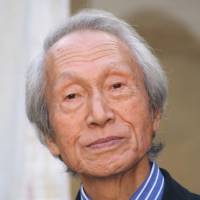
Portrait de Shoichi Hasegawa, 2008 - L'Estampe - CC BY-SA 3.0
Shoichi Hasegawa (長谷川彰一, also spelt Shoïchi) was a Japanese painter and printmaker who spent his working life in France. Born in 1929 in Yaizu, in Shizuoka Prefecture, he died in Paris in February 2023. He arrived in Paris in 1961 to learn printmaking at Atelier 17, the workshop of the British engraver Stanley William Hayter, and became a quiet master of the colour etching: luminous, transparent prints in which Western lyrical abstraction meets a Japanese feeling for sign and space.
Le Coin des Arts currently offers a ‘Carte de vœux’ (greeting card) dated 1976, a small greeting print that shows Hasegawa’s colour and graphic vocabulary on an intimate scale. We follow the artist’s work and offer his original prints as they come to light, chosen for quality of impression, edition, provenance and condition; to be notified, simply ‘follow the artist’ on this page.
The decisive encounter of Hasegawa’s career was British in origin. Stanley William Hayter, born in London in 1901, had founded Atelier 17 in Paris in 1927, moved it to New York during the war and brought it back to Paris in 1950. The workshop was renowned for its experiments in printing several colours from a single plate. Hasegawa, who had left Japan with his wife specifically to master colour intaglio, joined it in 1961 and absorbed its methods with remarkable speed.
Hasegawa grew up in Yaizu, a fishing port on the Pacific coast. He began painting after the Second World War and moved to Tokyo in the early 1950s. Accounts of his training differ, but they agree that his interest turned towards American abstraction, notably Jackson Pollock, Franz Kline, Mark Rothko and Morris Graves. He held his first solo exhibition in 1957.
Success came quickly. In 1963 the Victoria and Albert Museum entered his etching and aquatint Silence in its Circulation Department register (CIRC.552-1963), which lent works to schools and regional museums across Britain; the Contemporary Art Society also records the print. In 1964 the National Gallery of Victoria in Melbourne bought Derrière la scène, and the Museo Nacional de Bellas Artes in Santiago acquired two impressions from Hayter’s own collection. Hasegawa showed at the Salon des Réalités Nouvelles in Paris and at the international print biennials of Ljubljana and Kraków, and in 1968 won first prize for printmaking at the international exhibition in Como.
Settled permanently in France, Hasegawa divided his time between etching, painting and watercolour. His French titles, such as Lever du jour, Lumière de lune and Reflets au port, return again and again to light, water and the hours of the day. In 1974 he produced the suite Homme dans la ville, with title page and colophon. His long-standing publisher, the gallery L’Estampe in Strasbourg, issued and exhibited his prints, including lithographs dated as late as the 2010s.
Hasegawa’s printed work is essentially intaglio: etching, aquatint and sugar-lift (lift-ground) aquatint. Going beyond classical etching, he combined varnishes, solvents and acids and laid inks over one another to obtain secondary and tertiary tones, while the bitten line often reads as white on the sheet. He also made lithographs. To our knowledge no widely available catalogue raisonné of his prints exists; attribution rests on title, date, edition and comparison with museum or publisher impressions. Bénézit’s dictionary includes an entry on him.
Signature. Impressions are signed in pencil lower right in Roman script, sometimes with his name in Japanese characters; the title is often written in the centre. See the signature.
Edition. Recorded editions range from about thirty to more than a hundred, plus artist’s proofs (E.A.). Look for a pencilled number; see the printing.
Condition. His transparent colours are sensitive to light: check for fading, toning of the paper, foxing and creases in the margins.
Name confusion. Do not confuse him with Kiyoshi Hasegawa (1891-1980), the Japanese mezzotint master who also lived in France. Spellings such as ‘Shoïchi’, ‘Shoici’ or ‘Soichi’ appear in sale catalogues.
Small formats. Greeting-card prints are rarely numbered; their interest lies in impression and provenance. Our authenticity and framing pages explain our guarantees and the care of works on paper.
Le Coin des Arts selects Hasegawa’s prints for the freshness of their colour. Explore other Japanese artists in Paris, Yozo Hamaguchi, Kumi Sugai and Léonard Foujita, the etchers Johnny Friedlaender and Érik Desmazières, the School of Paris and lyrical abstraction and our engravings and lithographs.
E. Bénézit, Dictionnaire des peintres, sculpteurs, dessinateurs et graveurs, Gründ · Victoria and Albert Museum – Silence (CIRC.552-1963) · Contemporary Art Society – Shoichi Hasegawa · L’Estampe, Strasbourg – Shoichi Hasegawa · National Gallery of Victoria – Derrière la scène · Museo Nacional de Bellas Artes, Chile – Silence

Secure payment
3DSecure 2.2

Free DHL Express delivery from €1,200
Carefully prepared parcel
Parcel tracking

Shipment insured
for the value of the artwork, covering theft and damages

Fairest prices
Certificate of authenticity
Two galleries in Paris
Receive an email as soon as a new artwork is added for this artist
Your message has been sent ! We will get back to you as soon as possible.
Please fill in the form if you need further information such
Please fill in your email address, an email will be sent with a link to update your password.
You can now place orders and track your orders.
To save your wishlist, you can log in or create an account :
This is a 100% custom-made frame, carefully crafted by a professional framer. Finishes are available in light oak, white wood or black wood, with or without mat board and plexiglass. Delivery times may vary depending on the order, with an average lead time of 10 days.
This option will be offered during the cart step.

