
(1925-1991)

TINGUELY Jean
The Monster in the Forest (Tribute to Yves Klein)
Mixed media (modern) LCD7530
4 200.00€

 7
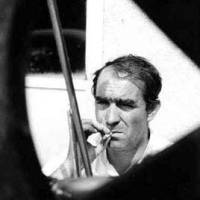
Portrait de Jean Tinguely par Erling Mandelmann, 1963 / CC BY-SA 3.0 ©ErlingMandelmann.ch
Jean Tinguely (born in Fribourg on 22 May 1925, died in Bern on 30 August 1991) was the Swiss sculptor who set art in motion. Brought up in Basel and based in Paris from the end of 1952, he built clattering, poetic and sometimes self-destroying machines – motorised reliefs, the Méta-Matic drawing machines, Homage to New York, Le Cyclop – and became a central figure of kinetic art and a founding signatory of Nouveau Réalisme. Alongside the sculpture runs a large body of work on paper: drawings, illustrated letters, collages, lithographs and screenprints, many of them worked over by hand.
Le Coin des Arts currently offers Le Monstre dans la forêt (Hommage à Yves Klein), c. 1973, a mixed-media sheet which, according to our catalogue entry, combines screenprint, watercolour heightening and collage; it is signed in pencil and numbered from an edition of 100, so no two impressions are quite alike. Its title borrows the nickname of the Cyclop at Milly-la-Forêt. Like everything we show, it was chosen for quality, edition, provenance and condition; other works on paper by Tinguely are offered as they become available.
Tinguely's family moved from Fribourg to Basel in July 1925, and he grew up in the Gundeldingen district. From 1941 he was apprenticed as a decorator at the Globus department store; dismissed in August 1943, he completed his training with the help of the decorator Joos Hutter, who sent him to the Basel Kunstgewerbeschule (School of Arts and Crafts). There he discovered Kurt Schwitters, Paul Klee and the Bauhaus. After Swiss military service in 1944-1945 he made his first wire sculptures and worked as a freelance window-dresser in Basel and Zurich. His daughter Miriam was born on 27 January 1950; on 10 May 1951 he married the artist Eva Aeppli, and late in 1952 the couple left for Paris.
His first Paris solo exhibition was held at the Galerie Arnaud in 1954. In 1955 he took a studio in the Impasse Ronsin, next door to Brancusi, and in April joined Le Mouvement at the Galerie Denise René, the founding exhibition of kinetic art. In 1958 he showed Mes étoiles – Concert pour sept peintures at Iris Clert and made joint works with Yves Klein. The Méta-Matic drawing machines followed in 1959; Méta-Matic No. 17 was shown at the Paris Biennale that October. The same year brought Tinguely to Britain: a solo exhibition at the Kaplan Gallery in London and, on 12 November 1959, a lecture at the Institute of Contemporary Arts.
On 17 March 1960 Homage to New York destroyed itself in the sculpture garden of the Museum of Modern Art. That September the Museum Haus Lange in Krefeld gave him his first solo museum exhibition, and on 27 October 1960 he signed the founding declaration of Nouveau Réalisme with the critic Pierre Restany, Yves Klein, Arman and others. Niki de Saint Phalle moved into his studio the same year. Study for an End of the World No. 1 followed at the Louisiana Museum in Denmark in 1961, and on 21 March 1962 Study for an End of the World No. 2 was blown up in the Nevada desert for NBC television.
From 1963 the machines were painted black. Heureka, built for the Swiss National Exhibition in Lausanne in 1964, has stood at the Zürichhorn in Zurich since 1967. Tinguely took part in documenta III (1964) and 4. documenta (1968) in Kassel; in 1966 he worked on Hon at the Moderna Museet, Stockholm, and in 1967 showed at Expo 67 in Montreal. His La Vittoria was destroyed in front of Milan Cathedral on 27 November 1970. In 1969 work began in the woods at Milly-la-Forêt, south of Paris, on Le Cyclop – also known as La Tête or 'the monster in the forest' – a 22.5-metre head of some 350 tonnes of steel, with contributions from Niki de Saint Phalle, Bernhard Luginbühl, Rico Weber and Daniel Spoerri. Tinguely and Saint Phalle married in 1971; in 1977 his Crocrodrome marked the opening of the Centre Georges Pompidou.
British audiences came to know Tinguely through the London galleries – the Kaplan Gallery in 1959 and the Hanover Gallery, which gave him a solo show in 1968 – and through group surveys such as 54-64: Painting and Sculpture of a Decade at the Tate in 1964. The decisive moment was the retrospective organised by the Kunsthaus Zürich, which ran at the Tate Gallery from 8 September to 28 November 1982 before travelling to Brussels and Geneva. During the show, the magazine Audio Arts recorded thirteen of the sculptures and a performance of Méta-Harmonie II, issued in 1983 as a cassette supplement now held in the Tate Archive – a reminder that his machines are made to be heard as well as seen.
The 1980s brought the great sound machines (Méta-Harmonie, Pandämonium No. 1, commissioned in 1984 for Tokyo) and the fountains: the Stravinsky Fountain beside the Centre Pompidou (1983), a joint commission from the City of Paris, the French Ministry of Culture and the Centre, pairs seven of his motorised mobiles with Saint Phalle's figures. After a fire destroyed his farmhouse at Neyruz in 1986, he used the debris for Mengele-Dance of Death. Major retrospectives followed at the Palazzo Grassi, Venice (1987, 94 machine sculptures) and the Centre Pompidou (1988). He died in Bern on 30 August 1991. Le Cyclop, given to the French State in 1987, opened in May 1994, and the Museum Tinguely in Basel, founded by Roche and designed by Mario Botta, opened in 1996.
Tinguely drew constantly – designs for machines, letters crowded with colour, collage and handwriting – and the Museum Tinguely holds around 1,500 works on paper. His prints carry on that idiom: lithographs, screenprints and, less often, etchings (intaglio), frequently finished by hand with colour, collage or stamps. The book La Vittoria, published in Milan in 1972 by Sergio Tosi Stampatore in an edition of 100 and now in the collection of MoMA, shows how mixed these publications can be: it combines offset lithographs (some altered by hand), original lithographs, etchings, a screenprint and reproductions. The standard catalogue raisonné, compiled by Christina Bischofberger (Jean Tinguely: Catalogue raisonné, Galerie Bruno Bischofberger, Zurich, three volumes, 1982-2005), covers the sculptures and reliefs, not the prints. For a print, the publisher, printer, edition and early documentation therefore matter all the more; see what is an original print.
Edition. Several editions were printed in 100 impressions, among them La Vittoria (1972) and our Monstre dans la forêt. Check that numbering, proofs and dimensions agree; see the printing.
Signature. Impressions should be signed by hand. Tell a pencil signature apart from one reproduced in the image, which is common on his posters.
Hand-finishing. A sheet heightened or collaged by the artist is both a multiple and a unique object: the description should say clearly what is printed and what was added by hand.
Posters and offset. Tinguely designed many exhibition posters printed in offset. Even when signed they are reproductions rather than original prints – and, as La Vittoria shows, a single publication may contain both.
Provenance. With no catalogue of the prints, a publisher's stamp, an early invoice or a gallery label carries real weight. Our guarantees are set out on the authenticity page.
Condition. Collage elements, tape and thin papers suffer in light: look for lifting and fading, and choose conservation framing.
We also look out for work by his fellow New Realists and kinetic artists: Niki de Saint Phalle, Yves Klein, César, Pol Bury and Jesús Rafael Soto. Explore New Realism, kinetic art and our engravings and lithographs.
Christina Bischofberger, Jean Tinguely: Catalogue raisonné. Sculptures and Reliefs, Galerie Bruno Bischofberger, Zurich, 1982-2005 · Guido Magnaguagno (ed.), Tinguely, Kunsthaus Zürich, 1982 (exhibition catalogue; Tate Gallery, 1982) · Tate Archive – Audio Arts, Jean Tinguely at the Tate Gallery · Museum Tinguely, Basel – biography · Le Cyclop · MoMA – La Vittoria

Secure payment
3DSecure 2.2

Free DHL Express delivery from €1,200
Carefully prepared parcel
Parcel tracking

Shipment insured
for the value of the artwork, covering theft and damages

Fairest prices
Certificate of authenticity
Two galleries in Paris
Receive an email as soon as a new artwork is added for this artist
Your message has been sent ! We will get back to you as soon as possible.
Please fill in the form if you need further information such
Please fill in your email address, an email will be sent with a link to update your password.
You can now place orders and track your orders.
To save your wishlist, you can log in or create an account :
This is a 100% custom-made frame, carefully crafted by a professional framer. Finishes are available in light oak, white wood or black wood, with or without mat board and plexiglass. Delivery times may vary depending on the order, with an average lead time of 10 days.
This option will be offered during the cart step.