(1921-2012)

MATHIEU Georges
Galerie Jacques Dubourg, 1961
Poster AF15
200.00€
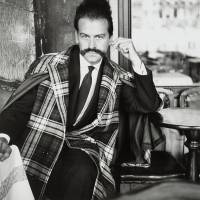
Portrait de Georges Mathieu par Barbara Niggl Radloff, 1961 - Aus dem Archiv des Münchner Stadtmuseums, Sammlung Fotografie, Archiv Barbara Niggl Radloff, Inventarnr. FM-2019/1.6.4.47 CC BY-SA 4.0
Georges Mathieu (born 27 January 1921, Boulogne-sur-Mer; died 10 June 2012, Boulogne-Billancourt) was the French painter who coined and championed lyrical abstraction, the gestural, calligraphic counterpart to geometric abstraction in post-war Paris. Famous for painting vast canvases in public, at speed, under titles borrowed from French history, he also carried abstraction into everyday life – posters, porcelain, tapestry, medals and the French ten-franc coin of 1974. His printed work, chiefly lithographs, translates that rapid, sign-like handwriting onto paper.
Le Coin des Arts follows Mathieu’s work closely and offers his original prints as and when fine impressions become available. At present the gallery holds a single poster: the one produced for his exhibition at the Galerie Jacques Dubourg, Paris, in 1961 – a period document rather than an original print. To be told when new works arrive, use the ‘follow the artist’ button.
Born Georges Victor Adolphe Mathieu d’Escaudœuvres, the son of a banker, Mathieu was educated in Boulogne-sur-Mer and at the Lycée Hoche in Versailles. He read English and then law at the University of Lille, and from 1942 taught English at the lycée in Douai – a background in English language and literature that he recalled in his inaugural address to the Académie des Beaux-Arts. He had no formal artistic training. His first oil paintings date from 1942; one early canvas is titled Oxford Street by Night. In 1946 his first abstract pictures were shown at the Salon des moins de trente ans in Paris; the Centre Pompidou holds Frotissance from that year.
Mathieu settled in Paris in 1947 and showed at the Salon des Réalités Nouvelles. On 16 December 1947 he took part in a group show of fourteen painters at the Galerie du Luxembourg, conceived as a manifesto for a ‘lyrical’ abstraction; its working title, ‘Towards Lyrical Abstraction’, was later changed to ‘L’Imaginaire’. In 1948, with Camille Bryen and the critic Michel Tapié, he organised ‘H.W.P.S.M.T.B.’ at the Galerie Colette Allendy, named after the initials of Hartung, Wols, Picabia, Stahly, Mathieu, Tapié and Bryen. In 1951 he featured in ‘Véhémences confrontées’ at the Galerie Nina Dausset, which set the Paris painters beside their American contemporaries. His first major large-scale picture, Hommage au maréchal de Turenne, was painted on 19 January 1952 and is now in the Musée national d’art moderne. From 1953 he also edited the Paris review of the shipping company United States Lines.
On 25 April 1954 Mathieu painted La Bataille de Bouvines, the first of his medieval ‘battles’. On 10 October 1954, in front of the dealer Jean Larcade’s house at Saint-Germain-en-Laye, he painted Les Capétiens partout ! (295 × 600 cm) in one hour and twenty minutes, straight from the tube and without a preliminary sketch; the canvas entered the national collection in 1956. In 1956 he painted Hommage aux poètes du monde entier, four metres by twelve, before an audience of some two thousand at the Théâtre Sarah-Bernhardt.
That year also brought his most celebrated British episode. On 23 June 1956, in London, Mathieu painted The Battle of Hastings – roughly two metres by five – between five o’clock and seven minutes to seven in the evening; the canvas is inscribed ‘23th June 56 / London’. It was shown as no. 1 in his exhibition at the Institute of Contemporary Arts, held from 4 July to 11 August 1956, and reviewed by the London press. The British collector Anthony Denney bought it from the artist; it was lent to the Tate Gallery in 1962–66 and 1967–71, and later to the Institut français in London, before Denney gave it to Toulouse in 1993. It now belongs to the Les Abattoirs museum. In 1957 Mathieu travelled to Japan, exhibiting at the Shirokiya Gallery in Tokyo and in Osaka, and painting there in public.
Mathieu was included in documenta II at Kassel in 1959, the year he painted Le Massacre de la Saint-Barthélemy in under half an hour to the drumming of Kenny Clarke. London saw him again in 1960 at the New London Gallery. In Paris, the Galerie Jacques Dubourg showed him in 1961, the Musée d’Art moderne de la Ville de Paris mounted a large retrospective in 1963, and the Galerie Charpentier hung about a hundred canvases in 1965. He now aimed to reshape everyday surroundings: a Gobelins tapestry for the French pavilion at Expo 67 in Montreal, gilded decoration for the Sèvres porcelain factory, a factory building at Fontenay-le-Comte completed in 1973, and, in 1967, a series of posters for Air France, each devoted to a destination – Great Britain among them. On 31 July 1974 his design for the ten-franc coin was chosen from 342 entries. Elected to the Académie des Beaux-Arts in 1975, he was formally received on 28 January 1976.
Mathieu set out his ideas in books such as Le Privilège d’être (1967) and De la révolte à la Renaissance, and designed the trophy for television’s 7 d’Or awards. He died at the Hôpital Ambroise-Paré, Boulogne-Billancourt, on 10 June 2012, and is buried in Montmartre Cemetery. A retrospective at the Galerie nationale du Jeu de Paume in 2002, which travelled to Liège and Milan and included The Battle of Hastings, began a reassessment that has since gathered pace: a retrospective at the Long Museum, Shanghai, in 2024, followed by ‘Georges Mathieu. Gesture, Speed, Movement’ at the Monnaie de Paris, co-produced with the Centre Pompidou, from 11 April to 7 September 2025. In Britain, Tate Etc. devoted a documentary feature to his performances in 2010.
Mathieu’s printmaking centres on lithography, the medium best suited to the speed of his line: whiplash strokes, flicks and spatters laid over pale or saturated grounds. His prints were pulled by leading Paris workshops, among them the Mourlot studio, usually on Arches or Rives wove paper. Alongside the signed, numbered editions there is a large body of posters – exhibition posters such as those for the Galerie Jacques Dubourg (1961) and the Galerie Charpentier (1965), and the much-collected Air France series of 1967. Some period posters were printed lithographically, but they carry a printed signature and were produced in quantity: they are posters, not original prints.
Unlike Chagall or Miró, Mathieu has no published catalogue raisonné of his prints, so his lithographs cannot be cited by a catalogue number. The Comité Georges Mathieu, founded in 2014 by Édouard Lombard, holder of the artist’s moral rights, is the only body entitled to issue certificates of authenticity and is assembling the preparatory files for a catalogue raisonné. For a print, therefore, the date, printer, edition and provenance do the work a catalogue number would otherwise do.
Edition and numbering. Signed lithographs are normally numbered by hand at lower left; artist’s proofs are marked ‘E.A.’. See the printing.
Signature. Mathieu signed in pencil at lower right, often adding the date. A signature reproduced in the stone or in the printing is not a hand signature. See the signature.
Paper and margins. Arches or Rives wove with full margins is what to look for; trimmed or light-struck sheets are worth considerably less.
No catalogue number. In the absence of a print catalogue, insist on a precise description – date, technique, printer, edition – and, for a significant sheet, consult the Comité Georges Mathieu.
Condition and provenance. Check for folds, foxing and fading, which shows readily on bright grounds; a period gallery or publisher provenance is a plus.
Pitfalls. Exhibition and Air France posters are often sold as ‘original lithographs’; they are posters. Recent offset reproductions also circulate. Our guarantees are set out on the authenticity page, and our framing page covers conservation mounting.
The gallery selects Mathieu’s work alongside that of the painters he exhibited with: Camille Bryen, Hans Hartung, Jean-Paul Riopelle, Karel Appel and Pierre Soulages. Explore the School of Paris and lyrical abstraction and our engravings and lithographs.
Georges Mathieu, Le Privilège d’être, 1967 (reissued Complicités, 2006) · Inaugural address of Georges Mathieu, Académie des Beaux-Arts, 28 January 1976 · Tate Etc. – Pretentious? Moi? Document: Georges Mathieu · French Ministry of Culture, Joconde – La Bataille de Hastings · Centre Pompidou – Les Capétiens partout ! · Comité Georges Mathieu · Wikipedia – Georges Mathieu

Secure payment
3DSecure 2.2

Free DHL Express delivery from €1,200
Carefully prepared parcel
Parcel tracking

Shipment insured
for the value of the artwork, covering theft and damages

Fairest prices
Certificate of authenticity
Two galleries in Paris
Receive an email as soon as a new artwork is added for this artist
Your message has been sent ! We will get back to you as soon as possible.
Please fill in the form if you need further information such
Please fill in your email address, an email will be sent with a link to update your password.
You can now place orders and track your orders.
To save your wishlist, you can log in or create an account :
This is a 100% custom-made frame, carefully crafted by a professional framer. Finishes are available in light oak, white wood or black wood, with or without mat board and plexiglass. Delivery times may vary depending on the order, with an average lead time of 10 days.
This option will be offered during the cart step.