
(1890-1967)
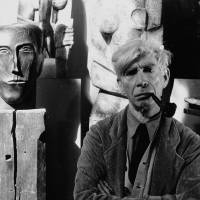
Emmy Andriesse for Anefo, Public domain, via Wikimedia Commons
Few sculptors of the School of Paris had such strong ties with Britain as Ossip Zadkine (1888-1967). Before he ever set foot in Paris, the young man from Vitebsk learnt English and woodcarving in Sunderland, attended classes at the Regent Street Polytechnic in London and spent his Sundays among the antiquities of the British Museum. He went on to become one of the great carvers of modern art – a sculptor of wood, stone and bronze whose work blends Cubism, Greek myth and a deep sense of tragedy, culminating in The Destroyed City in Rotterdam. A prolific draughtsman, he was also a fine etcher and lithographer.
From time to time, Galerie Le Coin des Arts in Paris offers original prints by Ossip Zadkine – etchings, lithographs and illustrated books – each chosen for the quality of the impression, its provenance and its condition.
Born Yossel Aronovich Tsadkin in Vitebsk, then part of the Russian Empire and now in Belarus, Zadkine came into the world in 1888 according to recent archival research – although he himself always gave 1890, the year still printed in many catalogues. He grew up largely in Smolensk and studied in Vitebsk at Yehuda Pen’s art school, where Marc Chagall was also a pupil.
Around 1905 he was sent to relatives in Sunderland, in the north-east of England. There he took art classes and learnt to handle the chisel, an experience that shaped his lifelong love of carving. Moving to London against his father’s wishes, he attended evening classes at the Regent Street Polytechnic, carved ornaments for furniture makers in the East End and studied ancient sculpture at the British Museum. On a summer visit to Russia in 1908 he carved a Head of a Hero directly in granite – the first sign of the direct-carving method that would define his art.
Zadkine settled in Paris in the autumn of 1910. He lasted barely six months at the École des Beaux-Arts, preferring the Egyptian galleries of the Louvre and Romanesque carving. From 1911 he worked at La Ruche, then near La Rotonde in Montparnasse, mixing with Picasso, Matisse, Apollinaire and his close friend Modigliani. London did not forget him: he showed with the Allied Artists Association in 1914 and 1915.
On 24 January 1916 he volunteered for the French army and served as a stretcher-bearer with the Russian ambulance unit in Champagne, until he was gassed in late 1916 and discharged in October 1917. The drawings he brought back from the front became his first printed work, a portfolio of twenty war etchings. In August 1920 he married the painter Valentine Prax (1897-1981), and in 1921 he took French nationality. His carvings of the early 1920s – Woman with a Fan and the Accordion Player series – are his most overtly Cubist.
In 1928 the couple moved to the house and studio at 100 bis rue d’Assas, today the Musée Zadkine. That same year Zadkine had a solo exhibition in London, followed by the Venice Biennale (1932), Brussels and New York (1933). Increasingly he modelled for bronze as well as carving, drawing on Greek mythology for Orpheus, Diana and the Maenads, after travelling to Greece in 1931. In 1934 he and Valentine bought a rambling house at Les Arques in the Lot, which became his summer workshop.
In June 1941 Zadkine sailed from Lisbon to New York. Isolated from Valentine, he worked in Greenwich Village, exhibited gouaches at Wildenstein, joined the celebrated Artists in Exile exhibition at Pierre Matisse Gallery in 1942 and taught at the Art Students League. He returned to France in September 1945.
The ruins of bombed cities inspired his masterpiece, The Destroyed City, commissioned by Rotterdam in 1950 and unveiled in 1953: a bronze figure some six metres high, its torso torn open, arms flung towards the sky. In 1950 he won the Grand Prize for Sculpture at the Venice Biennale, and he taught at the Académie de la Grande Chaumière until 1958. Recognition came from every side – documenta II in Kassel (1959), the Wallraf-Richartz Museum in Cologne (1960), the Kunsthaus Zürich (1965) – and, for British audiences, a major retrospective at the Tate Gallery in 1961. The Tate holds his work today. Zadkine died in Paris on 25 November 1967 and is buried in Montparnasse Cemetery.
Printmaking ran through his whole career. His etchings have the quick, wiry line of his pen drawings, while his lithographs, frequently in colour, turn the musicians, lovers and mythical heroes of his sculpture into supple contours and flat areas of colour. Most sheets are pencil-signed “O. Zadkine” and numbered from a small print run.
Notable illustrated books include Les Travaux d’Hercule (1960, colour lithographs), Portrait de l’Oiseau-Qui-N’Existe-Pas by his friend Claude Aveline (Geneva, 1965, eighteen lithographs), Robert Ganzo’s Lespugue (Marcel Sautier, 1966) and Apollinaire’s Sept Calligrammes (1967, ten etchings). The standard reference for the prints is Christophe Czwiklitzer, Ossip Zadkine, le sculpteur-graveur de 1919 à 1967 (1967), cited as “Czwiklitzer no.”; the sculpture is catalogued by Sylvain Lecombre, Ossip Zadkine. L’œuvre sculpté (Paris, 1994).
Before acquiring a Zadkine etching or lithograph, check the technique; the print run and annotation (numbered, artist’s proof or hors commerce); the pencil signature; the Czwiklitzer reference; the publisher and printer; whether the sheet comes from a livre d’artiste; and its provenance and condition – margins, paper tone, light-staining and foxing.
Original print or reproduction? Exhibition posters – including those for the 1961 Tate show, sometimes signed – and reproductions after his gouaches circulate widely. An original print was made by the artist for the medium, issued in a limited edition and recorded in the catalogue; a poster carries lettering and is unnumbered. Plates from illustrated books are genuine original prints, although they are usually unsigned.
Galerie Le Coin des Arts selects Zadkine’s original prints with careful attention to authenticity, provenance and condition, and can advise on framing and mounting. You may also enjoy prints by Marc Chagall, Pablo Picasso, Fernand Léger, André Masson and Léonard Foujita.
Musée Zadkine – Zadkine’s biography, Paris Musées · Ossip Zadkine, Wikipedia · documenta II (1959) · Sylvain Lecombre, Ossip Zadkine. L’œuvre sculpté, Paris, 1994 · Christophe Czwiklitzer, Ossip Zadkine, le sculpteur-graveur de 1919 à 1967, Paris, 1967 · Ossip Zadkine, Le Maillet et le ciseau, Albin Michel, 1968

Secure payment
3DSecure 2.2

Free DHL Express delivery from €1,200
Carefully prepared parcel
Parcel tracking

Shipment insured
for the value of the artwork, covering theft and damages

Fairest prices
Certificate of authenticity
Two galleries in Paris
Receive an email as soon as a new artwork is added for this artist
Your message has been sent ! We will get back to you as soon as possible.
Please fill in the form if you need further information such
Please fill in your email address, an email will be sent with a link to update your password.
You can now place orders and track your orders.
To save your wishlist, you can log in or create an account :
This is a 100% custom-made frame, carefully crafted by a professional framer. Finishes are available in light oak, white wood or black wood, with or without mat board and plexiglass. Delivery times may vary depending on the order, with an average lead time of 10 days.
This option will be offered during the cart step.