(1888-1976)

ALBERS Josef
Homage to the Square : HG442:a, 1964
Silkscreen LCD8146
6 000.00€
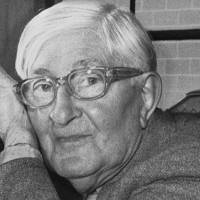
Portrait de Josef Albers par John T. Hill, 1972 - CC BY-SA 4.0, Sirocco Screen-printing, North Haven, CT
Josef Albers (1888-1976) is one of the great masters of twentieth-century geometric abstraction. Painter, printmaker, theorist and teacher, he moved from the Bauhaus to the United States and devoted more than half a century to a deceptively simple question: why does the same colour change according to the colours around it? His Homage to the Square series and his book Interaction of Color made him a point of reference for generations of artists, designers and colourists, and one of the forerunners of Op Art and Minimalism.
Galerie Le Coin des Arts in Paris offers original prints by Josef Albers, in particular screenprints and lithographs, which rank among the most accomplished expressions of his research into colour.
Josef Albers was born on 19 March 1888 in Bottrop, in the Ruhr region of Germany. Having trained as a primary school teacher between 1905 and 1908, he taught for several years in Westphalia while pursuing his artistic education: at the Royal Academy of Fine Arts in Berlin (1913-1915), where he qualified as an art teacher, and then at the School of Applied Arts in Essen (1916-1919), where he learned the art of stained glass under Johan Thorn Prikker.
In 1918 he completed his first public commission, the stained-glass window Rosa mystica ora pro nobis for a church in Bottrop. His first prints – still figurative lithographs and woodcuts – also date from this period: the catalogue raisonné of his printed work begins as early as 1915. He then studied briefly at the Academy of Fine Arts in Munich.
In 1920, at the age of thirty-two, he enrolled at the Bauhaus in Weimar, the school founded the previous year by Walter Gropius to unite art, craft, architecture and design. A student on Johannes Itten’s preliminary course, he made his first abstract works by assembling fragments of glass. He joined the teaching staff in 1922, was entrusted in 1923 with the preliminary course on materials, and became a professor (Master) in 1925, when the school moved to Dessau. That same year he married Anni Albers, a student in the weaving workshop, who would become one of the century’s great textile artists and printmakers. Albers taught at the Bauhaus until its closure under pressure from the Nazi regime in 1933.
In November 1933, Josef and Anni Albers left Germany for the United States, invited to teach at Black Mountain College in North Carolina, a newly founded experimental school where Albers placed art at the heart of the curriculum. He headed the painting programme there until 1949. His students included Robert Rauschenberg, Cy Twombly, Ruth Asawa, Ray Johnson and Susan Weil. The couple’s regular journeys to Mexico from the 1930s onwards had a lasting influence on his vocabulary of simple forms and frank colours.
In 1950, Albers became head of the Department of Design at the Yale University School of Art in New Haven, a post he held until 1958. Among his students were Eva Hesse, Richard Anuszkiewicz and Neil Welliver. His teaching was based on experience rather than theory: learning to “see” before knowing, comparing, and handling coloured papers to discover for oneself that the perception of a colour always depends on its context.
This method culminated in 1963 in the publication of Interaction of Color by Yale University Press. The first edition, limited to 2,000 copies, contains 150 screenprinted plates. Constantly reprinted and translated, it remains one of the standard works on colour theory, in art schools and design studios alike.
From 1950 until the end of his life, Albers devoted himself to the series that made him famous: Homage to the Square. Hundreds of paintings, drawings and prints follow the same scheme: three or four nested squares, set slightly below centre according to precise mathematical proportions. With the form fixed, only colour varies – and colour becomes the true subject: depending on their neighbours, hues seem to advance or recede, lighten or darken, merge or vibrate.
Albers painted these works on Masonite panels, applying colour straight from the tube with a palette knife in thin, even layers, and recording on the reverse the paints he had used. Yet this almost scientific rigour served a deeply sensory experience: “colour is the most relative medium in art”, he liked to say.
In the 1960s his research was hailed as a major source of Op Art, alongside that of Victor Vasarely. In 1971, the Metropolitan Museum of Art in New York gave him a solo exhibition: he was the first living artist to receive this honour.
Albers’s work was shown in London during his lifetime, notably at the Gimpel Fils gallery, which held a solo exhibition in 1961 and presented Josef Albers: Homage to the Square in 1965, after its showing in Zurich. His paintings and prints are now held in British public collections, including Tate.
The British public rediscovered the Albers couple’s Bauhaus legacy with Bauhaus: Art as Life at the Barbican (2012), then with the major Anni Albers retrospective at Tate Modern in 2018, which brought renewed attention to the whole Albers circle. Interaction of Color remains a key text in British art and design schools.
The printed work of Josef Albers occupies a central place in his oeuvre. Far from seeing printmaking as a mere means of reproducing his paintings, Albers regarded the print as the ideal field for experiment: printing allowed perfectly even areas of flat colour, free of any trace of the hand, and the precise comparison of countless colour variations on a single structure.
His prints are catalogued in Brenda Danilowitz’s catalogue raisonné, The Prints of Josef Albers: A Catalogue Raisonné, 1915-1976, which records more than 240 prints and portfolios. Each print is given a number, usually cited as “Danilowitz no.”: this is the first reference to check before any purchase.
The woodcuts and linocuts of the 1930s and 1940s, made mostly at Black Mountain, were followed from the 1960s by the great colour series printed in screenprint and lithography with the finest American workshops.
Screenprinting was Albers’s favourite technique: ink pressed through a silk screen forms an opaque, uniform layer, very close to his painted planes of colour. He worked closely with Norman Ives and Sewell Sillman, two of his former Yale students, whose publishing house Ives-Sillman issued several of his major ensembles, printed in North Haven, Connecticut.
Besides the plates of Interaction of Color (1963), Albers produced many Homage to the Square screenprints, published individually or in portfolios, as well as suites such as SP (1967). His last great project, Formulation: Articulation (1972), co-published by Harry N. Abrams and Ives-Sillman, brings together 127 screenprints on 66 folded sheets in two portfolios: a true synthesis of his entire career.
For these large ensembles, collectors should note that the artist’s signature generally appears on the portfolio’s colophon rather than on each plate: a single plate from Interaction of Color or Formulation: Articulation is therefore unsigned, which does not call its status as an original print into question.
Lithography offered Albers other possibilities: transparency, superimposition and softer, more velvety nuances. In 1963, at the Tamarind Lithography Workshop in Los Angeles, he created the suite Day and Night, a portfolio of ten Homage to the Square lithographs printed by Kenneth Tyler, each area of colour carefully blotted after printing to obtain a perfectly matt surface.
He continued this collaboration with Kenneth Tyler at Gemini G.E.L. in Los Angeles, where in 1966 he produced the two series of White Line Squares lithographs. In these works, a thin line of paper left in reserve between two squares is enough to transform the perception of the whole – proof, once again, that colour never exists on its own.
A naturalised American citizen from 1939, Josef Albers lived in Connecticut from 1950 and worked there until his final days. In 1971, together with Anni Albers, he established the Josef and Anni Albers Foundation, now based in Bethany, which preserves, studies and promotes the work of the couple.
Josef Albers died on 25 March 1976 in New Haven. In 1983 his home town opened the Josef Albers Museum Quadrat in Bottrop, which holds a major group of his paintings and prints. His works are today found in the world’s leading public collections, from the Museum of Modern Art and the Metropolitan Museum in New York to the Centre Pompidou in Paris.
Original prints by Josef Albers offer a way into the work of one of the most influential artists of the twentieth century, through a coherent, rigorously documented and clearly identifiable body of work.
When examining a Josef Albers screenprint or lithograph, several points matter: the technique used, the edition, the pencil signature, the reference in the Danilowitz catalogue raisonné, whether the sheet belongs to a portfolio, its provenance and its condition. With Albers, condition is decisive: large flat areas reveal the slightest stain or scratch, and the colours, which are sensitive to light, must have kept their original freshness.
Original print or reproduction? The Homage to the Square works are among the most widely reproduced images in modern art: exhibition posters, offset prints and book reproductions circulate in large numbers. An original print is printed under the artist’s supervision, on fine paper, and recorded in the catalogue raisonné; a poster usually carries lettering and is not numbered.
Galerie Le Coin des Arts selects original prints by Josef Albers with particular attention to their authenticity, provenance and condition, and advises collectors on choosing a work, its framing and its conservation. Prints are shipped insured to the United Kingdom and worldwide.
The Josef and Anni Albers Foundation, Bethany (Connecticut) · Josef Albers Museum Quadrat, Bottrop · Brenda Danilowitz, The Prints of Josef Albers: A Catalogue Raisonné, 1915-1976, Hudson Hills Press / The Josef and Anni Albers Foundation (revised edition, 2010) · Josef Albers, Interaction of Color, Yale University Press, 1963.

Secure payment
3DSecure 2.2

Free DHL Express delivery from €1,200
Carefully prepared parcel
Parcel tracking

Shipment insured
for the value of the artwork, covering theft and damages

Fairest prices
Certificate of authenticity
Two galleries in Paris
Receive an email as soon as a new artwork is added for this artist
Your message has been sent ! We will get back to you as soon as possible.
Please fill in the form if you need further information such
Please fill in your email address, an email will be sent with a link to update your password.
You can now place orders and track your orders.
To save your wishlist, you can log in or create an account :
This is a 100% custom-made frame, carefully crafted by a professional framer. Finishes are available in light oak, white wood or black wood, with or without mat board and plexiglass. Delivery times may vary depending on the order, with an average lead time of 10 days.
This option will be offered during the cart step.