
(1888-1976)

ALBERS Josef
Homage to the Square : HG442:a, 1964
Silkscreen LCD8146
6 000.00€
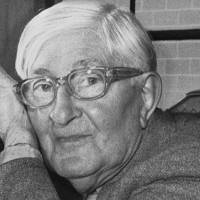
Portrait de Josef Albers par John T. Hill, 1972 - CC BY-SA 4.0, Sirocco Screen-printing, North Haven, CT
Josef Albers (1888-1976) is one of the great masters of twentieth-century geometric abstraction. A painter, printmaker, color theorist, and educator, he carried the spirit of the Bauhaus to America and spent more than half a century exploring a deceptively simple question: why does the same color change depending on the colors around it? His Homage to the Square series and his book Interaction of Color made him a touchstone for generations of American artists and designers, and a forerunner of Op Art, color field painting, and Minimalism.
Galerie Le Coin des Arts in Paris offers original Josef Albers prints, especially screenprints and lithographs, which are among the most accomplished expressions of his research into color.
Josef Albers was born on March 19, 1888, in Bottrop, in Germany’s Ruhr region. After training as an elementary school teacher from 1905 to 1908, he taught for several years in Westphalia while pursuing his art education: at the Royal Academy of Fine Arts in Berlin (1913-1915), where he earned his certification as an art teacher, and then at the School of Applied Arts in Essen (1916-1919), where he learned stained glass under Johan Thorn Prikker.
In 1918 he completed his first public commission, the stained-glass window Rosa mystica ora pro nobis for a church in Bottrop. His earliest prints, still figurative lithographs and woodcuts, also date from this period: the catalogue raisonné of his printed work begins as early as 1915. He then studied briefly at the Academy of Fine Arts in Munich.
In 1920, at age thirty-two, he enrolled at the Bauhaus in Weimar, the school founded the year before by Walter Gropius to unite art, craft, architecture, and design. A student in Johannes Itten’s preliminary course, he created his first abstract works by assembling fragments of glass. He joined the faculty in 1922, took over the preliminary course on materials in 1923, and was named a professor (Master) in 1925, when the school moved to Dessau. That same year he married Anni Albers, a student in the weaving workshop, who would become one of the century’s great textile artists and printmakers. Albers taught at the Bauhaus until it was forced to close by the Nazi regime in 1933.
In November 1933, Josef and Anni Albers left Germany for the United States after being invited to teach at Black Mountain College in North Carolina, a newly founded experimental school where Albers made art the center of the curriculum. He led the painting program there until 1949. His students included Robert Rauschenberg, Cy Twombly, Ruth Asawa, Ray Johnson, and Susan Weil. The couple’s frequent trips to Mexico, beginning in the 1930s, left a lasting mark on his vocabulary of simple forms and bold colors.
In 1950, Albers became chairman of the Department of Design at the Yale University School of Art in New Haven, Connecticut, a position he held until 1958. Among his students were Eva Hesse, Richard Anuszkiewicz, and Neil Welliver. His teaching was grounded in experience rather than theory: learning to “see” before knowing, comparing, and working with sheets of colored paper to discover firsthand that the perception of a color always depends on its context.
This method culminated in 1963 with the publication of Interaction of Color by Yale University Press. The first edition, limited to 2,000 copies, includes 150 screenprinted plates. Continuously reprinted and translated, it remains one of the most influential books on color ever written, used in art schools and design programs across the country.
From 1950 until the end of his life, Albers devoted himself to the series that made him famous: Homage to the Square. Hundreds of paintings, drawings, and prints follow the same format: three or four nested squares, set slightly below center according to precise mathematical proportions. With the structure fixed, only color changes, and color becomes the real subject: depending on their neighbors, hues seem to advance or recede, lighten or darken, blend or vibrate.
Albers painted these works on Masonite panels, applying paint straight from the tube with a palette knife in thin, even layers, and noting on the back the exact colors he had used. Yet this almost scientific rigor serves a deeply sensory experience: “color is the most relative medium in art,” he often said.
In the 1960s his work was recognized as a major source of Op Art, alongside that of Victor Vasarely, and of the hard-edge abstraction then emerging in American painting.
Albers’s American career is marked by several milestones. In 1956 the Yale University Art Gallery presented Josef Albers: Paintings, Prints, Projects. In 1963 his large mural Manhattan was installed in the lobby of the Pan Am Building in New York. Beginning in 1964, the Museum of Modern Art organized a traveling exhibition, Homage to the Square, which toured Latin America and then the United States; in 1969-1970 MoMA also showed The Graphic Constructions of Josef Albers.
The ultimate recognition came in 1971, when the Metropolitan Museum of Art devoted a solo exhibition to him: Albers was the first living artist ever to receive this honor at the Met. After his death, the Solomon R. Guggenheim Museum mounted a major centennial retrospective in 1988, followed in 2017-2018 by Josef Albers in Mexico, which highlighted the importance of his travels south of the border.
Albers’s prints are central to his work. Far from seeing printmaking as a way to reproduce his paintings, he considered the print an ideal field for experimentation: printing made it possible to lay down perfectly even, flat areas of color with no trace of the hand, and to compare countless color variations on a single structure with precision.
His prints are documented in Brenda Danilowitz’s catalogue raisonné, The Prints of Josef Albers: A Catalogue Raisonné, 1915-1976, which lists more than 240 prints and portfolios. Each print has a number, usually cited as “Danilowitz no.”: this is the first reference to verify before buying.
The woodcuts and linocuts of the 1930s and 1940s, made mostly at Black Mountain, were followed in the 1960s by the major color series printed in screenprint and lithography with the leading American print workshops.
Screenprinting (silkscreen) was Albers’s favorite technique: ink pushed through a fine screen produces an opaque, uniform layer, very close to his painted fields of color. He worked closely with Norman Ives and Sewell Sillman, two of his former Yale students, whose publishing firm Ives-Sillman issued several of his major projects, printed in North Haven, Connecticut.
In addition to the plates of Interaction of Color (1963), Albers made many Homage to the Square screenprints, published individually or in portfolios, as well as suites such as SP (1967). His last great project, Formulation: Articulation (1972), co-published by Harry N. Abrams and Ives-Sillman, brings together 127 screenprints on 66 folded sheets in two portfolios: a true summation of his entire career.
For these large portfolios, note that the artist’s signature usually appears on the colophon rather than on each plate: a single plate from Interaction of Color or Formulation: Articulation is therefore unsigned, which does not affect its status as an original print.
Lithography gave Albers other possibilities: transparency, layering, and softer, more velvety nuances. In 1963, at the Tamarind Lithography Workshop in Los Angeles, he created Day and Night, a portfolio of ten Homage to the Square lithographs printed by Kenneth Tyler, with each color area carefully blotted after printing to achieve a perfectly matte surface.
He continued working with Kenneth Tyler at Gemini G.E.L. in Los Angeles, where in 1966 he produced the two series of White Line Squares lithographs. In these works, a thin line of bare paper left between two squares is enough to transform the perception of the whole image: proof, once again, that color never exists on its own.
Albers became an American citizen in 1939 and lived in Connecticut from 1950, working there until the end of his life. In 1971, together with Anni Albers, he established the Josef and Anni Albers Foundation, now based in Bethany, Connecticut, which preserves, studies, and promotes the couple’s work.
Josef Albers died on March 25, 1976, in New Haven. In 1983 his hometown opened the Josef Albers Museum Quadrat in Bottrop, Germany. His work is held by leading museums worldwide, including the Museum of Modern Art, the Metropolitan Museum of Art, the Guggenheim, the Yale University Art Gallery, and the Centre Pompidou in Paris.
Original Josef Albers prints offer an entry point into the work of one of the most influential artists of the twentieth century, through a coherent, thoroughly documented, and readily identifiable body of work.
When evaluating a Josef Albers screenprint or lithograph, several factors matter: the technique, the edition, the pencil signature, the Danilowitz catalogue raisonné number, whether the sheet comes from a portfolio, provenance, and condition. With Albers, condition is critical: large flat areas reveal the smallest stain or scratch, and the colors, which are sensitive to light, should retain their original brilliance.
Original print or reproduction?Homage to the Square is one of the most widely reproduced images in modern art: exhibition posters, offset prints, and book plates circulate in large numbers. An original print is printed under the artist’s supervision, on fine paper, and listed in the catalogue raisonné; a poster typically includes text and is not numbered.
Galerie Le Coin des Arts selects original Josef Albers prints with close attention to authenticity, provenance, and condition, and helps collectors choose a work, with advice on framing and conservation. Prints are shipped fully insured to the United States.
The Josef and Anni Albers Foundation, Bethany, Connecticut · Josef Albers Museum Quadrat, Bottrop · Brenda Danilowitz, The Prints of Josef Albers: A Catalogue Raisonné, 1915-1976, Hudson Hills Press / The Josef and Anni Albers Foundation (revised edition, 2010) · Josef Albers, Interaction of Color, Yale University Press, 1963.

Secure payment
3DSecure 2.2

Free DHL Express delivery from €1,200
Carefully prepared parcel
Parcel tracking

Shipment insured
for the full value of the artwork, covering theft and damage

Fairest prices
Certificate of authenticity
Two galleries in Paris
Receive an email as soon as a new artwork is added for this artist
Your message has been sent ! We will get back to you as soon as possible.
Please fill in the form if you need further information such
Please fill in your email address, an email will be sent with a link to update your password.
You can now place orders and track your orders.
To save your wishlist, you can log in or create an account :
This is a 100% custom-made frame, carefully crafted by a professional framer. Finishes are available in light oak, white wood or black wood, with or without mat board and plexiglass. Delivery times may vary depending on the order, with an average lead time of 10 days.
This option will be offered during the cart step.



