
(1896-1986)
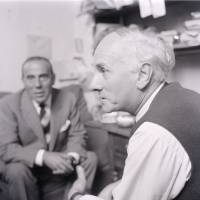
Gérard Schneider, 1961 — photographie Paolo Monti / Fondo Paolo Monti, BEIC — CC BY-SA 4.0, via Wikimedia Commons.
Gérard Schneider (born April 28, 1896, in Sainte-Croix, Switzerland; died July 8, 1986, in Paris) was a Swiss-born French painter and one of the founders of Lyrical Abstraction, the movement often compared with American Abstract Expressionism. His sweeping, high-energy brushstrokes made him a fixture of the postwar School of Paris, and from 1955 he was represented in New York by the Kootz Gallery. The Museum of Modern Art, the Phillips Collection and the Albright-Knox in Buffalo all hold his work. Less well known, but well worth a collector’s attention, are his fine art prints: lithographs, aquatints, screenprints and illustrated books.
Right now, Le Coin des Arts has two Schneider prints available: an untitled screenprint (Sans titre) and the 1968 lithograph La Peau des choses (“The Skin of Things”), hand-signed in pencil and numbered from an edition of 114, from the portfolio published in Paris by Jean-Robert Arnaud. We picked both for print quality, edition, provenance and condition. Want to know when more come in? Click “follow the artist” on this page.
Schneider grew up in Neuchâtel, where his father was a cabinetmaker and antiques dealer. At 20, in 1916, he left for Paris and enrolled at the École nationale des arts décoratifs. Two years later, in 1918, he joined Fernand Cormon’s studio at the École des beaux-arts – the same teacher who had trained Van Gogh and Toulouse-Lautrec. He had his first solo show in Neuchâtel in 1920, moved to Paris permanently in 1922, and made his debut at the Salon d’Automne in 1926. In the mid-1930s he stopped painting from nature, wrote poetry, and spent time in Surrealist circles; Kandinsky’s abstraction was another key reference. He met Picasso in 1939, studied with the mystic G. I. Gurdjieff from 1941 to 1943, and by around 1944 had become a fully abstract painter.
In 1946, Schneider was part of Peintures abstraites at Galerie Denise René, one of the first postwar shows of abstract art in Paris. That same year he contributed to Art abstrait, a portfolio of twelve lithographs with a preface by critic Charles Estienne, alongside Hans Hartung and Serge Poliakoff. Galerie Lydia Conti gave him solo shows in 1947, 1948 and 1950, and in 1949 exhibited him with Hartung and Pierre Soulages. He became a French citizen in 1948, the year of his first Venice Biennale (he returned in 1954 and 1966). He also showed at the São Paulo Biennial (1951, 1953, 1961) and at documenta in Kassel (1955, 1959).
Schneider’s American career started early. In 1949 he was in the group show Painted in France at the Betty Parsons Gallery in New York, which gave him a solo exhibition in 1951. That same year, the touring show Advancing French Art took his work to Louisville, Bloomington, San Francisco, Chicago and Washington. In 1955 he signed with Samuel Kootz, and the gallery gave him solo shows in 1956, 1957, 1958, 1959 and 1961. Museums followed: the Phillips Collection in Washington acquired Opus 445, and MoMA holds the painting Opus 95 B as well as several prints, including the aquatint Abstraction (1953), bought through the Larry Aldrich Fund in 1954. His work is also in the Albright-Knox Art Gallery, which showed him several times, and the Walker Art Center in Minneapolis. In 1956 he married Loïs Frederick, an American art student who had come to Paris on a Fulbright scholarship. In 1968 the touring exhibition Painting in France 1900-1967 brought him back to U.S. and Canadian audiences.
From 1960, the Milan dealer Bruno Lorenzelli became a key supporter, Galerie Der Spiegel in Cologne had been showing him since 1952, and in Paris he showed regularly at Galerie Arnaud. A retrospective opened at the Kunstverein Düsseldorf and the Palais des Beaux-Arts in Brussels in 1962. At the 1966 Venice Biennale he had a full room in the French pavilion, and in 1970 the Galleria Civica d’Arte Moderna in Turin showed about one hundred of his paintings. In 1974 he published Mots au vol, a book of poems with a preface by playwright Eugène Ionesco. Retrospectives in Neuchâtel and Dunkirk followed in 1983, and he died in Paris three years later at 90. Recent shows – L’Envolée lyrique at the Musée du Luxembourg (2006), Neuchâtel (2011), Orléans (2013) – have brought renewed attention to his work.
Schneider worked mostly in lithography, a medium that captures the width and speed of his brushwork. The 1946 Art abstrait portfolio (Opéra, Paris) was printed by Desjobert in 100 numbered copies; MoMA owns a complete set. In 1948 he made twelve color lithographs for Langage, poems by Robert Ganzo, published by Lydia Conti. The catalog of his 1957 show at Galerie Der Spiegel in Cologne includes an original lithograph printed at the famed Mourlot workshop. He also made intaglio prints: MoMA has the aquatint Abstraction and an etching and aquatint titled Composition, each from an edition of 100. In 1968, Paris dealer Jean-Robert Arnaud published La Peau des choses: ten prints (etchings, screenprints and lithographs) by Schneider, Hartung, Soulages, Zao Wou-Ki, Victor Vasarely, César, Émile Gilioli, James Guitet, John-Franklin Koenig and Huguette-Arthur Bertrand, with poems by critic Michel Ragon, in an edition of 114.
Heads up: to our knowledge there is no published catalogue raisonné of Schneider’s prints, and the catalog of his paintings is still being prepared. Prints are identified by title, date, technique, publisher, and the book, portfolio or exhibition catalog they come from. Be skeptical of any “catalog number” that doesn’t cite an author or book title.
Check the signature. Edition prints are hand-signed in pencil “Schneider.” A signature printed in the plate is not the same thing. More on signatures.
Check the edition size. Schneider’s editions are small – 100 for Art abstrait, 114 for La Peau des choses. The pencil number (say, 103/114) should match. See the printing process.
Know your book plates. The lithograph in the 1957 Der Spiegel catalog is authentic, but it’s signed in the plate and usually folded down the middle. Plates from Langage or Art abstrait aren’t signed individually. Price accordingly.
Watch out for posters and reproductions. Exhibition posters and offset reproductions “after Schneider” are not original prints – even if they carry a signature. Read what makes a print original.
Inspect paper and condition. Look for full margins, no folds, no yellowing. Bright inks fade in sunlight, so go with UV-protective glazing; see our framing options.
Ask about provenance. With no catalogue raisonné, an old invoice, the original portfolio case or the complete book helps document a sheet. Our guarantees are on the authenticity page.
Le Coin des Arts also offers prints by the artists who shaped postwar abstraction alongside Schneider: Hans Hartung, Pierre Soulages, Georges Mathieu, Jean-Paul Riopelle and Serge Poliakoff. Browse the School of Paris and Lyrical Abstraction and our engravings and lithographs.
Gérard Schneider, Mots au vol, preface by Eugène Ionesco, 1974 · MoMA – Gérard Schneider · MoMA – Art abstrait, 1946 · MoMA – Abstraction, 1953 · Perrotin – Gérard Schneider · Galerie Diane de Polignac – Gérard Schneider · Galerie Applicat-Prazan – Gérard Schneider · Phillips – La Peau des choses, 1968

Secure payment
3DSecure 2.2

Free DHL Express delivery from €1,200
Carefully prepared parcel
Parcel tracking

Shipment insured
for the full value of the artwork, covering theft and damage

Fairest prices
Certificate of authenticity
Two galleries in Paris
Receive an email as soon as a new artwork is added for this artist
Your message has been sent ! We will get back to you as soon as possible.
Please fill in the form if you need further information such
Please fill in your email address, an email will be sent with a link to update your password.
You can now place orders and track your orders.
To save your wishlist, you can log in or create an account :
This is a 100% custom-made frame, carefully crafted by a professional framer. Finishes are available in light oak, white wood or black wood, with or without mat board and plexiglass. Delivery times may vary depending on the order, with an average lead time of 10 days.
This option will be offered during the cart step.


