
(1901-1966)

Alberto GIACOMETTI
Standing Man, 1957
Sold
Looking for a similar artwork?
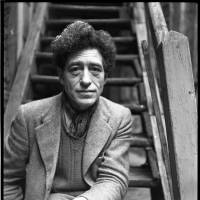
Emmy Andriesse, Public domain, via Wikimedia Commons
Swiss-born and Paris-based, Alberto Giacometti (October 10, 1901, Borgonovo, Switzerland – January 11, 1966, Chur) is the sculptor of the walking man: thin, upright figures that came to define postwar art. America played a decisive role in his career, from his first New York show in 1934 to the record $141.3 million paid at Christie’s New York in 2015 for L’Homme au doigt. Collectors often overlook another side of his work: original lithographs and etchings, more than 350 in all, documented in the catalog published in New York by Herbert C. Lust.
Right now, Le Coin des Arts has one Giacometti print available: Homme debout (“Standing Man”), a 1957 lithograph published by Maeght, Paris, hand-signed and numbered 47/100 (41 × 28.3 cm). Auction listings connect it to L’Atelier d’Alberto Giacometti, the text Jean Genet wrote about the artist’s studio, published by Maeght the same year. We look for Giacometti prints with strong impressions, sound provenance and good condition; click “follow the artist” to hear about new arrivals.
Giacometti grew up in Stampa, in the Bregaglia valley, the son of painter Giovanni Giacometti; painters Cuno Amiet and Ferdinand Hodler were his godfathers. He made his first woodcuts as a student at the Protestant school in Schiers, then trained in Geneva starting in 1919. In January 1922 he moved to Paris to study sculpture with Antoine Bourdelle at the Académie de la Grande Chaumière, and on December 1, 1926, he took the tiny studio at 46 rue Hippolyte-Maindron where he would work until his death. By 1929 he was part of the Surrealist circle; André Breton’s group expelled him on February 14, 1935, when he went back to working from the model. Prints were already part of that period: his first illustrated book, René Crevel’s Les Pieds dans le plat, came out in 1933, and in 1934 he made four prints for Breton’s L’Air de l’eau. He spent World War II in Geneva, where he met Annette Arm; they married in Paris on July 19, 1949, the year he made his first lithograph, a portrait of Tristan Tzara for the review Phases.
His American story starts early. His first U.S. solo show opened at the Julien Levy Gallery in New York in December 1934. In 1936, the Museum of Modern Art acquired The Palace at 4 A.M. (1932), and Pierre Matisse, son of Henri Matisse, became his dealer in the United States. In January 1948, the Pierre Matisse Gallery showed his new postwar figures, with a catalog essay by Jean-Paul Sartre; Harper’s Bazaar ran the first American magazine profile, with photographs by Brassaï. Matisse showed him again in 1950, 1958, 1961 and 1964. In 1954, Santa Barbara, California, hosted his first monographic museum exhibition, and in 1955 the Solomon R. Guggenheim Museum gave him a retrospective.
Around 1955, Pittsburgh industrialist G. David Thompson built a major Giacometti collection, buying mostly from Pierre Matisse; it later formed the core of the Alberto Giacometti Foundation in Zurich. From 1958 to 1960, Giacometti worked on a monumental project for Chase Manhattan Bank Plaza in New York, which was never carried out. In 1961, he won first prize at the Pittsburgh International of the Carnegie Institute; in 1962, the Grand Prize for Sculpture at the Venice Biennale; in January 1964, the Guggenheim International Award for painting. In 1965, the MoMA retrospective brought him to the United States for the first time, the same year as his retrospective at London’s Tate. He died in Chur, Switzerland, on January 11, 1966, and was buried in his native Borgonovo. Today the Fondation Alberto et Annette Giacometti, created in Paris in 2003 from his widow’s estate, preserves the archive, runs the Institut Giacometti with its reconstructed studio and publishes the online Alberto Giacometti Database, a catalogue raisonné of his sculptures, paintings, drawings and decorative objects.
Giacometti learned etching in 1933 at Atelier 17, the Paris workshop of Stanley William Hayter, and used it mainly to illustrate books by writer friends, from Georges Bataille’s Histoire de rats (1947) to Michel Leiris’s Vivantes cendres, innommées (1961), with 52 etchings. His first lithograph dates from 1949; from 1951, encouraged by his Paris dealer Aimé Maeght, he drew directly on the stone with lithographic crayon, and Fernand Mourlot’s shop printed the editions. His late masterpiece is Paris sans fin: 150 lithographs of streets, cafés and studio interiors, printed by Mourlot and published by Tériade in 1969. The standard reference is Herbert C. Lust, Giacometti: The Complete Graphics and 15 Drawings (New York: Tudor Publishing, 1970). When a dealer writes “Lust 15,” that is the print’s number in this catalog. U.S. museums cite it too: the National Gallery of Art in Washington catalogs its 1954 lithograph Studio II (edition of 30) as Lust 15, and both the NGA and the Toledo Museum of Art identify Paris sans fin as Lust 204–353.
Check the signature. A published impression should be signed in pencil “Alberto Giacometti.” A signature printed in the stone doesn’t count. Learn more about the signature.
Check the edition. Many 1950s Maeght lithographs were printed in editions of 100, like our Homme debout; a few earlier sheets had much smaller runs. See the printing process.
Match it to Lust. Ask for the Lust number and compare image, technique and size. No Lust number, no deal—unless there’s a solid explanation.
Watch out for reproductions. Posters, offset prints and sheets labeled “after Giacometti” are not original prints. Neither are unsigned pages of Derrière le miroir sold as if they were signed editions: they are real Mourlot lithographs, but unsigned and unnumbered by design. Paris sans fin appeared three years after the artist’s death, so its plates were never pencil-signed. For complete volumes, browse our illustrated books.
Know the fake problem. Forgers have long targeted Giacometti’s sculpture: in 2009 German police seized more than a thousand fake bronzes and plasters, and a representative of the Fondation Giacometti in Paris served on the expert panel in the Stuttgart trial. The Fondation fights counterfeits and runs an authentication committee for paintings, sculptures, drawings and decorative objects; for prints, rely on Lust, the signature, the paper and the paper trail.
Condition and framing. Look for full margins on Arches or Rives paper and no fading of the delicate grays; Giacometti’s light crayon work loses its depth quickly when a sheet has been hung in sunlight. Use UV-protective glazing when framing. Our commitments are detailed on the authenticity page.
We also handle prints by artists connected with Giacometti’s dealers, printers and circle: Henri Matisse, Joan Miró, Marc Chagall, Alexander Calder and Francis Bacon. Explore modern art, Surrealism and our engravings and lithographs.
Herbert C. Lust, Giacometti: The Complete Graphics and 15 Drawings, New York: Tudor Publishing, 1970 · Alberto Giacometti, Paris sans fin, Paris: Tériade, 1969 · Fondation Giacometti – Biographical Timeline · National Gallery of Art – Paris sans fin · Toledo Museum of Art – Paris sans fin · Alberto Giacometti Foundation, Zurich – History · L’Homme au doigt – sale history · The Art Newspaper – Giacometti fakes seized, 2010

Secure payment
3DSecure 2.2

Free DHL Express delivery from €1,200
Carefully prepared parcel
Parcel tracking

Shipment insured
for the full value of the artwork, covering theft and damage

Fairest prices
Certificate of authenticity
Two galleries in Paris
Receive an email as soon as a new artwork is added for this artist
Your message has been sent ! We will get back to you as soon as possible.
Please fill in the form if you need further information such
Please fill in your email address, an email will be sent with a link to update your password.
You can now place orders and track your orders.
To save your wishlist, you can log in or create an account :
This is a 100% custom-made frame, carefully crafted by a professional framer. Finishes are available in light oak, white wood or black wood, with or without mat board and plexiglass. Delivery times may vary depending on the order, with an average lead time of 10 days.
This option will be offered during the cart step.



