
(1881-1973)

PICASSO Pablo
A man in an Afghan vest pondering the love story of a &ldquo..., 1968
Etching LCD8579
9 500.00€


PICASSO Pablo
Fat Prostitute, Owl Witch, and Traveler in Clogs, 1968
Etching LCD8306
8 000.00€


PICASSO Pablo
Galleri Jorgen expose les lithographies de l'Atelier Mo..., 1984
Poster AF71
250.00€
1

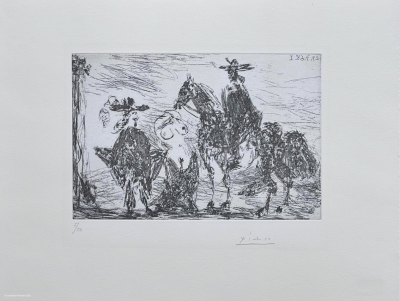
PICASSO Pablo
Gentleman, shameful woman and reitre, 1968
Etching LCD7365
Sold

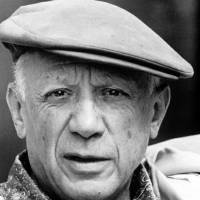
Portrait de Pablo Picasso par la revue Vea y Lea, 1962 - Domaine public
Spanish-born and Paris-based, Pablo Picasso (1881-1973) changed the course of 20th-century art more than any other single figure. He co-invented Cubism, worked in every medium from oil paint to clay, and produced one of the largest bodies of printed work in history – etchings, aquatints, drypoints, lithographs and linoleum cuts numbering in the thousands. For collectors, his hand-signed prints and his limited edition Madoura ceramics remain the most accessible way to own an original artwork by the master of modern art.
Le Coin des Arts, a Paris gallery specializing in original prints, currently offers hand-signed Picasso etchings pulled by the Crommelynck brothers – including works from the famous Suite 347 –, edition ceramics produced by the Madoura pottery and lithographed exhibition posters printed by the Mourlot workshop. Every piece is selected for impression quality, provenance and condition, and the gallery ships worldwide by insured DHL Express, free of charge for orders from €1,200.
Picasso was born in Málaga on October 25, 1881. His father, the painter and art teacher José Ruiz Blasco, trained him from childhood. The family moved to A Coruña in 1891, where Pablo showed his work publicly at thirteen, then to Barcelona in 1895, where he studied at La Llotja. After briefly attending the Royal Academy of San Fernando in Madrid in 1897, he joined the avant-garde crowd at the Barcelona café Els Quatre Gats, the venue of his first solo exhibition.
He first reached Paris in October 1900 for the World’s Fair and moved into the Bateau-Lavoir studios of Montmartre in April 1904. The somber Blue Period (1901-1904) was followed by the circus performers of the Rose Period. His first important etching, The Frugal Repast (1904), was published in 1913 by the dealer Ambroise Vollard along with other Saltimbanques plates. American patrons arrived early: Gertrude Stein sat for the portrait now at the Metropolitan Museum of Art, and a Picasso was among the works shown at the 1913 Armory Show in New York.
Les Demoiselles d’Avignon (1907), today one of the treasures of the Museum of Modern Art, upended the rules of perspective. Together with Georges Braque, Picasso went on to create Cubism, moving from the analytical phase to collage and synthetic Cubism around 1912. His dealer Daniel-Henry Kahnweiler signed him to an exclusive contract in December 1912. In 1911 he spent the summer in Céret, in the French Pyrenees, with Braque – a town whose modern art museum, founded in 1950 with his and Matisse’s backing, still honors him.
For Diaghilev’s Ballets Russes he designed Parade (1917), written by Jean Cocteau, and married the ballerina Olga Khokhlova in 1918; their son Paulo was born in 1921. His relationship with Marie-Thérèse Walter began in 1927 (their daughter Maya was born in 1935). In 1937 he painted Guernica for the Spanish Republic’s pavilion at the Paris World’s Fair. The mural-size canvas was entrusted to MoMA in New York, where generations of Americans saw it, and only returned to Spain in 1981; it has been at the Museo Reina Sofía in Madrid since 1992.
In November 1939 MoMA and the Art Institute of Chicago mounted Picasso: Forty Years of His Art, the landmark survey that introduced his full range to the American public. On August 15, 1967, the 50-foot Cor-Ten steel sculpture known as the Chicago Picasso was unveiled in what is now Daley Plaza; the artist declined the $100,000 fee and gave the design to the city. MoMA’s 1980 retrospective, Pablo Picasso: A Retrospective, filled the entire museum, and in 2010 the museum explored his printmaking in Picasso: Themes and Variations.
A member of the French Communist Party from 1944, Picasso saw his 1949 lithograph of a Dove become a worldwide symbol of peace. With Françoise Gilot, mother of Claude (1947) and Paloma (1949), he moved to the Riviera, where he took up ceramics in Vallauris. He bought the Château de Vauvenargues in 1958, married Jacqueline Roque in 1961, and spent his final years at Notre-Dame-de-Vie in Mougins, where he died on April 8, 1973.
Picasso’s intaglio work spans his whole life. In 1931 he illustrated Balzac’s Le Chef-d’œuvre inconnu for Vollard and Ovid’s Metamorphoses for Skira. The 100 plates of the Vollard Suite (1930-1937) were printed around 1939 by master printer Roger Lacourière, who also taught him the sugar-lift aquatint used in Buffon’s Histoire naturelle (1942); the Minotauromachy (1935) is a cornerstone of any print collection. In 1963, Aldo and Piero Crommelynck opened a print shop in Mougins near his home. With them he etched the Suite 347 between March 16 and October 5, 1968 – an edition size of 50 signed impressions, published by Galerie Louise Leiris and also shown at the Art Institute of Chicago – and later the Suite 156 (1970-1972), released after his death. Our Gentilhomme, femme honteuse et reître and Grosse Prostituée, Sorcière à la Chouette et Voyageur en Sabots (1968) come from Suite 347; Sculpteur travaillant à un buste de femme II (1965), etching and aquatint, was also printed by the Crommelyncks.
On November 2, 1945, Picasso began working at the Mourlot print shop in Paris, producing close to 200 plates in three years and stretching lithography in new directions: his eleven-state Bull (December 1945 – January 1946) is a famous lesson in abstraction. Fernand Mourlot documented this work in Picasso lithographe (4 volumes, 1949-1964). In Vallauris, printer Hidalgo Arnéra printed his posters for the town’s ceramics exhibitions from 1951 and its bullfights, paving the way for Picasso’s color linoleum cuts and the “reduction” technique. The gallery also has Mourlot-printed exhibition posters, such as Picasso et la tauromachie for the Céret museum.
Picasso met Suzanne and Georges Ramié of the Madoura pottery in Vallauris in the summer of 1946 and worked there from 1947. From 1947 to 1971 he created 633 designs that Madoura issued in editions of 25 to 500 – pitchers, plates, platters and vases replicated by the studio’s artisans from his original. These ceramics bear the stamps “Madoura Plein Feu” and “Edition Picasso,” or “Empreinte originale de Picasso” for pieces molded from a matrix he incised himself. The standard reference is Alain Ramié’s catalogue raisonné of the edited ceramics (1988), cited as “Ramié #.” Highlights at the gallery include Picador (1952, Ramié 162), Corrida (1953, Ramié 198), the Spanish Pitcher (1954, Ramié 245, edition of 200) and Pichet Têtes (1956, Ramié 368).
Before buying a Picasso print, confirm the medium, the edition size and number, the hand signature in pencil, and the catalogue raisonné references: Bloch (4 volumes, Kornfeld und Klipstein, Bern, 1968-1979), Geiser/Baer (Picasso peintre-graveur, 7 volumes, cited “Baer #” with state and printing), Mourlot for lithographs, Cramer for illustrated books, Czwiklitzer for posters. Also check the printer, publisher, provenance and paper condition. For a ceramic, verify the stamps, the Ramié number, the decoration against the model, any numbering, and that there has been no restoration.
Original or reproduction? Picasso is the most reproduced artist in the world. Prints “after” Picasso, the posthumous “Marina Picasso Collection” lithographs (1979-1982, editions of 500, pencil-signed by his granddaughter and estate-stamped) and later restrikes are not artworks signed by Picasso. An original print was created by the artist and is listed in the catalogues raisonnés. Exhibition posters, even Mourlot lithographs, are unsigned and unnumbered and are collected as posters.
Le Coin des Arts carefully checks the authenticity, provenance and condition of every Picasso work it offers and can advise on museum-quality framing. Explore the fine art prints of artists from his circle: Georges Braque, Henri Matisse, Joan Miró, Fernand Léger and Marc Chagall.
MoMA, Picasso: Themes and Variations (2010) · Chicago Picasso · Norton Simon Museum, States of Mind: Picasso Lithographs 1945-1960 · Musée national Picasso-Paris · Georges Bloch, Pablo Picasso: Catalogue de l’œuvre gravé et lithographié, Bern, 1968-1979 · Bernhard Geiser and Brigitte Baer, Picasso peintre-graveur, Bern, 1933-1996 · Fernand Mourlot, Picasso lithographe, André Sauret, 1949-1964 · Goeppert, Goeppert-Frank and Cramer, Pablo Picasso: The Illustrated Books, Geneva, 1983 · Alain Ramié, Picasso: Catalogue of the Edited Ceramic Works 1947-1971, Galerie Madoura, 1988.

Secure payment
3DSecure 2.2

Free DHL Express delivery from €1,200
Carefully prepared parcel
Parcel tracking

Shipment insured
for the full value of the artwork, covering theft and damage

Fairest prices
Certificate of authenticity
Two galleries in Paris
Receive an email as soon as a new artwork is added for this artist
Your message has been sent ! We will get back to you as soon as possible.
Please fill in the form if you need further information such
Please fill in your email address, an email will be sent with a link to update your password.
You can now place orders and track your orders.
To save your wishlist, you can log in or create an account :
This is a 100% custom-made frame, carefully crafted by a professional framer. Finishes are available in light oak, white wood or black wood, with or without mat board and plexiglass. Delivery times may vary depending on the order, with an average lead time of 10 days.
This option will be offered during the cart step.