
(1906-1997)

VASARELY Victor
The Fifties, 1989
Silkscreen LCD8540
1 300.00€


VASARELY Victor
Jenge
Silkscreen LCD5044
1 400.00€

VASARELY Victor
Clown, 1987
Silkscreen LCD3379
1 400.00€

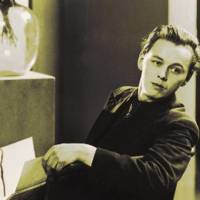
Portrait de Victor Vasarely par un photographe inconnu vers 1930 - Domaine public
When the Museum of Modern Art set out to define a new kind of “perceptual” abstraction in 1965, one name stood at its origin: Victor Vasarely (1906-1997). The Hungarian-born, Paris-based artist is known worldwide as the pioneer of Op Art, the art of optical illusion and movement, in which flat geometric shapes and color contrasts seem to pulse, bulge and shift before the viewer’s eyes. A former graphic designer, he wanted art to reach everyone, and limited edition serigraphs and multiples were central to that ambition.
Le Coin des Arts, a Paris gallery, offers original hand-signed Vasarely serigraphs, lithographs and multiples from the 1960s through the 1980s, each artwork chosen for its print quality, provenance and condition. We ship worldwide by insured DHL Express, free of charge for orders from €1,200.
Győző Vásárhelyi – the future Victor Vasarely – was born on April 9, 1906, in Pécs, Hungary, and grew up in Pöstyén (today Piešťany, Slovakia) and Budapest. He started medical school in 1925 but switched to painting two years later. Around 1928-1929 he enrolled at the Műhely, the design school led by Sándor Bortnyik, which taught graphic design and typography in the tradition of the German Bauhaus. That training in systems, grids and visual communication shaped everything he did afterward.
In 1930 Vasarely settled in Paris with his wife, the artist Claire Spinner; their son Jean-Pierre would later become the artist Yvaral. For several years he worked in advertising for the agencies Havas, Draeger and Devambez, while experimenting on his own with line, texture and black-and-white contrast. The famous Zebras of 1937, built entirely from wavy stripes, are often described as the first Op Art image.
His first exhibition took place in 1944 at the newly founded gallery of Denise René, who became his lifelong dealer. Between 1947 and the early 1950s he found his abstract voice, inspired by beach pebbles on Belle-Île, the tiled walls of the Denfert-Rochereau subway station in Paris and the summer light of Gordes, Provence, from 1948. In 1955, Denise René’s group show “Le Mouvement” presented Vasarely alongside Calder, Duchamp, Agam, Bury, Jacobsen, Soto and Tinguely – the birth certificate of kinetic art – and his notes for the show, the Yellow Manifesto, laid out its theory.
In 1964 Vasarely received the Guggenheim Prize. The following year he was a key figure in “The Responsive Eye,” organized by William C. Seitz at the Museum of Modern Art in New York (February 25 – April 25, 1965), a show of more than 120 works by 99 artists that toured to St. Louis, Seattle, Pasadena and Baltimore and made “Op Art” a household term. In New York, the Sidney Janis Gallery exhibited his work in 1966, 1972 and 1988; in October 1967 he spoke at the Vision ’67 conference at New York University at the invitation of designer Will Burtin, and a Vasarely Center opened in New York in 1978. Meanwhile his “plastic units” – a square combined with a contrasting shape, patented on March 2, 1959, and presented in 1963 as “Folklore planétaire” – fed the Vega and Hommage à l’hexagone series, and in 1972 he and Yvaral redesigned the Renault logo.
Vasarely opened a museum at the Château de Gordes in 1970 (closed in 1996) and created the Fondation Vasarely in Aix-en-Provence, whose hexagonal architectonic center opened in 1976. Museums devoted to him opened in his hometown of Pécs (1976) and in Budapest (1987). He died in Paris on March 15, 1997. A major retrospective, organized by the Städel Museum in Frankfurt and the Centre Pompidou in Paris, reintroduced his work to a new generation in 2018-2019.
For Vasarely, an artwork was a prototype meant to be reproduced faithfully. Screen printing, with its crisp edges and intense flat color, became his medium of choice. Many of his serigraphs of the 1960s and 1970s were printed in Paris at the workshop of Wifredo Arcay, a Cuban-born printer who worked for Denise René; the Paris studio Silium printed many later editions. He also made lithographs, notably at the Mourlot studio, and from the 1960s Denise René published his multiples – small sculptures and objects in Plexiglas, metal or screen-printed wood.
The gallery’s selection includes, among others, Ezust and Topaze (1966), published by Denise René and printed by Arcay; Mar-Kab (1973, Pierre Belfond) and Tsiga (1973); Heisenberg (1983) and the lithograph Zebra 3 (1984), both published by Graphos Verlag and printed by Silium; Clown (1987); Bellatrix-Pyr (1989); the Les années Cinquante suite (1989), published in Budapest by Pesti Műhely; and the Denise René multiples Turkiz positif and Beryl négatif (1967), each in an edition of 50, listed under ceramics and sculptures.
Vasarely is one of the most reproduced artists of the 20th century, so a careful checklist pays off. Before buying, confirm the medium; the edition size and numbering (or an artist’s proof, E.A., or H.C. annotation); the hand signature in pencil; the publisher and printer (Denise René, Arcay, Silium, Mourlot, etc.); the reference in the Pedro Benavides catalogue often cited by dealers (“Benavides no.”); the provenance; and the condition. Large flat color fields reveal any scratch or stain, and some inks fade with light, so UV-protective glazing and museum-quality framing are a wise investment.
Original print or reproduction? Vasarely’s imagery appears on countless posters, offset reproductions, unsigned or posthumous screen prints – and on fakes carrying a copied signature. A signature printed in the image, an unlikely edition number or the lack of any publisher information are red flags. An original print is hand-signed, numbered or annotated, and documented. For unique works such as paintings and gouaches, authentication is provided by Pierre Vasarely, president of the Fondation Vasarely, universal legatee and holder of the artist’s moral rights; the Foundation is preparing a catalogue raisonné of the paintings. Every artwork sold by the gallery comes with a certificate of authenticity.
Le Coin des Arts carefully selects every Vasarely print and multiple for authenticity, provenance and condition, and can advise you on framing and care. Explore more kinetic and geometric abstraction at the gallery with Jesús Rafael Soto, Yaacov Agam, Alexander Calder and Josef Albers.
The Museum of Modern Art, “The Responsive Eye” press release, 1965 · Encyclopedia.com, Vasarely, Victor · Victor Vasarely, Wikipedia · Fondation Vasarely, Aix-en-Provence · Städel Museum, “Victor Vasarely. In the Labyrinth of Modernism”, 2018-2019 · Centre Pompidou, “Vasarely, le partage des formes,” February 6 – May 6, 2019

Secure payment
3DSecure 2.2

Free DHL Express delivery from €1,200
Carefully prepared parcel
Parcel tracking

Shipment insured
for the full value of the artwork, covering theft and damage

Fairest prices
Certificate of authenticity
Two galleries in Paris
Receive an email as soon as a new artwork is added for this artist
Your message has been sent ! We will get back to you as soon as possible.
Please fill in the form if you need further information such
Please fill in your email address, an email will be sent with a link to update your password.
You can now place orders and track your orders.
To save your wishlist, you can log in or create an account :
This is a 100% custom-made frame, carefully crafted by a professional framer. Finishes are available in light oak, white wood or black wood, with or without mat board and plexiglass. Delivery times may vary depending on the order, with an average lead time of 10 days.
This option will be offered during the cart step.


