
(1961)

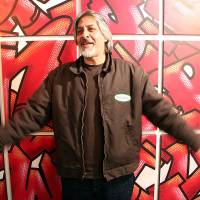
Portrait de Seen par Jean-Noël Lafargue, 2007 - CC BY-SA 3.0
If one name stands for the golden age of New York subway graffiti, it is often SEEN. Born Richard Mirando in the Bronx in 1961, he hit his first train in 1973 and spent the next sixteen years painting full-color whole cars with his crew, United Artists (UA), on the 2, 5 and 6 lines. He starred in the PBS documentary Style Wars, filled the pages of Subway Art, and earned the nickname the “Godfather of Graffiti”—even though, as his biographers point out, he didn’t start the movement. Today his canvases, drawings, sculptures, hand-painted subway maps and signed screenprints carry that train-yard style into collections worldwide.
Right now Le Coin des Arts has one screenprint by SEEN: Looney Lenny, hand-signed and numbered 35/66, image 22 × 18 in. (56 × 46 cm) on a 25 ½ × 21 ½ in. (65 × 55 cm) sheet, in excellent condition. We keep track of the artist and add his original prints when strong impressions turn up—hit “follow the artist” to get an alert.
According to the catalog text for Les Enfants du Graffiti (Gallifet Art Center, Aix-en-Provence, 2016), Mirando picked up an airbrush at age eleven, painted decorations for his uncle’s auto body shop and customized cars. In 1973 he went into the Lexington Avenue yard on the 6 line and painted his first piece. The tag he chose said it all: SEEN, because he wanted people to see his work. From then on he played cat-and-mouse with the police Vandal Squad, a running battle throughout his early years.
With United Artists—a crew that included his brother Mad, along with Pjay, Duster and Sin—SEEN specialized in “top-to-bottom” whole cars, painted from roof to wheels. He is credited with dozens of them, some of the most iconic images of the era. National exposure came with Style Wars, the documentary by Tony Silver and Henry Chalfant that aired on PBS in 1983. A year later Martha Cooper and Chalfant published Subway Art (1984), the book many writers still call the bible of graffiti, followed by Spraycan Art (1987) by Chalfant and James Prigoff. SEEN kept painting trains until 1989, well after MTA pressure had pushed many of his peers off the system.
SEEN started selling canvases in the early 1980s. In New York, the Stellweg-Seguy Gallery showed his work, while in Europe the Yaki Kornblit gallery in Amsterdam gave him shows in 1982, 1983 and 1985. Museums took notice too: he was part of Graffiti at the Museum Boijmans Van Beuningen in Rotterdam (October 22–December 4, 1983), which traveled to the Groninger Museum, and of a 1984 group show at Galerie Thomas in Munich. In 1985 he exhibited in Tokyo—and, per his official website, scrawled his name across the Hollywood sign in Los Angeles.
In the late 1980s SEEN opened Tattoo Seen, which grew into one of New York’s most successful tattoo studios, and worked there as a tattoo artist. Gallery shows picked up again with the Clayton Gallery in New York (1995), Bob’s Gallery (2001), the Stüssy gallery in San Francisco (2003), Rocket World in San Francisco and McCaig-Welles in New York (2005). Europe kept calling as well, with shows in London (StolenSpace, 2007) and Paris, where he opened a space under his own name in 2009 and had a retrospective at Opera Gallery in 2011.
On March 28, 2013, Cornell University Library announced that its Hip Hop Collection now holds the Richie “SEEN” Mirando Archive: more than 149 drawings and 370 photographs, including nearly all that remains of his original subway sketches, black books, gallery flyers and a rare original Style Wars poster. In 2014 he published They Call Me the Godfather of Graffiti, Chapter 1973–1981, with a limited run of 100 copies featuring hand-painted covers. His newer work riffs on comic-book superheroes like Wonder Woman and Spider-Man and includes 3-D sculpture, mixed media built from found materials and a series of hand-painted MTA subway maps. In 2018 he was featured in Beyond the Streets in Los Angeles.
Check the edition. SEEN’s screenprints come in short runs. The number, the stated edition size and any date should line up (see the printing process). Artist’s proofs should be a small fraction of the edition.
Look for the pencil signature. His name usually appears inside the image as lettering. That doesn’t count—what you want is a hand-written signature in pencil, normally in the margin.
Ask about the process. Some recent editions combine a digitally printed background with screenprinted layers. Get the exact technique in writing, and don’t mistake a purely digital print for a screenprint.
Skip the signed posters. Signed posters—compilations, event posters—turn up regularly. Signed or not, they are reproductions, not original prints.
Inspect paper and condition. Big flat areas of color show every scratch, crease and fingerprint, and bright inks fade in sunlight. Look for full margins and choose UV-protective glazing when framing.
Demand provenance. SEEN is a living, widely imitated artist. Buy prints you can trace back to the publishing gallery, an invoice or a certificate. Read how we guarantee every work on our authenticity page.
SEEN is a painter at heart—spray paint, airbrush, canvas, marker. His editions are mainly screenprints, signed and numbered in pencil and often limited to a few dozen impressions, like Looney Lenny in an edition of 66. Screenprinting builds the image in flat, opaque layers of ink, which suits his outlined letters and punchy color. He didn’t come up through the classic lithography or intaglio workshops; his editions come from galleries or his own studio. To our knowledge there is no published catalog raisonné of his prints, so be wary of any “catalog number” attached to one. Authentication comes down to the signature, the numbering, the paper and a documented edition. New to prints? Start with what is an original print.
We also handpick prints by other artists who came out of the street: JonOne, a fellow veteran of the New York subway, Shepard Fairey, Invader, Cleon Peterson and pop icon Roy Lichtenstein. Browse more contemporary art and our engravings and lithographs.
Cornell Chronicle – Graffiti, film, photo archives expand Hip Hop Collection (March 28, 2013) · Beyond the Streets – SEEN · Museum of Fine Arts, Boston – Basquiat and His Contemporaries timeline · Richard Mirando – About SEEN · Tony Silver and Henry Chalfant, Style Wars, PBS, 1983 · Martha Cooper and Henry Chalfant, Subway Art, 1984 · Henry Chalfant and James Prigoff, Spraycan Art, 1987 · Richard “SEEN” Mirando, They Call Me the Godfather of Graffiti, Chapter 1973–1981, 2014

Secure payment
3DSecure 2.2

Free DHL Express delivery from €1,200
Carefully prepared parcel
Parcel tracking

Shipment insured
for the full value of the artwork, covering theft and damage

Fairest prices
Certificate of authenticity
Two galleries in Paris
Receive an email as soon as a new artwork is added for this artist
Your message has been sent ! We will get back to you as soon as possible.
Please fill in the form if you need further information such
Please fill in your email address, an email will be sent with a link to update your password.
You can now place orders and track your orders.
To save your wishlist, you can log in or create an account :
This is a 100% custom-made frame, carefully crafted by a professional framer. Finishes are available in light oak, white wood or black wood, with or without mat board and plexiglass. Delivery times may vary depending on the order, with an average lead time of 10 days.
This option will be offered during the cart step.

