
(1909-2000)

HAMAGUCHI Yozo
Two slices of watermelon, 1954
Mezzotint LCD7638
2 000.00€
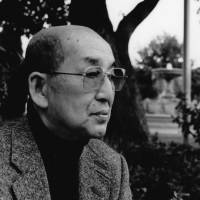
©Musée Hamaguchi Yozo: Yamasa Collection
Japanese printmaker Yozo Hamaguchi was born on April 5, 1909, in Hiromura (today Hirogawa), Wakayama Prefecture, and died on December 25, 2000, in Tokyo. He is the artist who revived the mezzotint, a slow seventeenth-century technique, and figured out how to print it in color. He spent nearly three decades in Paris, then fifteen years in San Francisco. His subjects are simple: cherries, lemons, grapes, walnuts, butterflies, a slice of watermelon. What makes them unforgettable is the black around them, soft as velvet. For collectors of fine art prints, his mezzotints are among the most recognizable images of postwar printmaking.
Le Coin des Arts currently has one original mezzotint by Hamaguchi: Two slices of watermelon, from 1954. It is a black-and-white print made right after his return to Paris, just before he turned to color. We picked it for its deep blacks, the quality of the impression, and its condition. The Rhode Island School of Design Museum in Providence owns an impression of the same print, numbered 46/50 and measuring 8 by 12 inches, which came to the museum as a gift from the collection of Mr. and Mrs. Barnet Fain. It dates from 1954, the same year he made his first color trials, printed from two plates.
Hamaguchi was the third son of Hamaguchi Gihei, the tenth president of Yamasa, a soy sauce maker dating back to 1645. The family moved to Choshi, in Chiba Prefecture, in 1914. He studied sculpture at the Tokyo School of Fine Arts (now Tokyo University of the Arts) but dropped out in 1930; the painter Ryuzaburo Umehara had told him to go to France. In Paris he took brief classes at the Académie de la Grande Chaumière and the Académie Colarossi and mostly taught himself painting and copperplate engraving. From 1934 he exhibited oils in Paris Salons under the name “Zoti.” He made his first copperplate print, Cat, in 1937, and had his first solo show at the Galerie André Schoeller in December 1938.
Hamaguchi went back to Japan in November 1939, losing most of his early work, and served as an interpreter in French Indochina during the war, where he contracted malaria. After a long recovery he returned to printmaking in the fall of 1949 in Yoyogi, Tokyo. His first print show took place at the Formes Gallery in Ginza in 1951. That year’s drypoint Rabbit was later acquired by the Museum of Modern Art through the Larry Aldrich Fund. In late 1953 he left again for Paris with his wife, the artist Keiko Minami.
In Paris, from December 1953, Hamaguchi worked with dealer Heinz Berggruen, whose gallery became his main outlet. He made his first two-plate color prints in 1954, and in 1955 produced Watermelon, one of his first color mezzotints. Roofs of Paris (1956) followed. In 1957 he took the grand prize for prints at the 4th São Paulo Biennial. MoMA’s press release of September 20, 1957, announcing the awards, named him “best non-Brazilian printmaker.” Other honors followed: a prize at the Tokyo International Print Biennale (1957), an award in Lugano (1958), Japan’s pavilion at the 1960 Venice Biennale, and the grand prize at the Ljubljana Biennial in 1961. Berggruen’s 1958 show Manière noire came with a text by Maria Helena Vieira da Silva.
American museums were collecting him long before he moved here. MoMA lists eight works online, including Rabbit (1951), Roofs of Paris and Bowl of Grapes (both 1956), Opened Pomegranate (1958), and Green Field (1985–92). In 1979 the Print Club of Cleveland gave the Cleveland Museum of Art his 1978 set of six color mezzotints. In 1981 Hamaguchi moved to San Francisco, where he worked for about fifteen years. The Vorpal Gallery (San Francisco and New York) published prints such as Three Butterflies (1985–91), and he had solo shows in New York and San Francisco in 1983. In 1982 his Watermelon won the grand prize at the Northern California regional print competition. His work is also in the Metropolitan Museum of Art, the Art Institute of Chicago, the National Gallery of Art, the Philadelphia Museum of Art, and LACMA, which lists 35 records under his name.
In 1984 his Cherries and Blue Bowl (1976) became the poster for the Sarajevo Winter Olympics; MoMA lists the poster in its collection. Japan gave him a first retrospective at the National Museum of Art, Osaka, in 1985, and the Order of the Rising Sun in 1986. He moved back to Japan in 1996. In November 1998 the Yamasa Corporation opened the Musée Hamaguchi Yozo: Yamasa Collection in Tokyo’s Nihonbashi district, the only museum devoted to his work. He died in Tokyo on Christmas Day 2000, at 91.
Mezzotint works from dark to light. The artist first roughens the whole copper plate with a rocker, so that it would print solid black, then scrapes and burnishes the surface to bring out the lights. It is a form of intaglio printing. Hamaguchi’s breakthrough was color: according to his museum, his darks come from four plates – yellow, red, blue, and black – printed on top of one another. Up close, you can see the colors mixing in the shadows. His 1950s and 1960s editions are usually 50 impressions, often on BFK Rives paper; later large plates ran to 75, 145, or 150 (the 1981 Watermelon was editioned at 150). Auction catalogs cite his prints by number from the catalog raisonné published in Tokyo by Chuokoron Bijutsu Shuppan (for example, “Chuokoron Bijutsu Shuppan 109” for Seventeen Cherries, 1968).
Check the numbering. Look for a pencil number at lower left (the RISD impression is numbered “46/50”). Artist’s proofs and “h.c.” impressions also exist. More on the printing process.
Look for the pencil signature. “Hamaguchi,” lower right. A printed signature means a reproduction. See the signature.
Watch out for book plates. A 1962 Tokyo monograph (Bijutsu Shuppansha, reprinted in 1970) has photomechanical plates that get framed and sold as originals, sometimes with suspicious numbers. A real mezzotint has texture you can see in raking light, plus a platemark.
Don’t pay print prices for posters. The Sarajevo Olympics poster and exhibition posters are reproductions, not original prints.
Ask about late editions. Several sources say that after he stopped printing around 1993, some editions were finished under his publisher’s supervision. For 1980s and 1990s plates, ask for documentation.
Inspect the condition. Mezzotint blacks scuff and show every fingerprint. The sheet must never touch the glass. Use a mat and UV-filtering glazing for framing, and see our authenticity guarantees.
We select Hamaguchi prints for impression quality and condition. See them alongside Shoichi Hasegawa, Johnny Friedlaender, Kumi Sugai, Léonard Foujita, and Érik Desmazières, or explore our engravings and lithographs and modern art.
Manière noire, exhibition booklet, text by Maria Helena Vieira da Silva, Galerie Berggruen, Paris, 1958 · Catalog raisonné of the prints, Chuokoron Bijutsu Shuppan, Tokyo · MoMA – Yozo Hamaguchi · MoMA press release, IV São Paulo Bienal, 1957 · RISD Museum – Two Slices of Watermelon · Musée Hamaguchi Yozo: Yamasa Collection · Art Platform Japan – Hamaguchi Yōzō

Secure payment
3DSecure 2.2

Free DHL Express delivery from €1,200
Carefully prepared parcel
Parcel tracking

Shipment insured
for the full value of the artwork, covering theft and damage

Fairest prices
Certificate of authenticity
Two galleries in Paris
Receive an email as soon as a new artwork is added for this artist
Your message has been sent ! We will get back to you as soon as possible.
Please fill in the form if you need further information such
Please fill in your email address, an email will be sent with a link to update your password.
You can now place orders and track your orders.
To save your wishlist, you can log in or create an account :
This is a 100% custom-made frame, carefully crafted by a professional framer. Finishes are available in light oak, white wood or black wood, with or without mat board and plexiglass. Delivery times may vary depending on the order, with an average lead time of 10 days.
This option will be offered during the cart step.



