
(1886-1964)
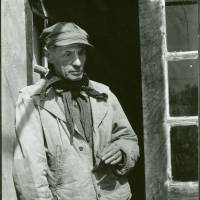
Christ-schmitt, CC BY-SA 4.0, via Wikimedia Commons
Roger Bissière was born on September 22, 1886, in Villeréal, in southwestern France, and died on December 2, 1964, at his farmhouse in Boissièrette (Lot). Teacher, critic, and painter, he became a father figure of the School of Paris after World War II, known for glowing grids of color, signs, and stitched-fabric hangings. He won France’s Grand Prix National des Arts in 1952, exhibited at the first three documenta shows in Kassel, and received an honorable mention at the 1964 Venice Biennale, the year Robert Rauschenberg took the painting prize. His original prints – color woodcuts, aquatints, and lithographs – are few, which makes good impressions worth seeking out.
Le Coin des Arts has several Roger Bissière fine art prints from the 1950s in stock: the aquatint L’Étoile (1953), from a small edition numbered in Roman numerals out of fifteen; the 1956 lithographs Le Château and Lumière dans la forêt, both pencil-signed and numbered out of 75 on BFK Rives paper; and the aquatint Composition 60. We picked each one for print quality, edition, provenance, and condition.
A notary’s son, Bissière went to school in Cahors and Bordeaux, started painting at about 17, and dropped law. After a year in Algiers (1904-05), he studied at the Bordeaux School of Fine Arts under Paul Quinsac, then joined Gabriel Ferrier’s studio at the École des Beaux-Arts in Paris in 1910. From 1913 to 1919 he wrote art criticism for the weekly L’Opinion. He married Lucie Lotte – “Mousse” – in 1919. In 1920, the dealer Léonce Rosenberg commissioned him to write a book on Georges Braque, the first monograph on the Cubist painter. He also wrote on Seurat, Ingres, and Corot for L’Esprit Nouveau, and had his first solo show at Galerie Paul Rosenberg in 1921.
Starting in 1923, Bissière showed regularly at Galerie Druet and taught at the Académie Ranson, where he opened a fresco studio in 1934. His students included Alfred Manessier, Jean Le Moal, and Jean Bertholle; the Musée Granet chronology also names Maria Helena Vieira da Silva. At the 1937 Paris World’s Fair, he led a team of former students decorating the Railway and Merchant Marine pavilions, part of the group around Robert and Sonia Delaunay.
In April 1939, Bissière moved to an old presbytery in Boissièrette, in the Lot. The war left him unable to paint; he farmed instead. In late 1945 he designed seven fabric hangings, sewn and embroidered by Mousse, and took up painting again. His show at Galerie René Drouin (December 1947 – January 1948) sold poorly, though Jean Dubuffet admired it. Starting in July 1950 he painted in egg tempera on rough wood panels. When Galerie Jeanne Bucher showed them in October 1951, critics and collectors finally came around, and the gallery showed his work regularly from then on.
American institutions noticed Bissière as soon as his late style took off. The Museum of Modern Art in New York owns Red and Black (1952) and listed him among the French artists new to its collection in its Recent Acquisitions show of December 1959. The Cincinnati Art Museum holds a 1960 color sugar-lift aquatint, Composition, from the Albert P. Strietmann Collection, and the Worcester Art Museum in Massachusetts bought a color lithograph, Noir et Rouge, printed on Rives paper. According to Hyperallergic, his only solo show in the United States was at World House Galleries in New York in 1961, which helps explain why he is less known here than his students.
Bissière received the Grand Prix National des Arts on December 23, 1952, and went back to oil in 1954. He took part in documenta in 1955, 1959, and 1964, had a touring retrospective in Germany and the Netherlands in 1957-58, and a retrospective at the Musée d’Art moderne de la Ville de Paris in 1959. He designed stained-glass windows for churches in Develier and Cornol, Switzerland, and for Metz Cathedral in France. After Mousse died on October 13, 1962, he painted the Journal en images, small panels dated day by day. At the 1964 Venice Biennale, the French pavilion showed three hangings and 41 paintings; he received an honorable mention for the “historical and artistic importance” of his work, and died that December.
Interest in Bissière has grown steadily in France and Europe. The Musée de Lodève marked the 50th anniversary of his death with a major retrospective, the Centre Pompidou-Metz included him in a 2016 show, and Lisbon’s Fundação Árpád Szenes-Vieira da Silva exhibited his work in 2022. From September 2023 to January 2024, the Musée Granet in Aix-en-Provence presented Bissière, la part de l’Autre: 47 of the 152 small paintings of the Journal en images, made over 780 days, co-curated by his granddaughters Isabelle and Caroline Bissière. For American collectors, these shows are a reminder that his prints offer an affordable way into the work of a painter still being rediscovered.
His key print project is St. Francis of Assisi’s Cantique à notre frère Soleil: eleven color woodcuts, shown at Jeanne Bucher in November 1954 and, per the 1970 Luxembourg museum catalog, printed on a hand press by Marcel Fiorini. He went on to make aquatints, including sugar-lift plates, and lithographs such as the 1956 sheets in our stock. In 1962 he contributed the etching Centro to the portfolio Paroles peintes I (Éditions O. Lazar-Vernet), and the December 1964 issue of XXe Siècle (no. 24) carried a lithograph printed by Mourlot.
As far as we know, there is no published catalog raisonné of his prints. The reference for his work overall is the three-volume catalogue raisonné by Isabelle Bissière and Virginie Duval (Ides et Calendes, Neuchâtel, 2001), which records 2,912 works from 1943-44 to 1964 in its second volume. For prints, the best ID is the original publication plus a clear edition record.
Check the edition. Editions are numbered in Arabic numerals (e.g., out of 75) or, for small runs, Roman numerals – VI/XV means one of about fifteen. Learn more about the printing process and what makes a print original.
Check the signature. Lifetime editions are pencil-signed. Anything printed after December 1964 can’t bear his own signature. See the signature.
Know your magazine plates. The XXe Siècle lithograph and the Paroles peintes etching are real prints, but they were issued unsigned and unnumbered – and are priced lower.
Avoid look-alikes. Lithographs “after” paintings with printed signatures are reproductions. Prints by his son, Louttre.B (Marc-Antoine Bissière), can carry the same family name. And paintings in his style were faked by John Myatt for John Drewe between 1985 and 1995.
Inspect paper and condition. BFK Rives can yellow over time. Full margins and no light stains matter; use UV-protective glazing when framing.
Ask about provenance. A Jeanne Bucher label or old invoice helps. See our authenticity guarantees.
We also offer prints by artists connected to Bissière: Alfred Manessier, Vieira da Silva, Georges Braque, Jean Bazaine, and Maurice Estève. Browse the School of Paris and lyrical abstraction and our engravings and lithographs.
Isabelle Bissière and Virginie Duval, Roger Bissière, catalogue raisonné, 3 vols., Ides et Calendes, Neuchâtel, 2001 · MoMA – Roger Bissière · MoMA – Recent Acquisitions press release, 1959 · Cincinnati Art Museum – Composition, 1960 · Worcester Art Museum – Noir et Rouge · Hyperallergic – Roger Bissière, the Last “Primitive” · Musée Granet – chronology · Galerie Jeanne Bucher Jaeger – Roger Bissière

Secure payment
3DSecure 2.2

Free DHL Express delivery from €1,200
Carefully prepared parcel
Parcel tracking

Shipment insured
for the full value of the artwork, covering theft and damage

Fairest prices
Certificate of authenticity
Two galleries in Paris
Receive an email as soon as a new artwork is added for this artist
Your message has been sent ! We will get back to you as soon as possible.
Please fill in the form if you need further information such
Please fill in your email address, an email will be sent with a link to update your password.
You can now place orders and track your orders.
To save your wishlist, you can log in or create an account :
This is a 100% custom-made frame, carefully crafted by a professional framer. Finishes are available in light oak, white wood or black wood, with or without mat board and plexiglass. Delivery times may vary depending on the order, with an average lead time of 10 days.
This option will be offered during the cart step.


